

A Subwoofer Like No Other: Fleetwood Fundamental Review
By Steve Huff
It’s been several weeks since a big, hefty box arrived via FedEx. Inside was something I had been wanting to hear for almost a year. I am talking about a subwoofer, and this one is unlike any other I have experienced. But is that a good thing? To be clear, I have not been a big fan of subwoofers lately when used in a music system.
Still, I had to hear this one, as it was supposed to be a perfect match for my fave speakers, the Fleetwood Helios. It should also work its magic with just about any speaker. Sensitive or hard to drive, even horns.
Why did I choose to review this one? It may be the most transformational product I have had all year for what it did with my Helios system. Keep in mind, though, this sub does not behave quite like other subs I have used in the past due to teh way it was designed.
This subwoofer is called the Fundamental from Fleetwood Sound, and it is all about bringing solidity, foundation, punch, precise and fast midbass, as well as low bass, to your system. It is said to do this in a clean, non-puffed-up, non-bloated way. I can confirm that it’s fast. In fact, it is the fastest subwoofer I have ever experienced.
This is what Fleetwood says about this creation:
“A lot of music produced today is bass heavy, and small speakers just can’t reproduce it. All the subwoofers on the home hifi market make boomy, sluggish bass that doesn’t keep up with the kind of ultra fast, detailed and lifelike speakers and sound we create at OMA and Fleetwood Sound. The new Fundamental Subwoofer is the first time we figured out how to solve this problem in a small size.
So many subwoofers chase 20Hz. The Fundamental takes a different approach. It delivers more output between 50 and 100Hz, where the weight, punch, and body of music actually live. It isn’t built to reach the lowest note possible. It’s built to make every bass note sound fuller, tighter, and more real. The result is better sound.
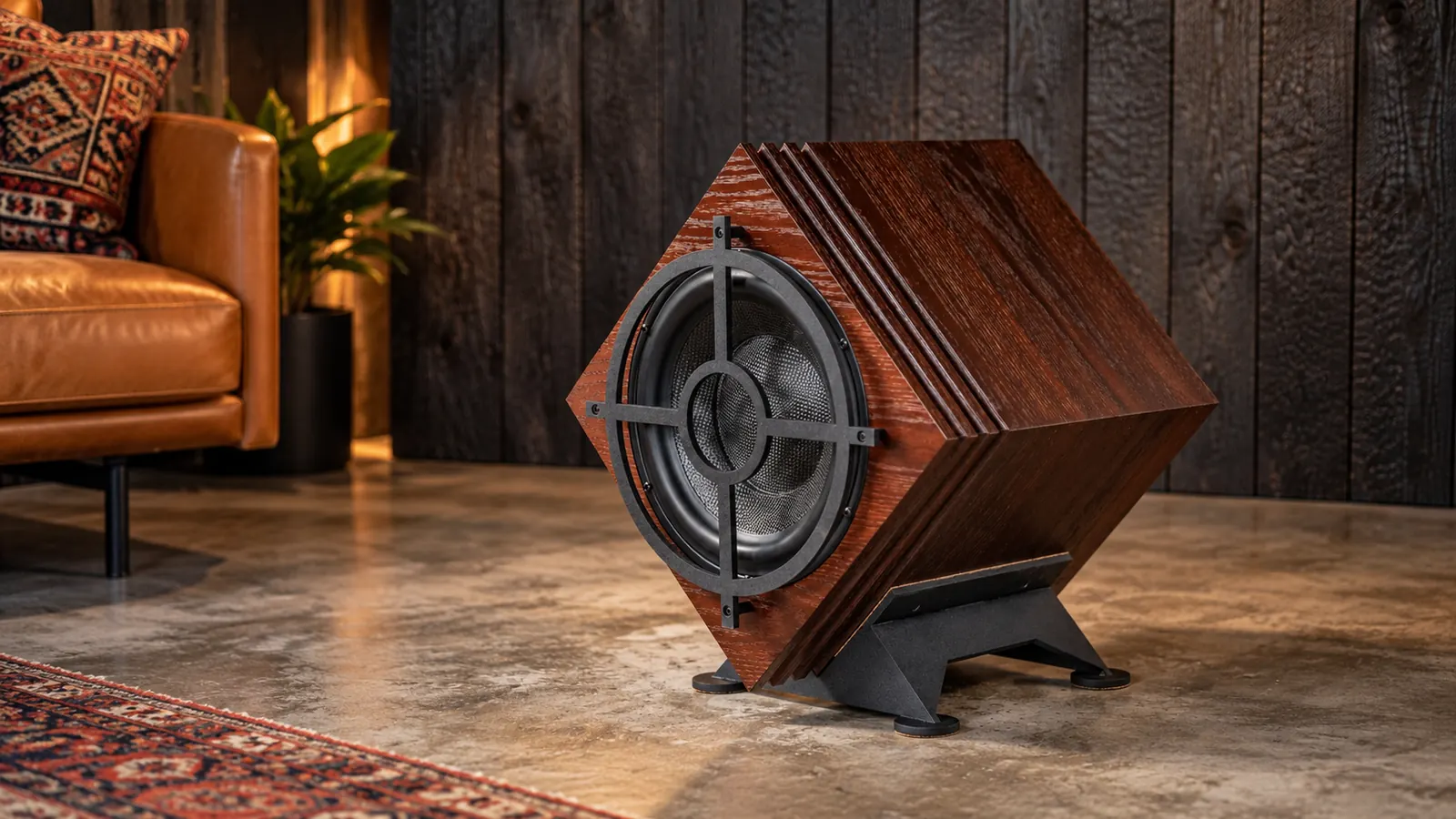
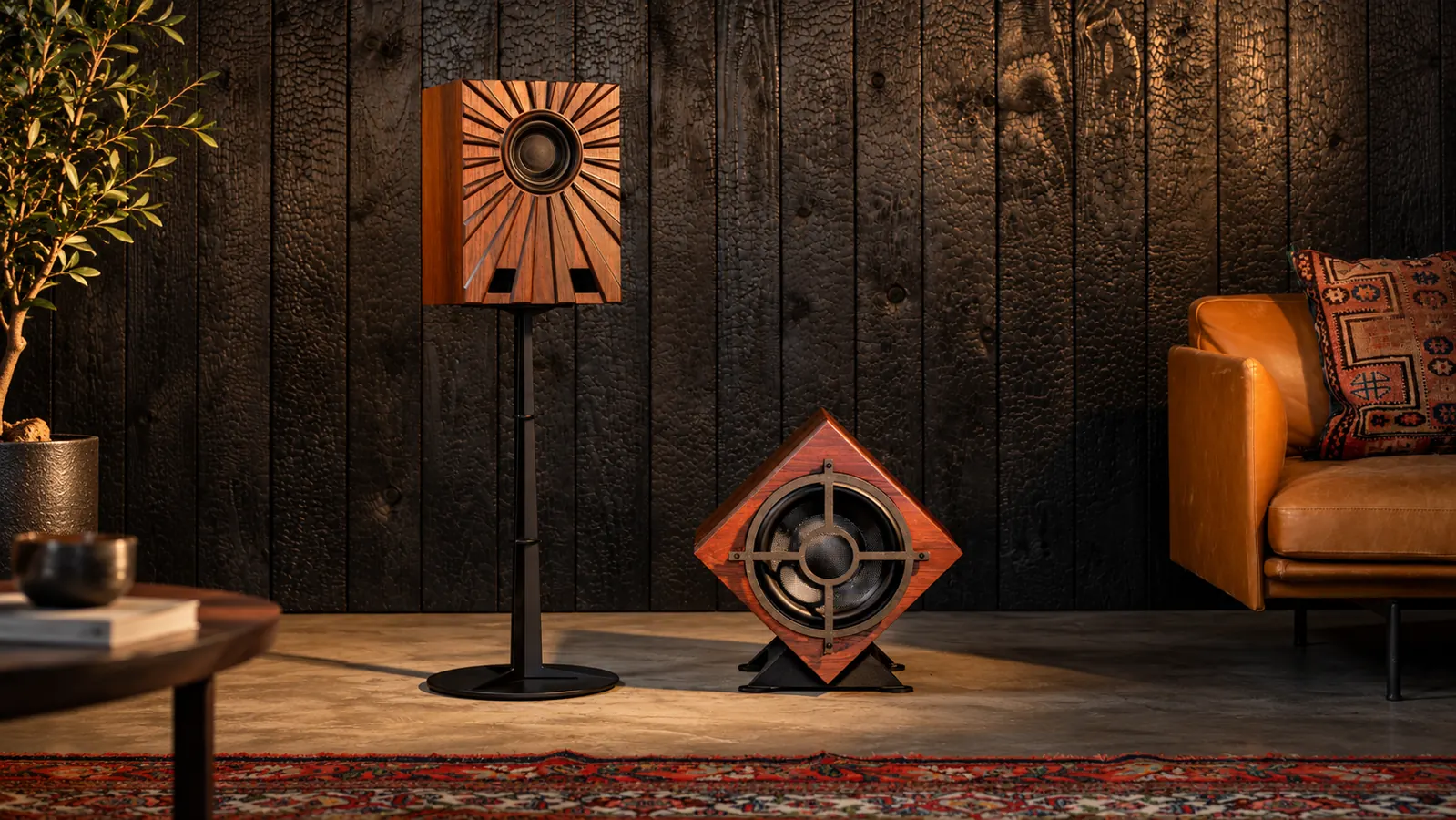
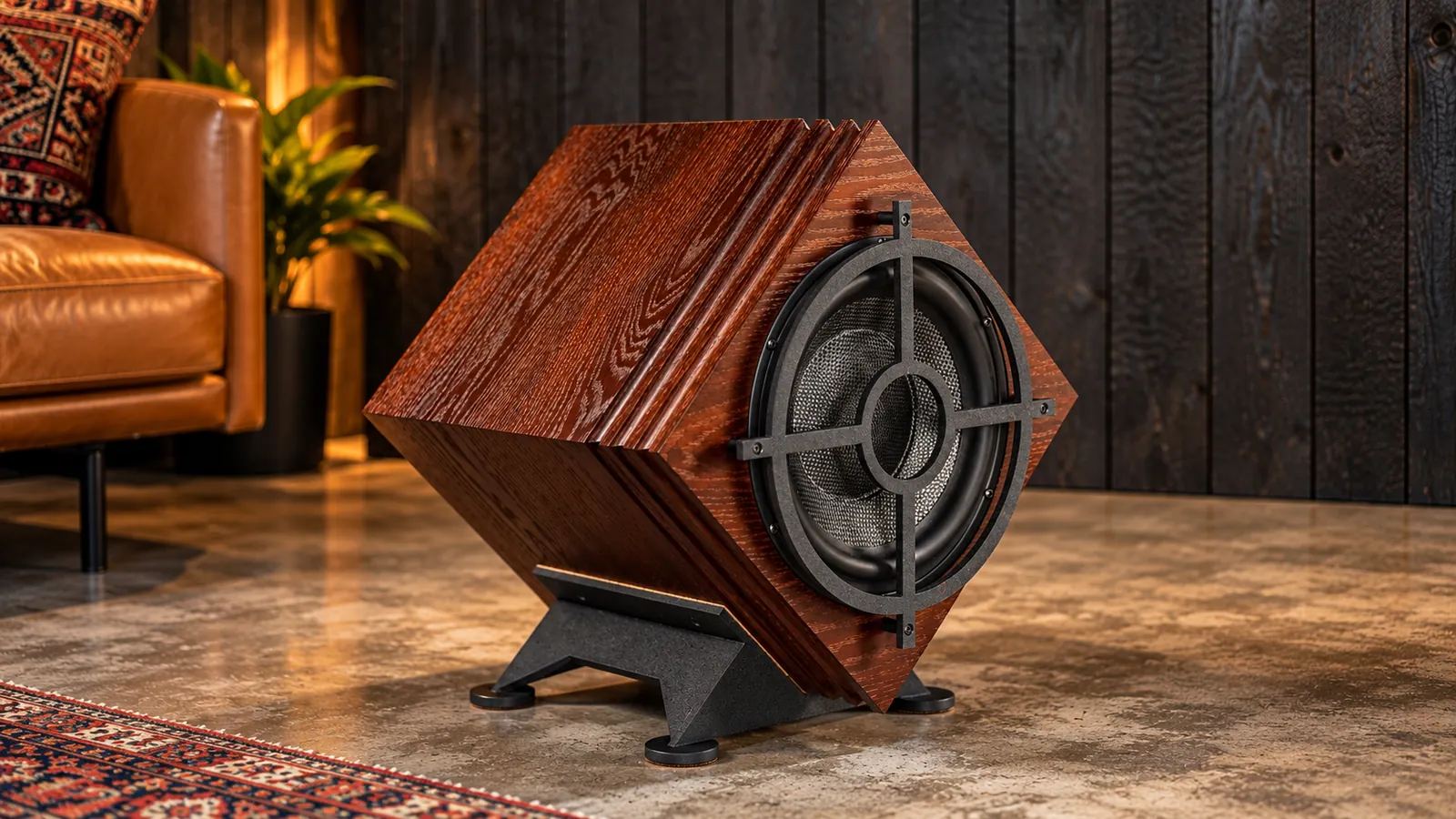
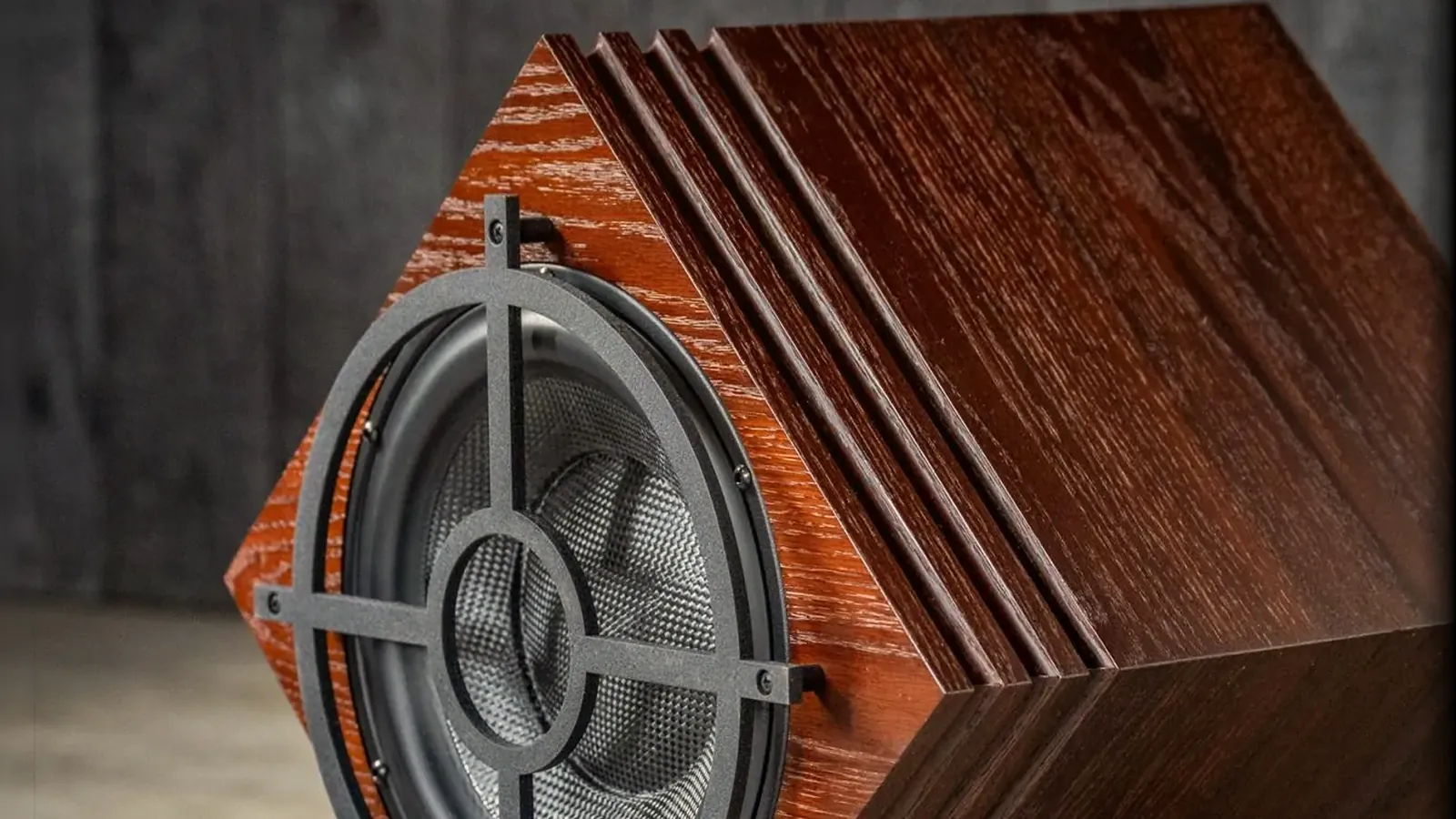
We use a superior 10” woofer with exceptional bass extension in a sealed, solid 1” thick torrefied Pennsylvania oak hardwood case that will pair with our horn loaded loudspeakers. All in a package that looks more like art than a boombox.
Sitting on a heavy, solid steel powder coated stand designed by David D’Imperio. With a 500 watt amplifier of our own design, you can control gain and frequency. An on/off switch senses signal, remaining quiescent when not in use. Inputs are line level RCA and speaker level banana jacks.”
I agree with what is said here and also agree that this is how subs should be made. Instead of trying to reach the depths where no real music lives, or not much at all, a sub should reinforce the bass that is actually in the recording and do so without making its presence known. It should never add bloat or artificial bass, but rather enhance what is there so we can hear it and even feel it. Weight should be added without mucking up the sound.
The Fundamental does this.
Yep, the Fundamental is much faster than the pair of fancy subs I once owned ($7k), and much better sounding as well, all from a single Fundamental. Again, it’s the speed here, and the fact that it is sealed and doesn’t use a passive radiator. Some are fans of passive radiators and some are not. Me, I am not so much.
There is a lot to say about this one, yet at the same time, not much at all.
You guys know I adore my Fleetwood Helios speakers. In fact, you may have missed this update post about them after almost a year with them. I just feel like Fleetwood is one of the few companies doing what they do for the right reasons: music, enjoyment and life enhancement through music. There are others out there who create audio products this way, but on the flip side, I often see products that seem to have no passion behind them, created just for profit. Fleetwood Sound is refreshing.
SPECS?
Fleetwood Sound does not publish full specs for this sub, only stating that it uses their own in-house-designed 500-watt amp. As Fleetwood Sound themselves state, this sub is not about going to the darkest depths but is designed to blend and vanish with your speakers easily. It is designed to let you feel the most important frequencies within our music, those that deliver the soul and connection.
The Fundamental is a fully sealed sub with one 10-inch pro driver and can reach up to 115 dB without damage.
Also, no one else uses this pricey driver in home audio or audiophile subwoofers, but Fleetwood is all about using very pricey pro-audio drivers. They feel they are better, and I cannot argue with them, as I have experienced these pricey pro drivers in their Helios and Deville as well. They do stand apart to these ears.
So while the full numbers are not posted, I can tell you that this sub does just what they say it does on their website. It’s about music more than rumble.
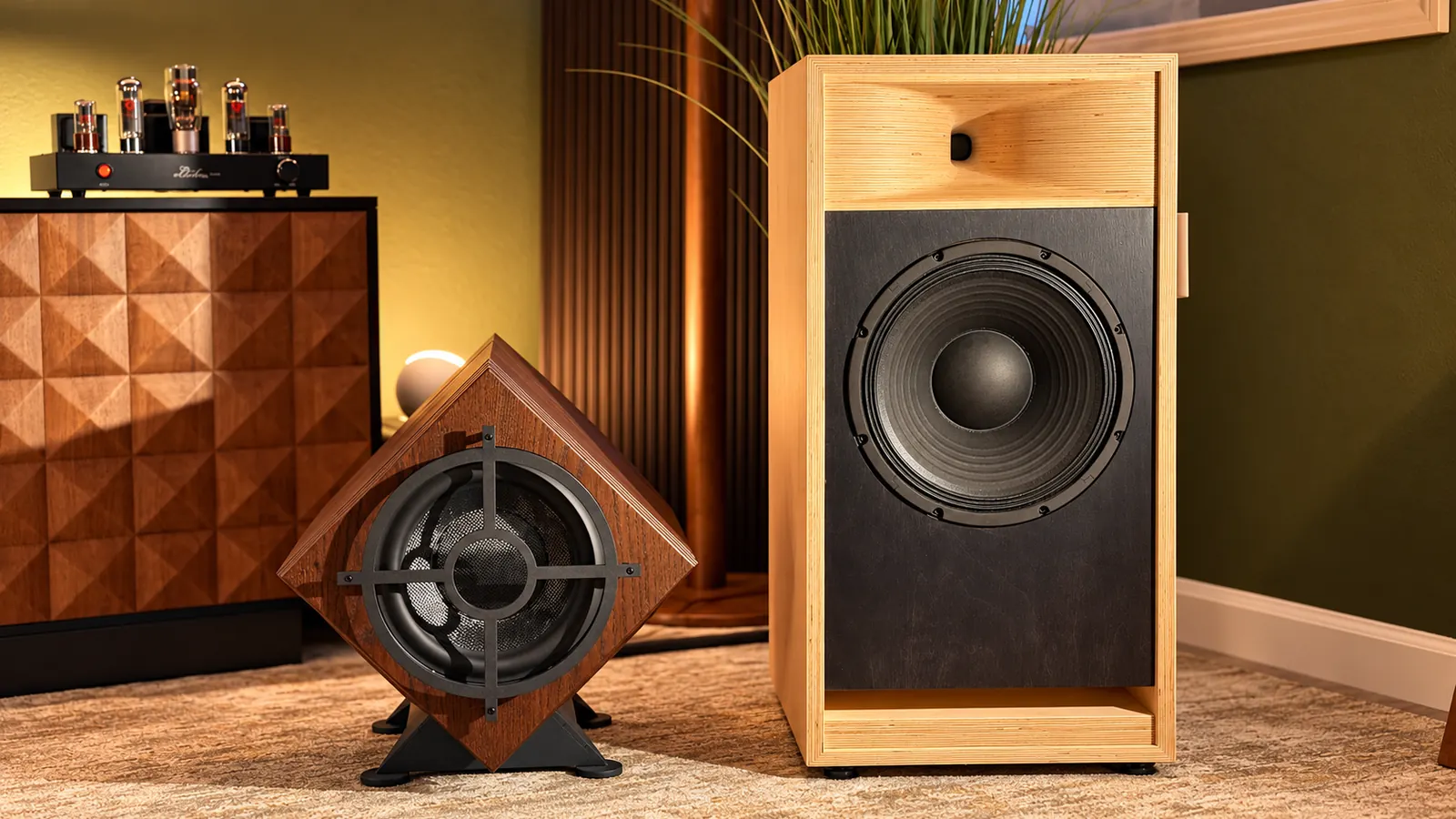
The Shakuto Audio Vitalic 12 is a horn speaker and it sits next to the Fundamental though these do not need it, the sub does blend easily with them.
I liked subs. Then hated them. Then loved them. Then disliked them again.
I have hated subs (with music) for most of my audio life, but I did have “flings” with a few here and there over the last 40 years.
I have had those $120 “boombox” specials from Best Buy (awful, just awful for sound quality) back in the day, as well as $500, $2,500, $3,500 and even one $5k subwoofer. That is where I tapped out, as they were all very similar in actual performance and sound. While I enjoyed a snazzy, glossy $7k pair for a while as well, after many months I found they were more of a pain. I could get them dialed in just right at times, but when the next song came on, I had to adjust them again. Probably my fault, as they were too much for the room, I think.
I could never get them to fully vanish from the room. There was also boom unless everything was dialed way down, and then they could barely be heard. I bought two because I couldn’t get the first one dialed in at all, and I had mono amps. It was suggested that I add a second to make them easier to blend. Yea. That didn’t really last long. Also, it is false info that if you run balanced mono amps, you need two subs. You do not.
Even when I had the pair, it seemed that just when I got them dialed in, along would come a track that made them boom rather than integrate and blend. Some of you who have had similar experiences may understand what I am saying. I figured that was just how it was and lived with them for a while. But over time, I found they did not really enhance anything in a major way in my room. They were sold.
I then tried a very popular mid-level model from another brand. That one had more boom and was quite unruly, so I did not review it. I tried a fancier sub, which I got on sale, as the original price was $5k. I had the same issue. These subs, for me, were becoming more of a pain than a benefit, so I swore them off again and decided they were not needed anyway. Nothing as pure as a great speaker on its own, I said to myself. Maybe it was just me? I do not rule that out.
I have lived sub-free, happily, for the last few years and even turned down three offers to review new subs that hit the market (now I regret it, as maybe they were better). Even so, there was still one subwoofer that had me curious, due to the way Jonathan over at OMA/Fleetwood Sound described it.
The Fundamental.
When it came in, I installed it the same day and tested its low-level and high-level inputs. I tested both, but when running balanced differential amps, it is always tricky to get this done the right way with a sub connection.
I ended up using low level via the RCA jacks for the first week. I did test high level and low with an Accuphase E-3000 and a cheap $300 tube amp, and it did VERY well with both. Later, I landed on a high-level connection from the speakers to the sub with the Electrocompaniet EC5 and AW300 amps, wired for balanced mono amps. I tried all ways and landed on one connection that sounded the best by far. That is the low level via the stereo RCA jacks on the back.
It took me about an hour of listening and dialing it in, and after that I never had to change anything. It stayed flab-free, yet grew the soundstage quite a bit when used with my Helios. In fact, it makes my Helios sound bigger and more like a $20k+ set of speakers. It really does. So much so that the Helios and Fundamental are my fave speakers that I own, and get the most listening time.
To me, the Helios and Fundamental sound better than the brand’s more pricey Deville on its own. The Deville is $20k+, but this is just my opinion after owning both. Then again, I am sure the Deville with the Fundamental may bring even more magic.
This sub was truly made for Fleetwood speakers, as they need a fast sub, but it will work with any speaker, even fast horn designs, which is what OMA is known for. Even so, it worked magic with the Helios.
Day after day, night after night, week after week…I sat and listened to the Helios, SV Gro and other speakers that were in for review with the Fundamental. I tested with normal speakers and even fast horns from Shakuto Audio. The Fundamental blended easily, but due to the 97 dB sensitivity of the Shakuto speakers, the gain had to be boosted via the dial on the back compared with the Helios.
Let’s talk about the build and design.
This is a big part of what we are paying for here, as the Fundamental is designed to last a lifetime and be reliable. It does come with a lifetime warranty, so there is that. It is made of solid oak that has been torrefied (cooked) for stability, and it is thick. This is not some kind of veneer. It’s real, solid wood from PA, so immediately the design and build quality shine.
I once had a cooked neck on an Ernie Ball guitar I owned many years ago. It was super nice to look at, but the process also helps make the wood more stable over time. Same here with the Fundamental.
This subwoofer is a substantial piece of audio art, and it is art that also happens to perform at a higher level than the popular brands I have tried. But it is different in a few ways as well.
The 10-inch driver, again, is from the pro-audio world, and it is quite nice. The magnet inside is extremely powerful and, along with this driver, the sub brings some truly spectacular, tight bass. As with everything Fleetwood does, it is done with class as well.
It’s not all about the DEEP. The sub and music myth. Lower is not better.
There are subs that are very well known for their quality and performance, and these are usually marketed as going so low and deep, even down to 15 Hz in some cases. That is all marketing fluff IMO, as I have never, ever heard any benefit from any sub for music that goes down to 15–18 Hz. Heck, even 20 Hz. It seems to me that most hear these low numbers and feel that makes a sub better. What I have found in my lifetime of audio is that some subs use these numbers to impress on paper, but rarely do they perform as expected with real music in real rooms, at least for me. Marketing. To look good on paper.
I am just ranting here, but you see why I haven’t reviewed any subs in a while.
Do not get me wrong, though, as I have enjoyed some subs very much, like the REL T9/X, which was very good in my last room. It wasn’t as boomy as some others and had nice output in the deep midbass regions that fleshed out the sound. I never did get that vanishing act, though, nor did it really enhance my soundstage much, rather just a touch.
Note that the T9/X is around $1,500, or about $7k LESS than the Fleetwood.
The Fundamental also has a solid steel, powder-coated stand, feet and grille. This adds weight but also solidity and stability to the sub. It anchors itself to the floor simply through its design and weight. This is physically the most impressive design and build I have seen in a subwoofer. Others may look more flashy, but this one is made to last, even the electronics.
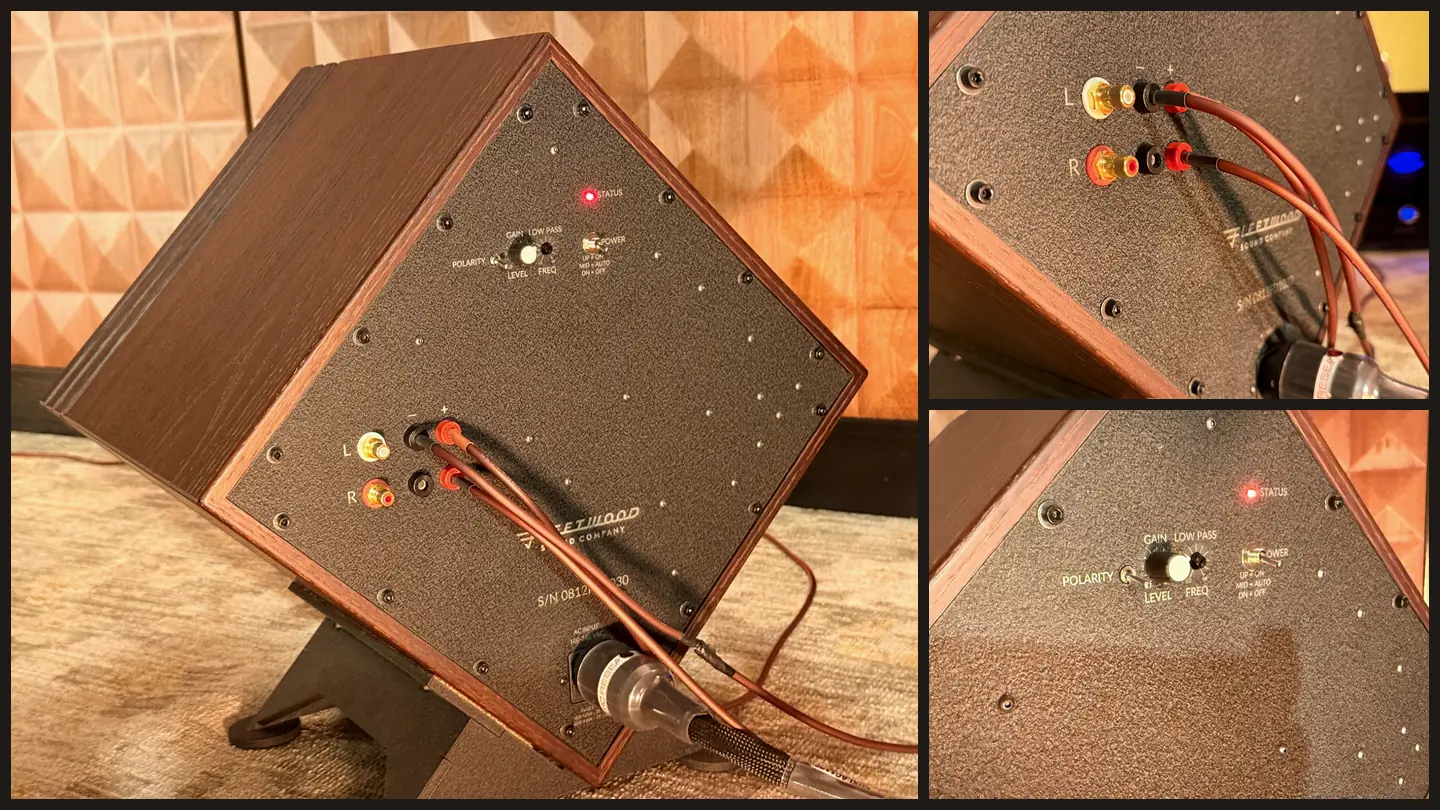
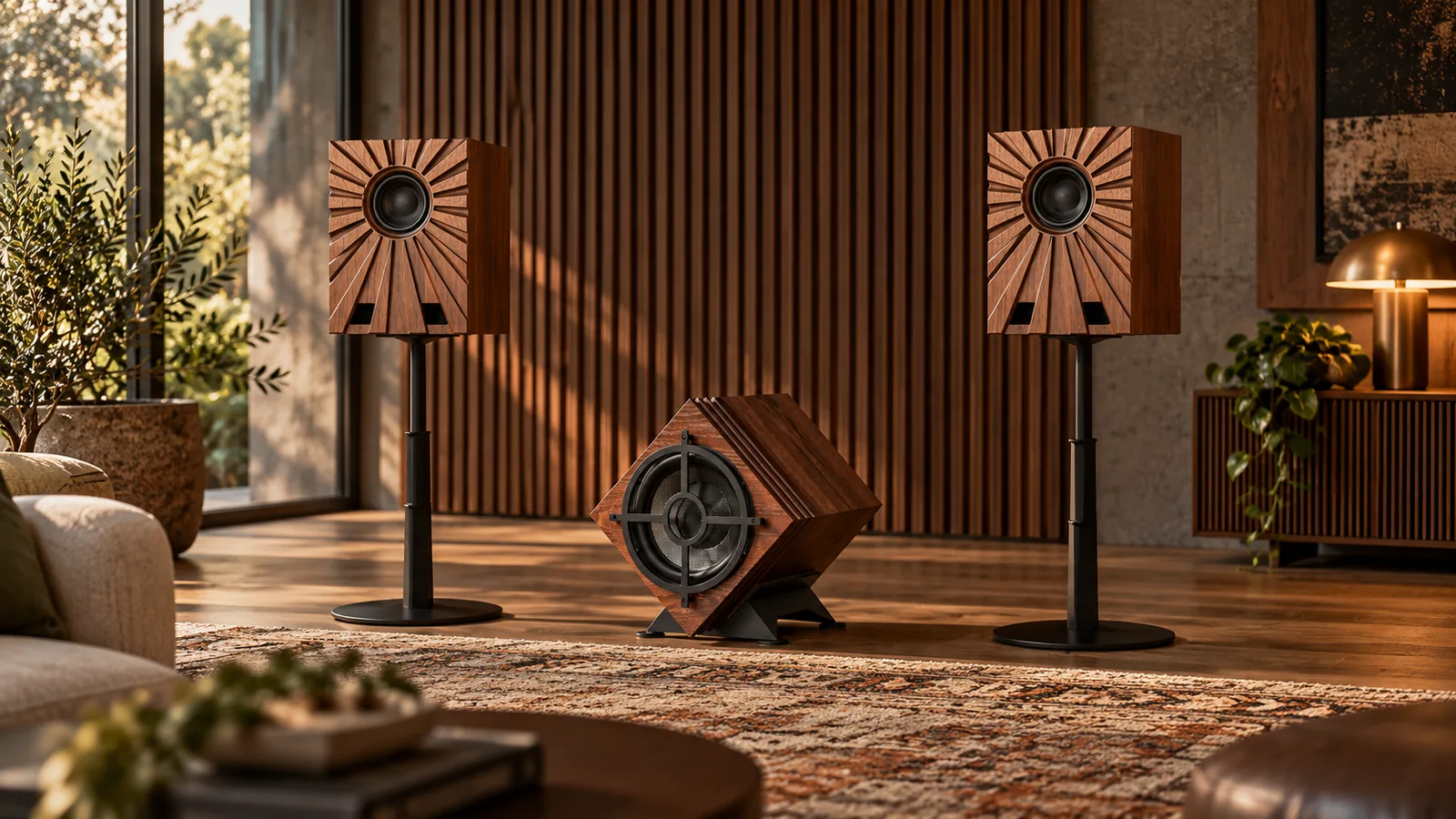
Around back, there are stereo high-level inputs and low-level inputs as well. Fleetwood recommends starting with the gain high, around 3 PM, and the crossover about three-quarters of the way up. This will provide big output, but I had to dial down the crossover to around 12–1 o’clock, as it was adding almost too much warmth at the higher settings. No bloat or boom, though. At all. I landed at around 1pm on the crossover as my final setting.
The First Listen – Magic with Helios.
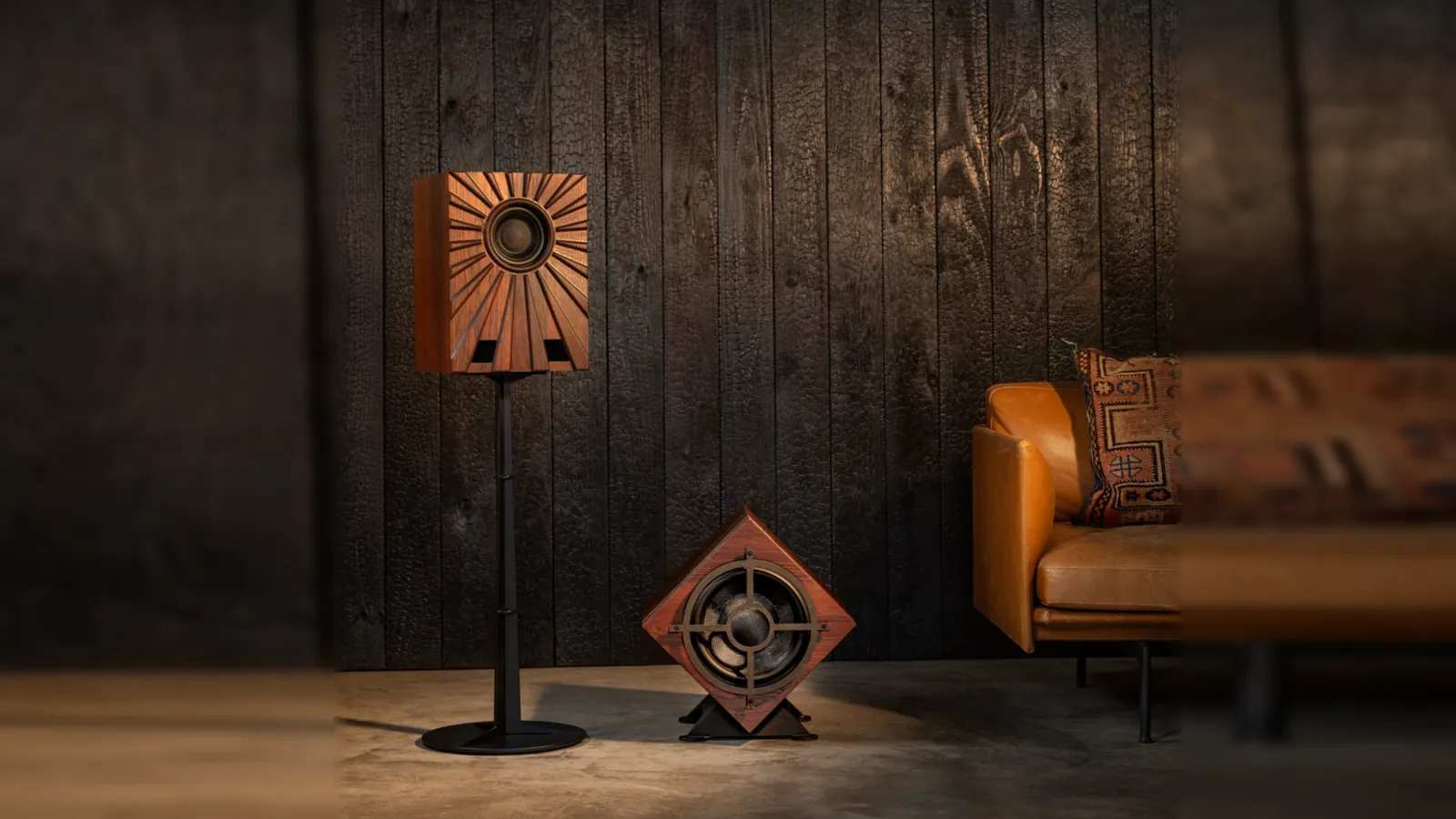
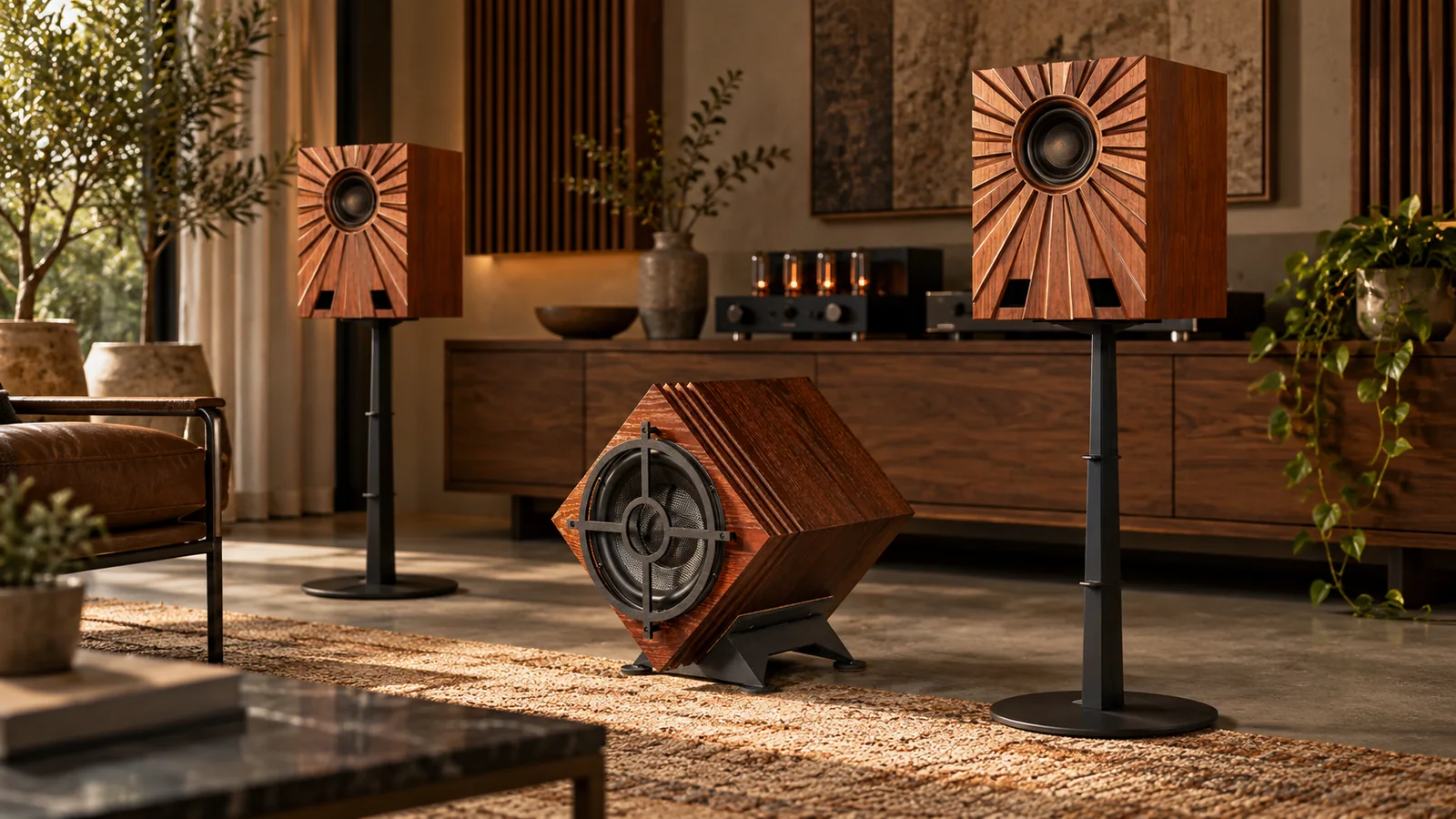
I started with the Helios, as truth be told, the Fundamental was designed by the same guy who designed the Helios. They are natural mates. Soulmates, even. I will just say this…if you own Helios…and can swing it…the Fundamental is a must. As much as I love the Helios on their own, with the Fundamental they sound complete and like a much bigger, much more immersive and much more majestic setup.
Do not let anyone in this hobby make you feel a speaker setup like this is not world-class. I had a guy email me a few months ago, scolding me. Why? He told me the Helios was not a serious speaker and I should be ashamed to “hype” it. I was curious and asked if he had a set he did not like. I asked about his room size, amp, etc. He then came back and said, “I never heard ’em.”
He went on to say he knew just from looking at that small driver that they “couldn’t fill his closet, let alone his listening room.” I asked what speakers he had, and he owned a set of $86k speakers that I am sure are superb. I just replied, “I bet these Helios could give your speakers a run for their money if set up right and with a sub that can keep up.”
In any case, the guy stopped replying. What I say in my Helios review, follow-up and right here stands.
Getting back to the listening.
This is not the kind of sub I am used to. This one is lightning-fast, and because there is no passive radiator here, it is free of slop, farts and bloat. It seems like it isn’t doing much when you listen. In fact, when it is on, I almost want to say, “It’s not working,” as I cannot really pinpoint this newfound, deep, textured bass throughout the space with the Helios. This is what I have always sought in a sub yet never fully found.
In no way does this new bass energy sound like it is coming from the Fundamental. There is a lack of bloat, boom and insanity that some subs deliver. The Fundamental is super clean and fast, and it can fool you.
When turned up, kick drums hit me in the chest and deep bass is felt emotionally, but the house or room never rumbles or shakes. Pictures on the wall do not vibrate, and they should never do that anyway for music.
This one was clean, textured, immersive and laid down a foundation of bass in a masterful way. As if the Fundamental were saying, “This is how it is done,” to all of those 18 Hz passive-radiating monsters. Even at low volume, the sound was fully fleshed out, yet transparency remained as well.
The sealed design allows the sub to be fast, tight and blend seamlessly with the mains. It brings serious quality in the 40–120 Hz range, and dialing in the crossover was easy. It does go lower, as I heard output at 20 Hz with a test tone. But again, you will only hear this if it is in the track, and very deep bass reproduction at high output was not part of the design here. The focus was on quality bass that will fill out, flesh out and make your system sound complete. Makes sense to me.
One thing to note: when using the RCA inputs, the gain structure of the sub is sort of low if your source is not putting out enough voltage to the Fundamental inputs. I learned this with the EC5 preamp from Electrcocompaniet.
This can become an issue if your source has low output and you are running highly sensitive speakers. That is a tricky combo for any sub, especially a fast sealed design. I wish the sub had more gain on tap for this kind of situation as it seems it doesn’t start to rock and roll until you get close to max on the dial when used with my EC5 preamp (low output) and sensitive speakers at 97db efficiency. I was assured I could turn it as high as I needed without issues but I found a cheap and easy solution anyway.
Using the Electrocompaniet EC5 and AW300 mono amps proved tricky for me, even with the Helios, and I wanted to use low-level RCA. This is a fully balanced system, so the RCA outs of the EC5 preamp have a 6 dB lower output than the XLRs that feed the amps.
This means the sub will not match the volume of the speakers at the same settings, so the sub’s gain has to be turned up. So much so that I ended up buying a $39 booster from Amazon that fully fixed my lower gain output from the EC5 RCA out and allowed the sub to really come alive no matter what speaker I ran with it. It was remarkable really and gives me tons of headroom without any negative effects.
With the Accuphase E-3000, the RCA outs were great and output was normal, showing that these outputs on preamps and integrated amps can vary wildly. The solution for my low gain output from the EC5 pre was this $39 booster, which is remarkable for the money. I now set the Fundamental to full gain, dial in the crossover to blend and use the booster to adjust the gain.
I tried the high-level connection as well, following Fleetwood’s own manual for my setup. I run one positive lead from each speaker’s positive terminal to the corresponding positive banana input on the back of the Fundamental. One negative lead from the Fundamental goes to the ground connection on the back of my EC5 preamp, not to a negative speaker output on either AW300 mono amp. The leads to the sub come from the speakers rather than directly from the amps. The one black serves as ground.
With the Accuphase E-3000, I use red and black from each speaker directly to the sub using the second set of speaker outs. How it is connected will depend on your amp, but a balanced differential amp will need a different connection. Always check with your amp maker for connecting a sub with balanced mono amps if you have them. When connected this way, at high level, the sub receives the same signal as your speakers. You will need an extra set of speaker cables, though I use these here as they are cheap and easy.
I still preferred the RCA low level in.
My Wife Listens
One day, I had my wife in here with me listening to the Helios with the new addition, and she wasn’t sure what had happened to the sound. I did not tell her about the sub. She saw it but didn’t know what it was.
I asked her what she thought, and she said everything was much bigger and deeper and asked what I had changed. She liked it. I pointed out the sub and had her stay in the seat. I walked over to it and turned it off…she said, “WHAT JUST HAPPENED?”
Lol. She noticed the sound shrink, get leaner and lose that foundation in real time. When I turned it back on, boom, it was back. She then said, “You have to keep that!” I told her the price, and she said, “Oh…well…but YOU NEED IT.”
I love my wife so much and feel so blessed to have her in my life. I just had to say that.
I then had her do the same for me. I sat in the seat with some kind of immersive, deep-bass spatial track, and when she flicked the switch, that all-out magic vanished into thin air. Sure, the Helios still sounded amazing on their own, but now that I had them here with their bass soulmate, the Fundamental, it was very hard to go back.

SV Gro
I then brought in the $33k SV Gro speakers from Denmark, and while the Gro go down into the 30 Hz range on their own, the Fundamental also provided a little more meat, muscle, depth and richness to these as well. While I did not need the sub here at all, it still enhanced the sound and blended just as well. No boom, nothing detached. It just filled in what the SV Gro didn’t, and it really added size to the stage. Effortless sound and no holes.
I listened to these with and without it, and the difference was very noticeable on tracks with big bass. Not needed, but very much enjoyed. The sax at the end of Melody Gardot’s live “Bad News” is amazing, and when you have the bass, you will feel that sax! Also, listening to “GBTC” from KatzPascale was a treat indeed with the Fundamental. If you have great bass capabilities, give that one a listen.
If you want to test your system’s bass, listen to a track called “Poland – Mixed” by Olafur Arnalds. You will know if your sub or speakers’ bass is loose and sloppy or tightly controlled here, as there is quite a bit of output you can feel. You should notice tremendous bass output that is tight and clean. With the Fundamental, this stayed tight and controlled and really made the room feel pressurized without anything offensive or out of whack. Was amazing.

Vanishing Act
The goal of a sub for music is not to sound like a sub is in the system. Rather, it should sound natural, as if part of the main speaker. Invisible. A friend of mine came by one day and assumed a sub was supposed to ADD bass to your system. That couldn’t be farther from the truth. A sub should reproduce what is in the recording and do so faithfully, not add bass boom to all music. Sometimes you will never know it is on, and that’s when you know it’s dialed in just right.
We should not see the sub cone moving violently. That does not make for great output. Instead, it should do its job like a ninja, and the Fundamental does this. I sit and listen and marvel at the solidity of the sound. It’s complete.
Shakuto Audio Vitalic 12
I have some gorgeous, handmade-in-the-USA horn speakers in from Shakuto Audio in California for review.
They just have that look and sound…projection…size…alive. Really the opposite of the SV Gro speakers I have here, which are darker, deeper, wetter and more about flow versus energy. These Vitalic 12 speakers are more like a massively upgraded Klipsch Heritage, say between a Forte and Cornwall, but with a richer, deeper sound and using real wood and better parts. More refined, no shout or sibilance though a touch dry compared to the SV Gro and Helios. They brings a live music feel.
I turned on the Fundamental with the Vitalic 12 speakers and again, instant blend. No bloat, no boom, no flappy floppiness. It vanished again and was now providing deep bass to these speakers that also, on paper, go down to 25–30 Hz. The sub was enhancing these down in the lower mids as well, but naturally. It was just reinforcing the bass that was there not adding artificial bass.
The best I heard the sub was with the Helios, full stop. Soulmates.
It’s Different.
I had a phone call with Jonathan from OMA a few weeks ago, during which he explained to me that he didn’t see the Fundamental as a “subwoofer.” He referred to it as more of a “bass module,” which may sound negative to some, but it is actually a positive.
He explained, and I agreed, as I felt the same, that most music doesn’t even have bass as low as 15–20 Hz. He is right. Movies, sure, you want those explosions to sound deep, room-shaking and real. Music, though…that requires finesse. It requires the utmost control. It requires SPEED and quality in the 40–120 Hz area more so than the lowest frequencies.
When a brand tries to reproduce and claim the deepest and lowest of frequencies, I believe, and this is my opinion, that it can take away from the musical precision of the sub where it matters most.
Most music that I listen to, tens of thousands of tracks across many playlists…almost none have bass under 25 Hz, and most live in the 35 Hz and up range. The magic bass for music lies in the deep midbass for me. This is what gives you the punch to the chest. This is what delivers big kick drums into your room. That ultra-deep 18 Hz bass does nothing for me with music, as it is not really there in most of the music I listen to. I mean, there are some tracks, maybe…but not many.
Another thing is that I have never been able to blend any normal sub with horn speakers with any real success. Timing has usually seemed off to me, as those big radiators never seemed to keep up. The Fundamental has been designed for speed, so it blends easily with horns. But the more sensitive the speaker, the more gain you may need, as your volume dial will be lower and the output to the sub will be lower. Any sealed sub without a radiator may have less output, but to my ears this design also sounds faster, tighter and cleaner.
You want the sub controlled by your preamp or integrated amp’s volume, so it receives a signal that follows the level of your main speakers.
It’s Pricey yet it doesn’t go to 15Hz. It’s sealed… so lower output. Worth it?
The Fleetwood Sound Fundamental is $8,450.00. That is not peanuts, but there are benefits here.
- Lifetime warranty on all OMA and Fleetwood gear. Peace of mind.
- Made of solid, torrefied oak in the USA.
- Solid steel stand and feet for stability.
- Stereo high-level and RCA low-level inputs for left and right channels.
- Fast as lightning and easy to blend. Super easy.
- Vanishes in the room and lays down a clean, deep foundation.
- Midbass is fast and improved as well.
- Uses Fleetwood’s own 500-watt amp design.
- Built to last a lifetime.
- It’s hassle-free and a work of art.
- Not for the ultra-low-bass fans.
If you seek a sub that is artfully made, fast, highly configurable with its inputs and controls, handmade in small batches and backed by a lifetime warranty, here it is.
I will say it again, though. If you own Fleetwood speakers of any variety, this sub will enhance them all and blend with ease. A must for me, as once I heard the Helios with the Fundamental, it was instant love. And now, many weeks later, I can’t imagine owning the Helios without it. These two are magic together indeed.
Musical Bliss
For me, this is a true musical sub design. For others who just look at output and how low it will go, this will seem overpriced. When I first saw the Fundamental on the Fleetwood website, I too thought it was overpriced, as it costs more than the Helios. Then again, the Fundamental is a purpose-built audio work of art designed to last a lifetime, versus having a MKII come out next year. All depends on what one seeks. Besides, everything in 2026 is expensive and this is bespoke kind of stuff really, so expect to pay a little more for the design, materials and performance.
After living with the Fundamental for a while now, I no longer see it as overpriced at all. We are getting what we are paying for. I can spend half and get a great sub, but I would deal with the same issues I always have. I can spend more on exotic subs but then would lose the unique mid-century design, and who knows if they are even much better? Can it get better? I am sure, but I have not tried a ton of subs nor any that cost as much as this one does. Børresen just released a $21,000 sub, so there is that.
More about the Connections..Detailed.
Do note that if you buy a Fundamental sub and the output seems low, check your connections. I first tried the RCA inputs with an Accuphase E-3000 and its preamp output as mentioned. The output was fine here, but the more sensitive the speaker, the more gain you will need from the sub.
Most should be just fine, but if you ever find you need more gain with any sealed sub, this works very well with lower-output, low-level connections. I tested it with my RCA output from the EC5, which is 6 dB lower than the XLR output, and it boosted the gain without noise, giving me more than I could ever need. It was quite nice, actually, and gave me a huge sound due to having more gain on tap. It offers up to 20DB of gain, so I just used it at 11AM on its dial to blend to make up for the 6db loss vs my XLR outs that drive the amps.
Also, some RCA outputs from a preamp or integrated are volume-controlled (what you want), and some are not. Some have low output, others high. Matching the gain is key for any sub with sensitive speakers.
With the Benchmark LA4, the RCA outs did just fine without a booster, on par with the Accuphase E-3000 RCA out.
With balanced mono amps, always confirm the proper connections for your specific gear before wiring anything up! Always check how to make a high-level connection with your specific amp before connecting anything. The good news is that the Fundamental brings full stereo connections rather than just one mono connection. No need to use a proprietary cable and no, you will not need a pair of Fundamentals if using balanced mono amps.
The Real Deal.
Fleetwood Sound is among my top three audio companies ever for what I love about speakers, sound and design. I also agree with their philosophy on sound for the most part. They make products to last rather than making them disposable, to be replaced or sold year after year. It is refreshing to see in today’s audio world, where everyone tries to outdo everyone else with specs and numbers.
This, for me, makes owning Fleetwood Sound products more like an investment. I feel they will hold their value well, but also bring years of enjoyment to my life. I have already experienced this, and the company also has fantastic customer service.
I am happy to throw my support behind this company. They are unique in a world where many things are more similar than different. They also have serious passion for what they do. I love what they are doing and can’t wait to see their next project, whatever that may be.
Me, I cannot live without the Fundamental now that I have heard it with the Helios. The Fundamental is designed to be a bass soulmate to all of the Fleetwood speakers and then some. It sure did sound best with the Helios so if you own these, or the Deville, the Fundamental could be your next upgrade.
The fact that it focuses on the main bass frequencies that matter in music, and has the speed to deliver them cleanly with impact, is the secret sauce here. It’s simple, really, as it’s not trying to reproduce the thunder of Godzilla’s foot, but more so the complexity and richness of a true foundation of bass where it really matters.
You can disagree with me, as I just relay my true experience. Nothing more or less. I hope you have enjoyed my review of the Fleetwood Fundamental subwoofer. If you have the Helios and Fundamental and like to rock out sometimes, throw on Rammstein Live in Mexico and turn it up. What an experience! I was there when listening to the first two tracks that have been released. Amazing stuff.
You can see more on the Fundamental subwoofer at the Fleetwood Sound website here.