
Eversolo C10 Master Clock Review — What Does It Actually Do?
The Invisible Part of Digital Audio
When we talk about improving our Hi-Fi systems, we usually focus on speakers, amplifiers, DACs, streamers, and cables. These are things we understand, things we can change, and things that can sometimes make a dramatic difference in how we experience our favorite music.
But there’s another part of digital audio that most of us never really think about. Timing.
That’s where the new Eversolo C10 Master Clock comes in.
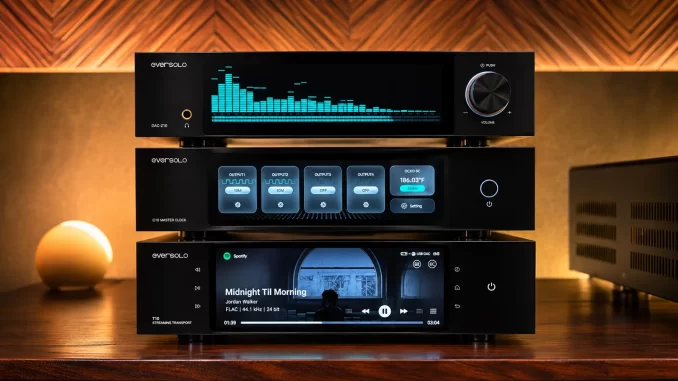
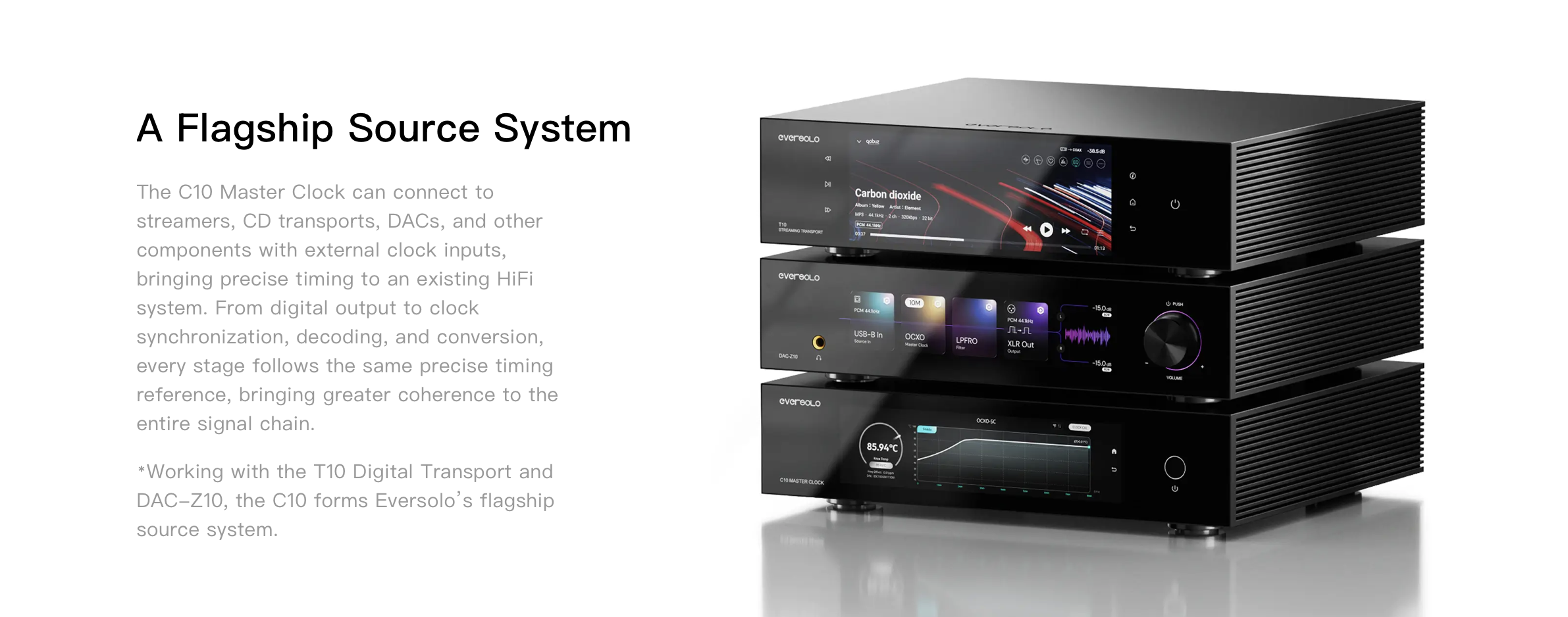
For weeks I have had the C10 here with the brands T10 streamer and Z10 DAC. I have used the full “triple stack” and tested the C10 with a LAIV Harmony 2 as well.
At $1,880, the C10 is a rather specialized piece of Hi-Fi equipment. It doesn’t play music, it doesn’t decode digital audio, and it doesn’t have anything to do with volume, tone controls, or amplification.
Sounds strange huh? I used to think the same thing but that all changed quite a few years ago when I first heard the DCS LINA Clock paired to my then DCS LINA DAC.
Ah yes, I remember it well. I had the Fleetwood Deville speakers, which I truly adored more than I knew at the time, and I sometimes miss those speakers. It’s one reason why I could not let go of my Helios as they are also quite beautiful. Just something about all wood handcrafted speakers being made like they used to make them.
Anyway…back to the focus of the review! I had the DCS Lina DAC that I also loved at that time. What a sound that was and while I do not remember the amp, that setup sounded divine. As of today it may stand as my most holographic system ever.
My wife and I would sit in the room on weekend nights and listen together. We loved that setup but it did get even better.
When I added the DCS LINA clock I was a bit surprised (I was skeptical of the clock) as I heard improvements in spatial reproduction, soundstage width and more. When I removed that clock, I lost those enhancements. It was easy to hear in that system and I had no doubt that the clock was helping the system to sound its best.
That was the biggest difference I have ever heard with a master clock being added to just a DAC but that was also quite the costly setup.
I also had the lovely and classy Matrix SC-1 clock last year back when it was a $5k investment. Today it is $7k, and for me, that one is now overpriced. The Matrix was not as “wow” as the DCS and in no world would I pay $7k for the SC-1. In fact, the Eversolo C10 for me sits just about in line with the performance of the Matrix SC-1. For $5200 less cash outlay and a plainer black box vs a more classy design.
The Eversolo C10 is a much more affordable clock than the DCS as well as the Matrix SC1 clock. This makes the C10 appear to be a steal of a deal, but is it really? I will say now it is not as good as a DCS clock and it doesn’t have the classy build of the Matrix. But a clock should only do what it does and nothing more.
It is a fact that your music never even passes through the C10 in any way at all. So what exactly does this box do, and why would anyone spend almost $2,000 on a component that doesn’t actually play or process any music? Well, let’s talk about that.
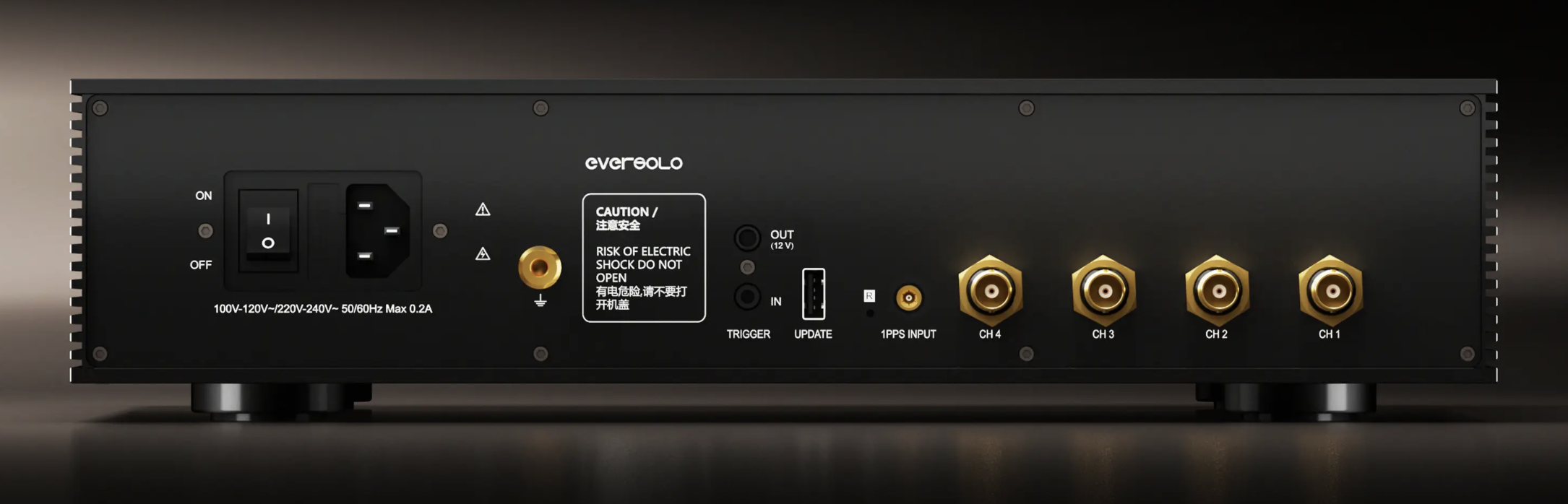
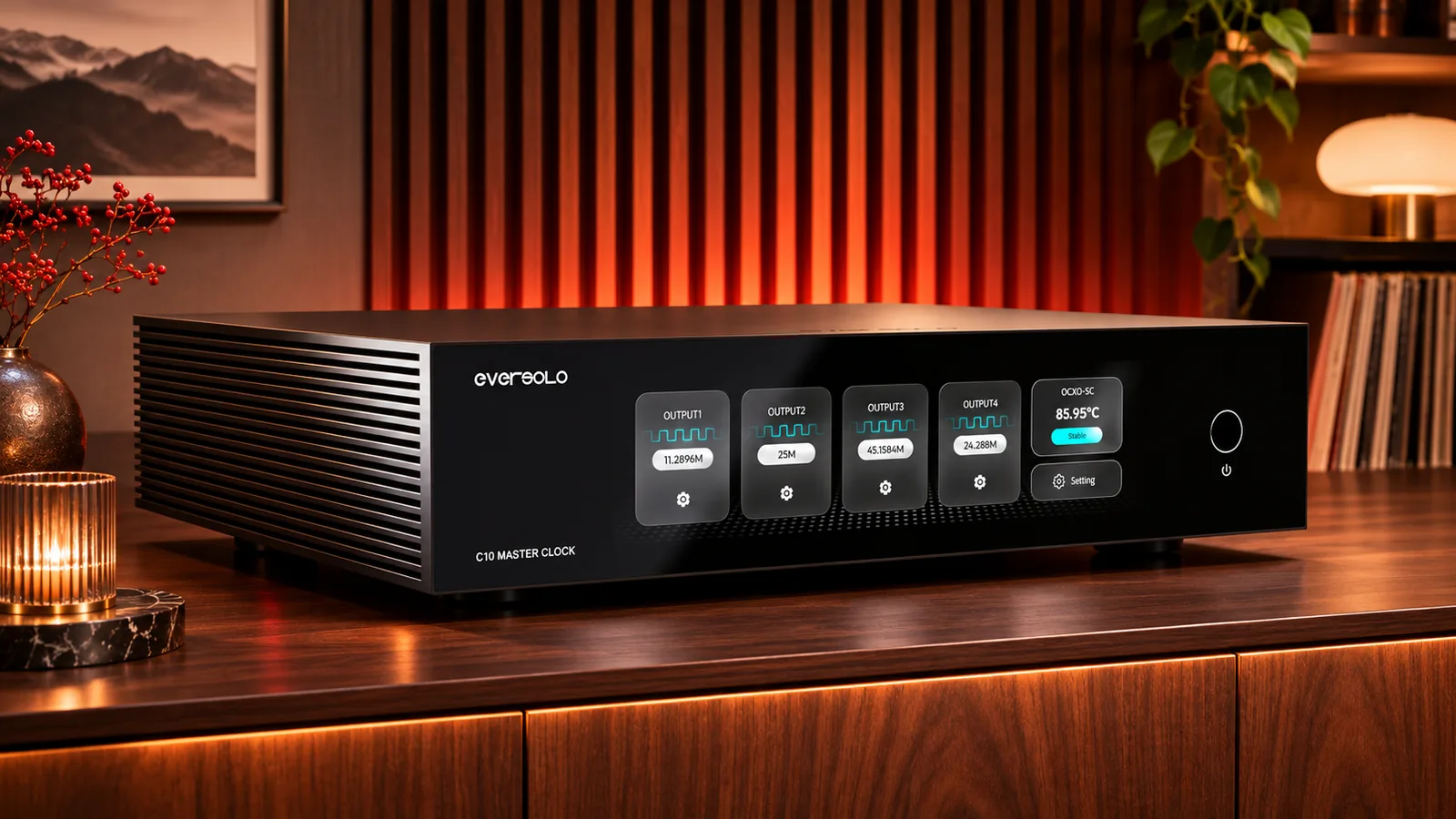
All we have on the back of the C10 are the four outputs. Connect each one to a DAC, Streamer or even an ethernet switch.
What Is a Master Clock?
Every digital audio device relies on an internal clock. This clock helps control the timing involved in processing and converting digital information.
Think of it as a very precise metronome operating inside your digital audio equipment. Tick, Tick, Tick, Tick…in perfect time.
Digital audio depends on accurate timing, especially when those digital samples are ultimately converted back into the analog waveform we hear through our speakers.
The problem is that no electronic clock is absolutely perfect. There can be extremely small variations in timing, often referred to as jitter. When jitter affects the actual digital-to-analog conversion process, it can introduce unwanted noise or distortion. How significant that effect becomes depends heavily on the design of the equipment.
The C10 is designed to provide a highly stable external reference clock that compatible components can use instead of relying entirely on their own internal timing references. It can be used with any DAC, streamer or ethernet switch that has a clock input. It will sync them all together as it allows multiple compatible components to work from one common reference.
In theory, this can help reduce timing-related problems and improve the precision of the digital audio chain. I have to say though that the C10 is not for everyone. It’s not like adding a new DAC or streamer but again, and I must stress, more of that “Cherry on Top” finishing touch.
This can bring that final bit of performance to your digital streaming setup. Fore example, If you have the T8 or T10 and the Z10 or R8 you can add the C10. Will it improve your sound? Maybe. Maybe not.
It will depend on your setup. Is it designed for critical listening? A sweet spot chair? Speakers pulled from wall? Then a clock can and may be beneficial for you if you seek perfection in your digital streaming. If you have a system set up for fun rather than soundstage, imaging and immersion the C10 will most likely not do a thing for you.
What Makes the Eversolo C10 Special?
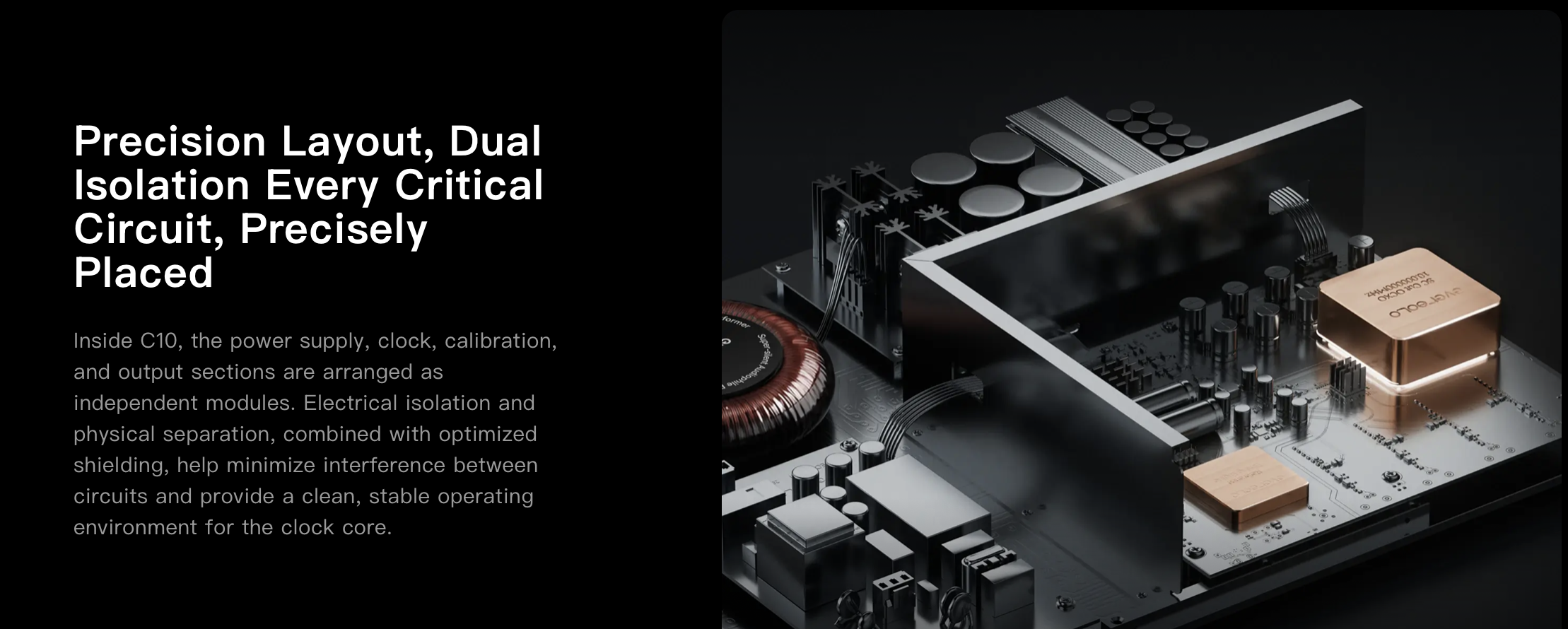
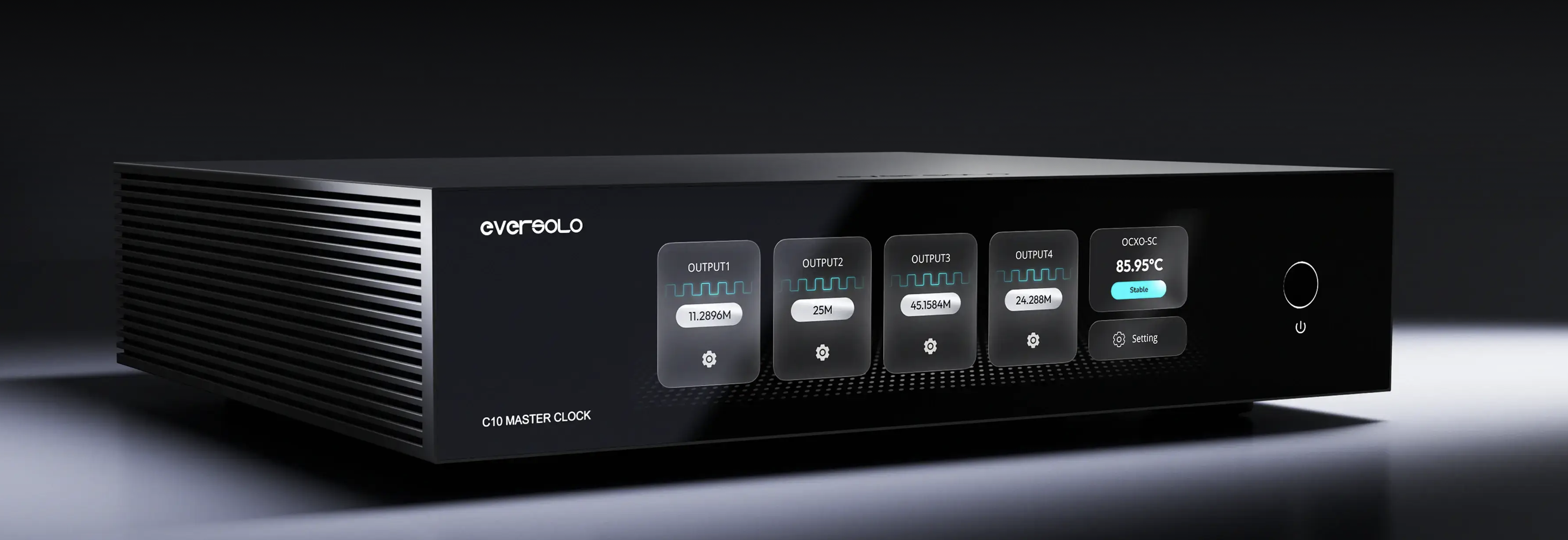
Inside the C10 is a custom, high-precision 10 MHz SC-cut OCXO, which stands for Oven-Controlled Crystal Oscillator.
That’s quite a mouthful, but the concept is actually pretty simple.
Crystal oscillators can be affected by changes in temperature. The C10 uses a specially cut quartz crystal that is designed to resist temperature-related changes and internal stress. It then keeps that crystal at a carefully controlled operating temperature. We can see this temp displayed on the screen at all times. It lets us know it is operating at optimal temp.
By maintaining a stable environment for the oscillator, Eversolo can achieve very high levels of frequency stability while minimizing certain timing variations.
The company specifies ultra-low phase noise of -115 dBc/Hz at a 1 Hz offset, along with a noise floor of -170 dBc/Hz or lower.
In other words, Eversolo has gone to considerable lengths to make this a remarkably stable timing reference. As I said, I feel it is about equal to the Matrix SC-1 in performance for $5,000 less.
The C10 also offers four independently buffered BNC clock outputs. This means you can connect as many as four compatible digital components and provide each with a reference derived from the same precision oscillator.
It supports multiple output frequencies, including 10 MHz, 25 MHz, and 100 MHz, along with frequencies associated with the 44.1 kHz and 48 kHz audio families.
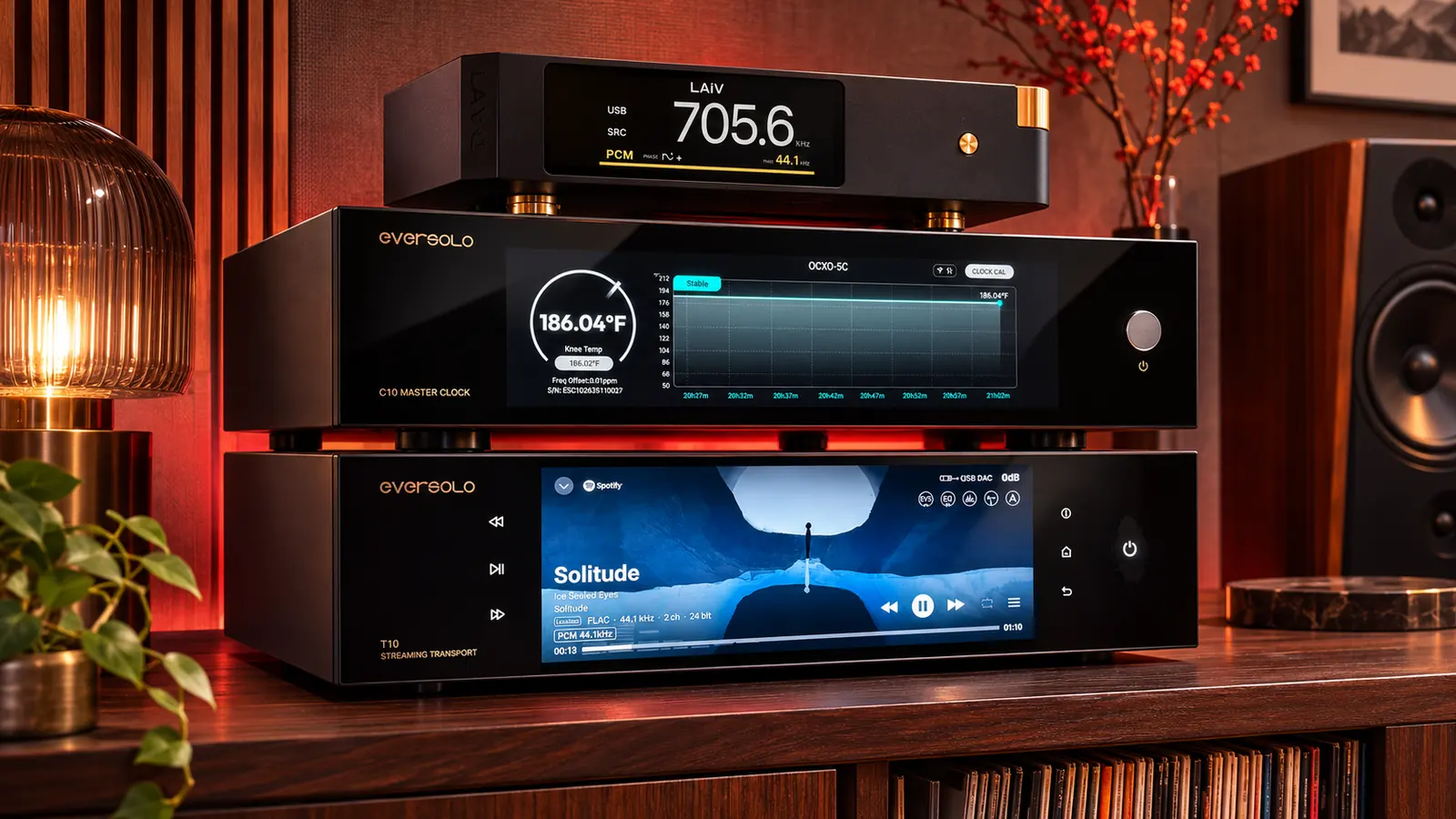
On the front is a large 8.8-inch IPS touchscreen that displays the clock’s warm-up process, temperature, operating status, and calibration information.
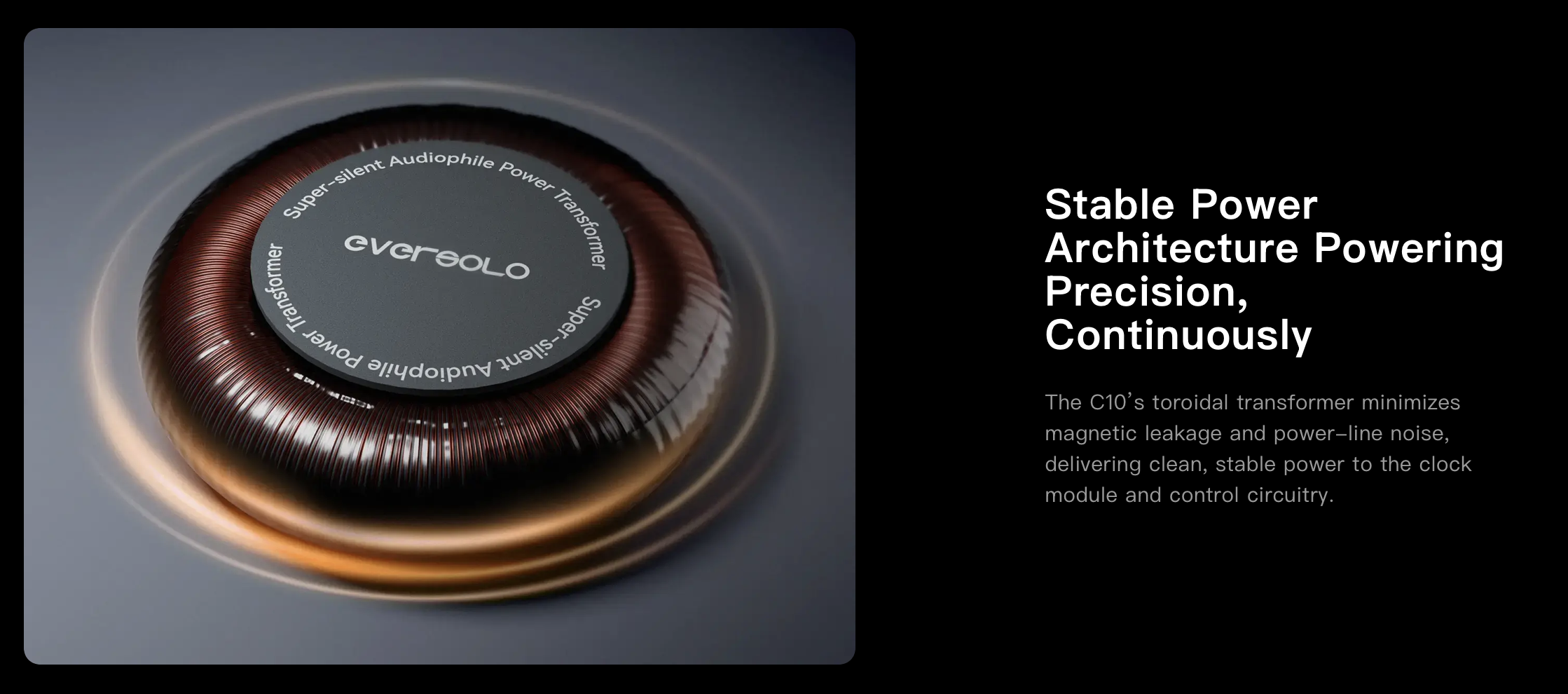
Eversolo specifies a warm-up time of within five minutes at a room temperature of 25°C. The C10 is housed in an aluminum chassis and features a toroidal power transformer, with internal sections arranged to help minimize electrical interference. I heard no noise from it at all. It is silent.
I left the C10 on 24/7 for the entire time it has been here, which has been several weeks now. This way it stays on, stable in temp and is ready to do what it does.
What About the Sound?
This is where things get interesting.
According to Eversolo, the purpose of the C10 is to help improve clarity, soundstage precision, instrument separation, and the natural flow of music.
If a better timing reference results in lower jitter at the actual conversion stage, there is a technical basis for improved audio performance. However, this doesn’t mean that adding an external master clock will automatically transform the sound of every system.
Keep in mind that many modern DACs already have extremely sophisticated internal clocking and jitter-rejection circuits. Some may benefit from an external reference, while others may show little or no measurable or audible improvement.
The specifications can tell us how precise the C10’s clock signal is, but they don’t tell us exactly what we’ll hear when it’s connected to our own systems. That is something we need to determine through listening and, ideally, controlled comparisons.
Good thing I have been listening to this thing non stop and am ready to talk about what it has done in my reference system. What you have been waiting for I am sure.
MY EXPERIENCE with the TRIPLE STACK (and then some)
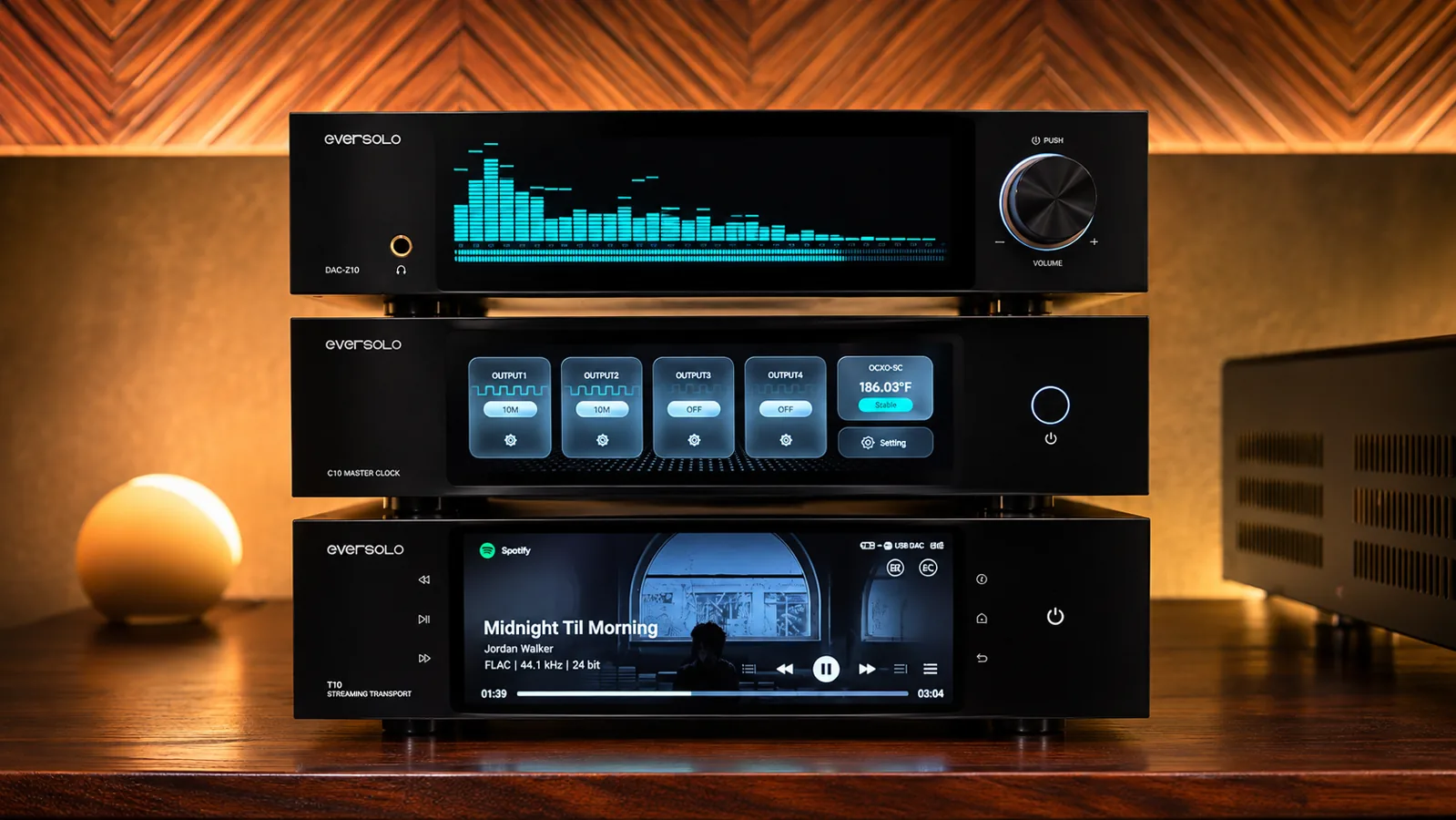
As I awaited the arrival of the C10 I was listening to the T10 streamer with Z10 DAC. It’s been a while since I had the Z10 in and once it was playing I remembered it very well.
My take/refresh on the Z10 is this: The Z10 is a DAC that borders on being a little bit analytical but it stops short of that.
It does have some warmth in the midrange but it is really about clarity, transparancey and being open with an illumination up top vs warmth. Unlike an R2R DAC the Z10 is about precision but for me it sits about right where it costs. It is not a giant killer nor a heart touching kind of DAC.
The Z10 is for those who value the clean, clear and detailed variety of DAC but with a hint of warmth along with some body in the mids.
When swapping for the LAIV Harmony 2 which I truly adore, the Z10 sounded a little sterile and just a hair flat in the depth, only in direct comparison. The LAIV is warmer, richer and deeper hut also costs double of the Z10. The Z10 is a natural mate for the T10 and C10 and it currently sits as the flagship streaming setup from Eversolo. A three piece affair.
The Z10 though does do very well when the C10 is added to the mix. It sounds better still, even if by a small amount. It’s about the flow and the music. When everything is timed perfectly together the difference is there.
My take/refresh on the T10 Streaming Transport
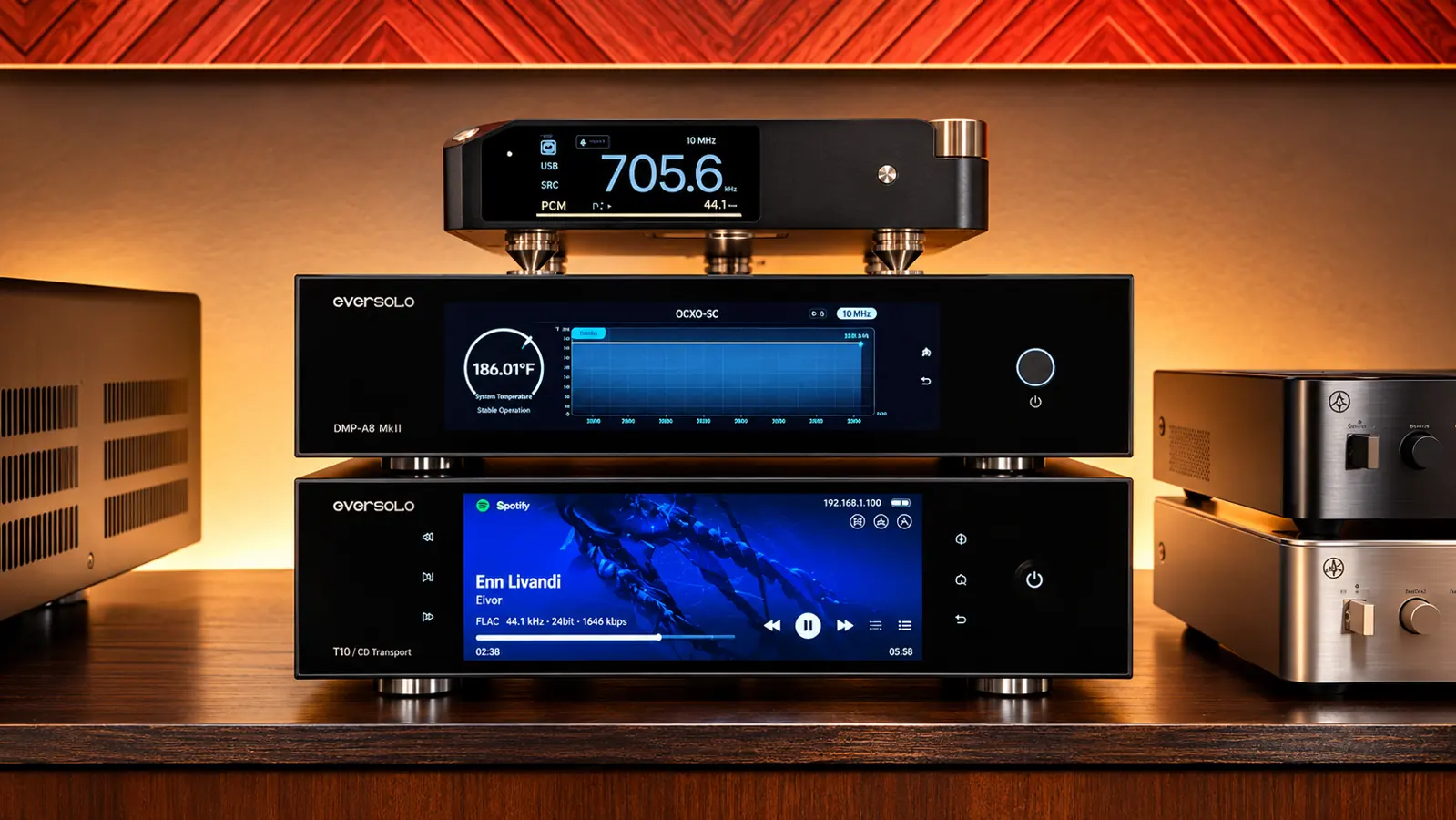
The T10 has been in play with my system since before it was launched. It has not left and this is because I feel I cannot best it for anywhere near the price point.
I would have to spend triple to best it. The T10 has been stable, especially after the firmware updates. Initially I was getting some drop outs with Spotify and Tidal but these days it is rock solid. As stable as it gets.
Sound quality wise? I have heard better streamers. The Matrix NT-1 does sound better to me. The Lumin U2 does sound better but it’s not a night and day thing. It’s more different than better really. The display is awesome as well and the features are incredible for a streamer.
I have been extremely pleased with the T10 and I am a picky guy when it comes to my audio.
When I added the C10 to the T10/Z10 combo I instantly heard what it was doing but before I dig in let me list the system:
SPEAKERS: SV Audo Gro/Fleetwood Helios
Pre/Amp: Electrocompaniet EC5 and AW300 mono amps
Integrated: Accuphase E-3000
Cables: Full Loom Synergistic Research Foundation XL.
Power: Synergistic Research Powercell 12SX
TESTING: T10/C10/Z10/H2
Whether I had the beautiful SV Gro or my Helios playing the C10 was bringing about a 5% improvement in soundstage depth. I heard more layers within the music. Vocals seems more locked in and spatial. Meaning, reverb trails were easier to hear. More immersion.
Now, keep in mind I am talking small change here, like 5%. The “cherry on top” as I already have mentioned. The C10 will not alter the sound like a new DAC will. Instead it will bring that last extra bit of refinement to the sound.
As for me, if I decided that my main streaming setup was going to be the T10 and Z10, or even the T10 and H2, I would add the clock for sure. For me.
It comes down to how much more you want from your streaming. I feel clocks are for the more obsessed among us. For those who seek that last bit of refinement and immersion.
I then hooked up the LAIV Harmony 2 to the T10 and C10 and heard similar things. With the H2 the sound was larger, wider, deeper and richer still. Warmer as well. I love this DAC and it pairs so well with the T10/C10.
When I disconnected the C10 from the T10 using the Eversolo App and the menu on the LAIV I did notice something went “missing”. I couldn’t put my finger on it exactly but I truly did miss whatever it was. With the C10 back on, there it was again. A sense of ease, a more analog approach, beautiful sound, more refined.
Again, small difference but it was there.
At $1800+ this is not a cheap device to just try out but if you have dialed in your system and want that final bit of extra for your streaming then the C10 might do this for you. I enjoyed having it in and never wanted to turn it off.
Once you hear what it does, even if it is minor and not anything night and day, you will not want to be without that subtle “something” that a good master clock does for digital music.
It’s all about timing and yes master clocks do what they are advertised to do. I just can’t see spending $7k on a Matrix SC-1 when the Eversolo C10 is under $1900.
Is the Matrix a better clock? Probably but even when I had the full Matrix stack (and it was awesome) I heard the same effects when I added their clock. It didn’t do this any better when it came to experience but it sure looks nice. The DCS was amazing, but DCS has been making clocks forever. They are very high end. I feel Eversolo nailed the quality and price tag here as it is quality inside as well.
Who Is the Eversolo C10 For?
I don’t believe a master clock is something the average music lover needs to rush out and purchase.
If you’re using a simple all-in-one streamer or DAC without an external clock input, the C10 isn’t going to do anything for you. It cannot connect to equipment that doesn’t support an appropriate external clock reference.
But let’s say you have a more ambitious digital front end.
Maybe you’re running a separate digital transport and DAC, both capable of accepting an external clock signal.
Perhaps you’ve already put together a highly resolving system and are curious about getting that last bit of performance from your digital source. Maybe you do not want to fork over $5k, $7k or $15k for a master clock.
This is the sort of system and person the C10 is designed for.
It’s especially relevant for owners of Eversolo’s T10 transport and DAC-Z10, which are designed to work with external clock references. Also happens to work beautifully with the LAIV H2 as it now has that clock input.
So yes, it can also be used with compatible equipment from other manufacturers, provided the clock frequency, signal level, and connection requirements are correct.
The C10 isn’t intended to replace your DAC or streamer. It’s a specialized addition to an already capable digital system.
Is It Worth $1,880?
That’s going to depend on the system, the listener, and the results. Oh, and your ears.
If you’re building a system from scratch, I would certainly prioritize good speakers, amplification, room acoustics, and a capable DAC before spending money on an external master clock.
But for someone who already has an accomplished system and enjoys exploring the finer details of digital audio, something like the C10 may be worth investigating.
Ultimately, what matters isn’t how many impressive specifications a component has or how elaborate the technology inside may be. What matters is whether it makes a meaningful difference when we sit down, press play, and enjoy our music.
And that’s exactly what I wanted to find out with the Eversolo C10 and I did just that!