
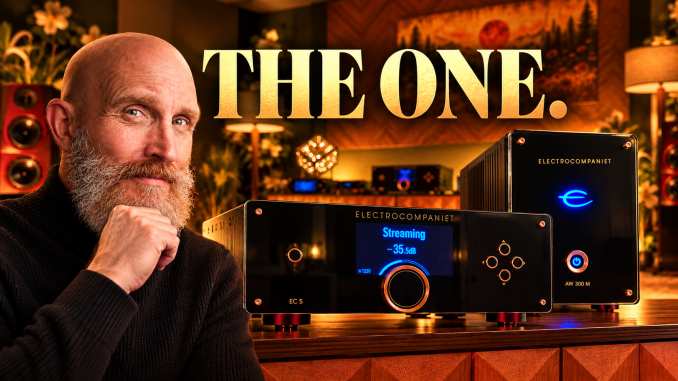
The Electrocompaniet EC 5 & AW 300 M Review 2026
By Steve Huff
Settle in, my friends. Grab a coffee, sit down and relax as you read this one. It’s a longer review, but it has to be. This is world-class stuff.
While I’ve been in this hobby for most of my adult life, now over 40 years, I’ve never been one to spend crazy exotic money on audio. What does “crazy exotic” mean to me? Well, anything over $20k is exotic, or to put it simply, very expensive. Yes, I’ve spent some big cash over the last few years trying things I normally never would have been able to. Many times, that comes down to getting some deals on review units and used gear.
I’m one of those audio dudes who tries as much as possible until that one special piece lands and hits me in the heart. It’s rare that something arrives here that’s so special I think of it as a lifetime purchase. Over the years, as I’ve heard more and more new gear across all price ranges (thanks to being a reviewer), my tastes have evolved a little as well.
I have three pieces here now that I have no interest in moving on from: the Helios, Fundamental and SV Gro. But I’ve never really found an amplifier I felt I could live with forever. The same goes for a DAC, streamer and preamp. As close as I’ve come to that dream sound living inside my head, nothing has fully lived up to it long-term.
The T+A 3100 HV integrated amp came extremely close, but I couldn’t afford even the price offered to me for a well-used unit back then. It was several years old, scratched and still cost five figures. Even so, it was probably the finest all-around integrated amplifier I’ve tested.
The recent Accuphase E-3000 also hits me right where it should. Like velvet, with midrange glow and warmth, yet still open and precise. The looks are gorgeous and classic. I much prefer a system that delivers rich body, depth and wonderful imaging. I love immersion and a connection to the music. I do like effortless power as well. Both the T+A and Accuphase do these things very well, so why would I review a set of amplifiers and a preamp costing more than $50k in the USA?
When I’m asked these days to review a very expensive product, I hesitate a little for various reasons.
I’ve heard some extremely pricey gear I wouldn’t recommend at all because, for me, the price doesn’t always equal the experience. Sometimes it does, which makes things tricky. With this one, though, it was a no-brainer because I already knew how wonderful Electrocompaniet gear could be for the soul. The brand’s ECI 6 DX MKII is still one of my all-time favorite integrated amps, mainly because of its amplifier section.
Big, solid, beefy, slightly laid-back, but with superb imaging, detail, richness and bass. That’s the EC sound, but there’s much more to it than those words suggest. It’s hard to fully describe. I do know that when someone finds this kind of sound in their system, they often keep the gear for decades. In fact it’s very rare to see the big EC amplifiers for sale used. Many loved the previous-generation NEMO amps, and those who have heard both generations have told me the newer AW 300 M and AW 800 M are even better.
The New EC 5 and AW 300 M
I’ve now spent weeks with the new statement-level flagship EC 5 preamp and the somewhat more manageable AW 300 M monoblocks. I’ve listened for hours every single day, comparing them with integrated amplifiers that probably shouldn’t be compared at all, considering they cost around one-fifth as much. I tried anyway! Then came the writing, talking, filming and publishing. Oh, and no, I wasn’t paid a penny for this review. In fact, I may end up sending some money to Electrocompaniet because of it.
I can already hear it… and yes, I know.
This flagship Electrocompaniet setup is expensive, designed and made in Norway in relatively small production quantities, with components and engineering developed in-house.
That goes for both the EC 5 and AW 300 M.
A little background: Electrocompaniet develops and manufactures its hardware and software at its facility in Tau, Norway. The company builds its own amplifier modules, develops its streaming software and produces its own circuit boards. There’s a lot more going on here than simply putting a name on somebody else’s gear.
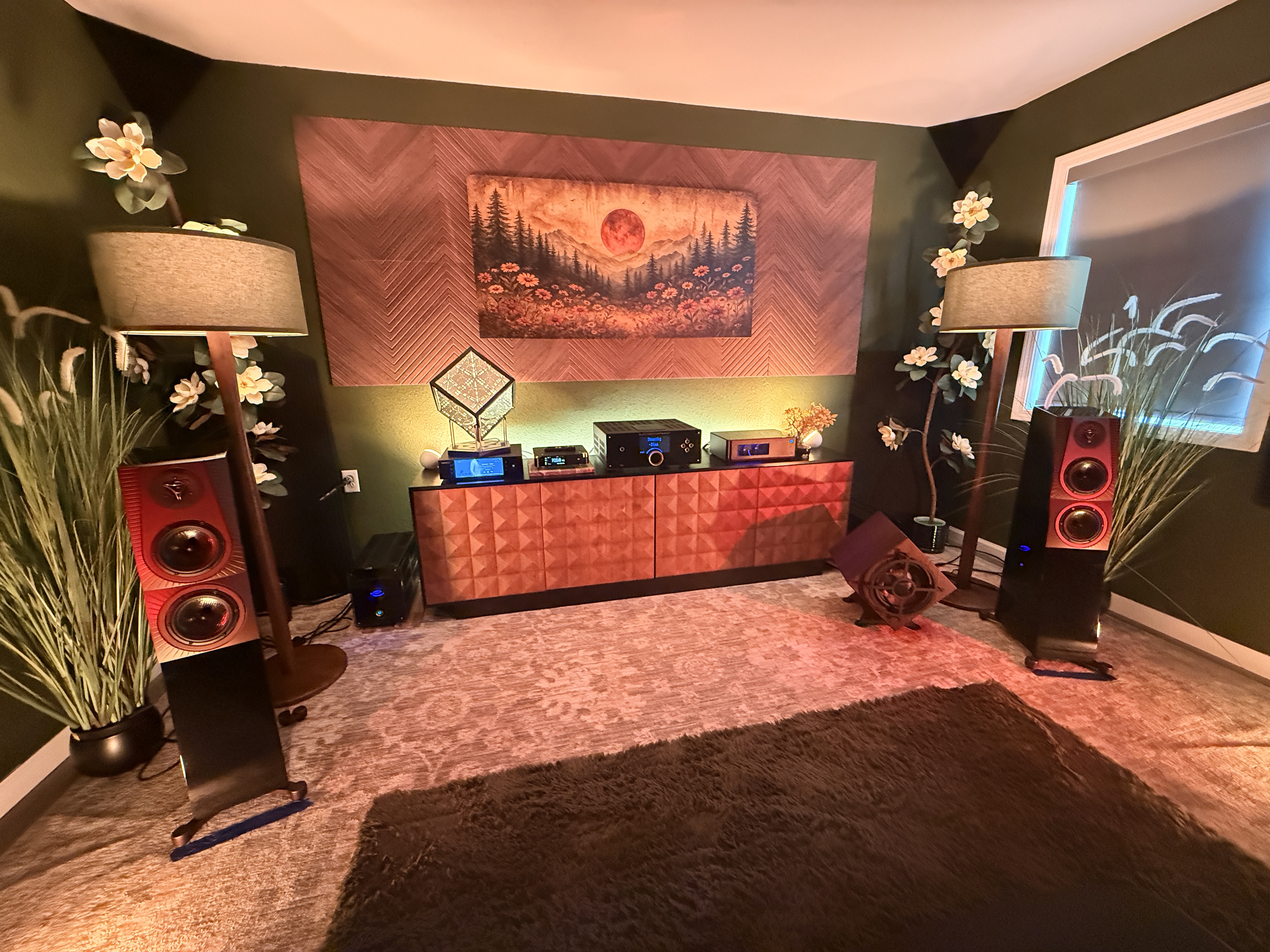
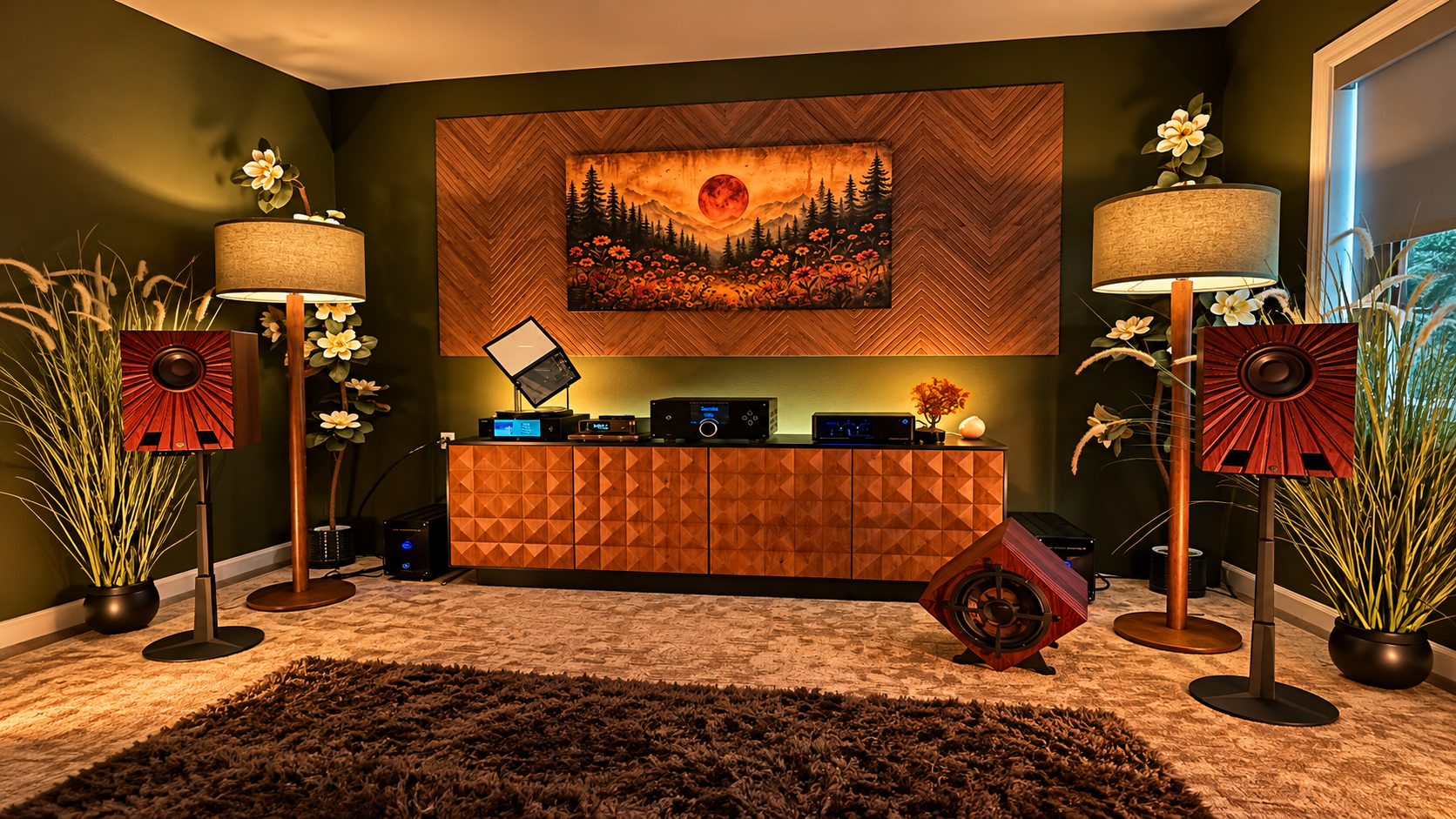
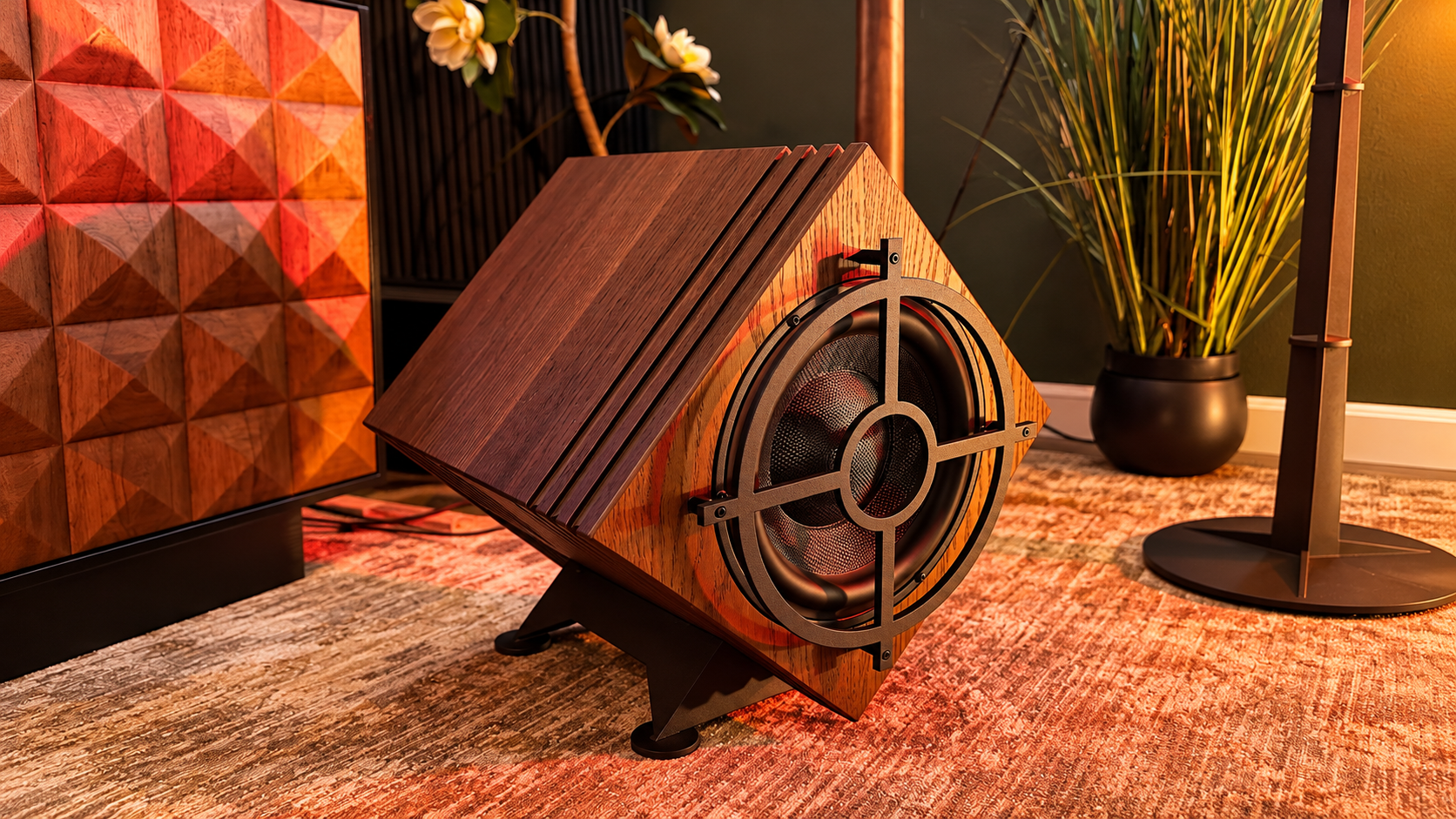
The SV Audio Gro and Fleetwood Sound Fundamental Sub with the EC Gear
Today I’ll be talking about my experience with Electrocompaniet’s newest flagship preamp, the EC 5, which retails for around $25,500 USD. The matching AW 300 M mono amplifiers are also here, at roughly $30,000 for the pair. That’s $55,500 before tax, delivery and anything else. I stretched this review out as long as I reasonably could because I really didn’t want to send them back, hahaha.
To me, $55k is a small fortune. That’s about what my parents paid for their home when I was a teenager in Chicago. Back when I was 17, I had a $1,500 stereo, and it was a different time. I never dreamed I’d be listening to this kind of setup at 57. If I could have peek into the future and seen these prices back then, they would have scared the crap out of me. Then again, we’re talking about flagship products from a Norwegian brand with more than 50 years of history. It’s 2026, and at least here in the USA everything seems to get more expensive by the week.
Of course, there are people with far more disposable income who may find this system affordable. It’s all relative to where you are in life and what music means to you. For me, music is my therapy, my joy and a daily part of life. It’s much more than a hobby.
I am not one to keep you reading while I drag out what I really think, so I will say it right now, without any BS or nonsense:
This preamp and power amp combination delivers the finest sound I have experienced in any of my listening spaces over the last 40 years. It’s unreal how much these pieces have transformed my room and, more importantly, my experience of listening to music. They have transformed both of my main speakers as well, to levels I did not know they could reach.
I’ve had some fantastic, memory-making amplifiers here. None has brought this combination of solidity, bass, depth, layering, impact, punch and humanity to music. That, my friends, is my kind of sound. At times it’s dreamlike, and it has that unmistakable EC character.
As for me, I vowed never to buy big-money gear again as I just do not have that kind of cashflow. But..there is always a “But”.
We sold our old home in the woods, made a nice little profit and moved into a new place. Our bills have decreased by about 75%. The house is brand new, built by a small-town builder who put up four different homes in a row. We paid what I feel was a very fair price, and when all was said and done, we had a little more money left than I’d expected.
Even so, I’ve been saving that money and was perfectly happy with the gear I already had for listening.
Then the Electrocompaniet gear showed up.
WARNING:
Do not audition these in your home unless you’re in a position to buy them. If this is the sound you’re after, you may very well want them or lust after them even. I haven’t felt gear lust at this level in twenty years. That’s a fact.
I’ll get to the specs and what makes each piece special before diving into the sound. Because, yes, these have a sonic personality unlike that of any other brand I’ve heard.
The AW 300 M Specs and Features. Why $30k? Let’s Get Real.
When someone sees $30,000 for a pair of mono amplifiers, the first question is usually obvious.
Why?
After all, there are amplifiers out there making 300 watts for a tiny fraction of this price. Watts are watts, right?
Well, not really.
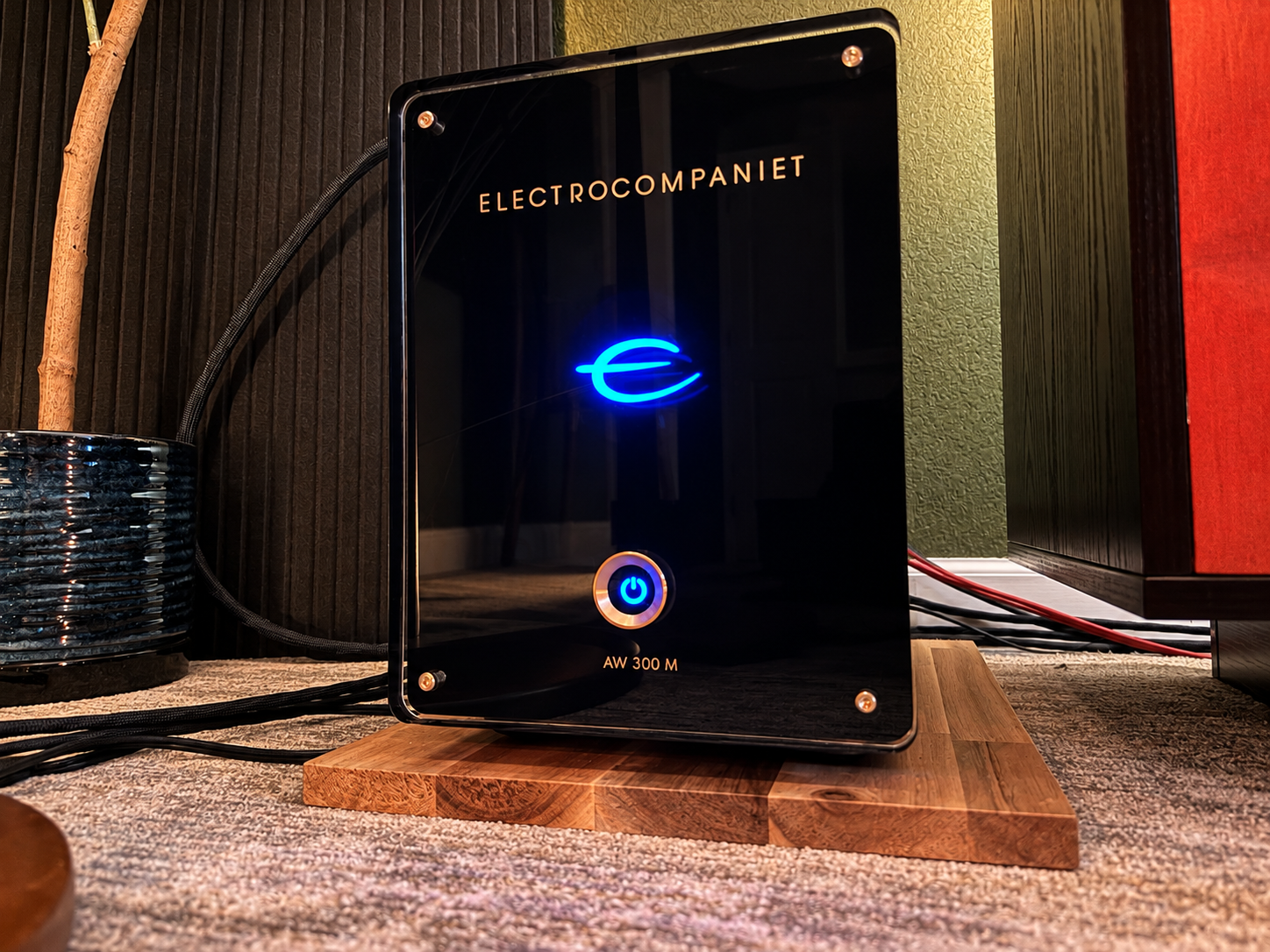
The AW 300 M was introduced as a completely re-engineered mono amplifier, designed from the start as a monoblock rather than a stereo amp switched into mono mode. It borrows technology and design ideas from Electrocompaniet’s much larger flagship AW 800 M, but puts them into a more manageable package.
Each AW 300 M is rated at 300 watts into 8 ohms, 600 watts into 4 ohms and a whopping 1000 watts into 2 ohms.
That last figure tells me something interesting. This isn’t merely an amplifier with an impressive wattage number on paper. It’s designed to keep delivering serious power as speaker impedance drops.
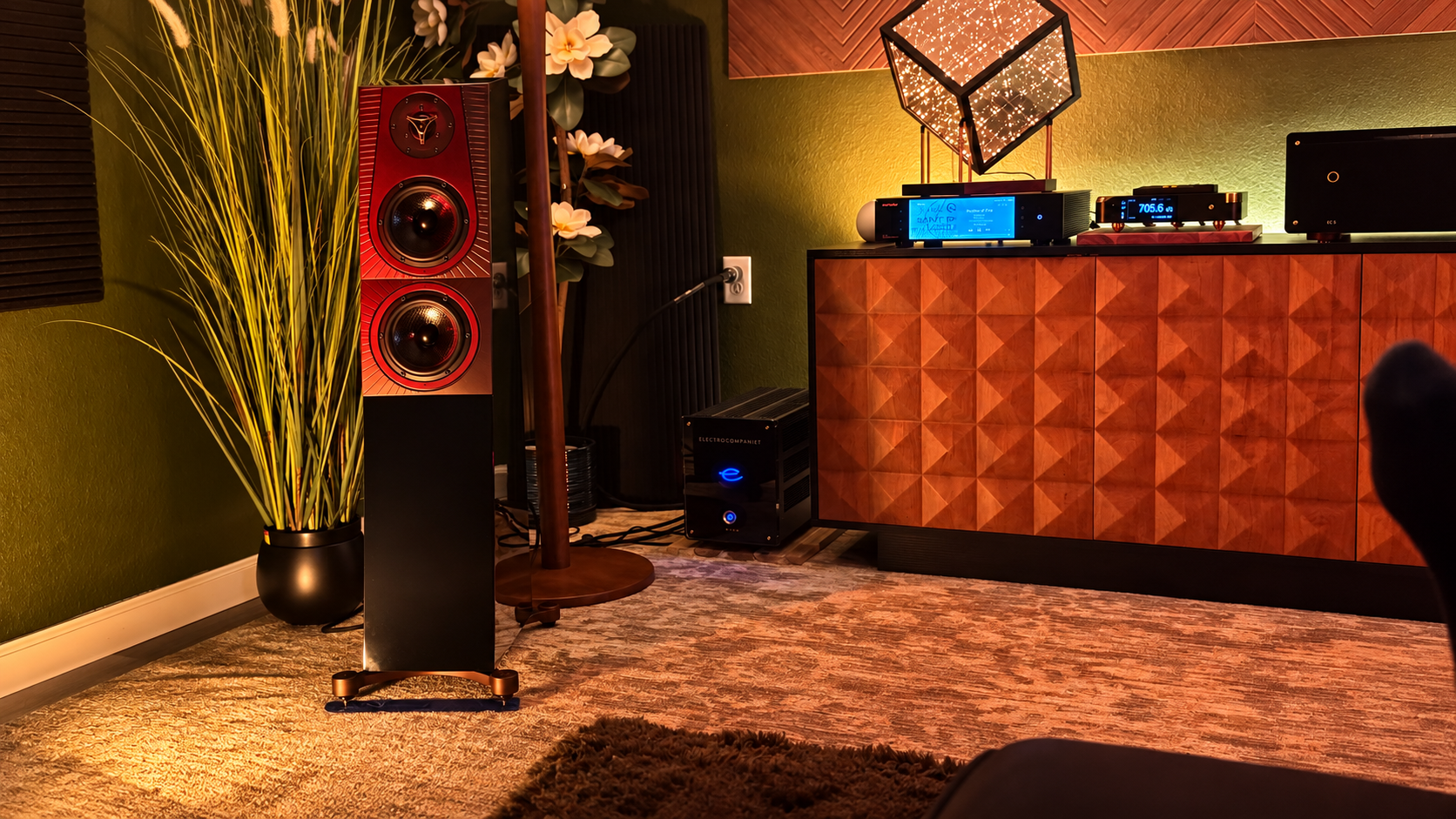
That matters with speakers that present difficult loads. An amplifier can be rated for huge power into 8 ohms yet struggle when a speaker dips into the 2-3 ohm region. Even with easy-to-drive speakers, these amps bring the EC sound in a big way.
Inside each amplifier is an 800 VA transformer feeding a power supply with 110,000 µF of filtering. The mains input is heavily filtered for both DC and RF noise, and Electrocompaniet uses magnetic and electrostatic shielding around the transformer to help keep interference away from the audio circuits. In my setup, I heard no buzz, hum or ground-loop noise.
But yeah, that’s a LOT of power supply for one channel.
The internal grounding system is also substantial, designed to keep rectifier and output currents away from the amplifier’s internal ground reference. The goal is a quieter signal and a stable soundstage, even when the amplifier is working hard.
Electrocompaniet uses its direct-coupled, high open-loop bandwidth topology in the AW 300 M. It’s part of an engineering philosophy the company has refined for decades. The amplifier stages offer very wide bandwidth and a high slew rate, specified at 140 V/µs with the input filter disabled.
The rated frequency response with the normal input filter active is an incredibly wide 0.5 Hz to 220 kHz. Disable that filter and Electrocompaniet rates it from 0.5 Hz all the way out to 1.1 MHz.
No, we humans aren’t hearing anything close to those upper frequencies. That’s not the point. The idea is that the amp can operate comfortably throughout the audible range without approaching the limits of its circuitry.
Electrocompaniet also designed a new output stage to help isolate the input and driver stages from the speaker load. In theory, this allows the amplifier to remain more consistent no matter what speaker is attached. That could also help explain one of the things I hear from these amps.
I also heard these put out the first 10 watts into class A. Very nice.
Massive control. And I mean massive.
The AW 300 M has a specified damping factor of greater than 1000 into 8 ohms. Again, a number on a spec sheet does not tell us how something will sound, but what I hear from these amplifiers in the bass certainly lines up with what I would expect from an amplifier with tremendous control over the drivers.
The bass from these amps is something special. Magical, even, at least compared with anything else I’ve heard.
Electrocompaniet rates THD+N at just 0.0006% and IMD below 0.001%. Signal-to-noise ratio is specified at 120 dB referenced to full power. Input impedance is a very high 330k ohms, while voltage gain through the balanced input is 29 dB.
Each AW 300 M weighs around 66 lbs, so a pair means you are dealing with more than 130 lbs of amplification. They also include protection for DC, overload and excessive temperature.
These are not Class D power amps hiding inside giant boxes. They’re substantial linear amplifiers with large transformers, capacitor banks, serious output stages and extensive heat sinking. I’ve enjoyed plenty of Class D amps over the last few years, but the 300-watt models I’ve heard sound nothing like the AW 300 M. In direct comparisons, those amps sounded leaner to me, with less richness, texture and soundstage scale. As good as some of them are, none were close to what the AW300 M has brought here.
The AW 300 M chassis has also been redesigned compared with older Electrocompaniet amplifiers. The construction is modular and extremely solid, while retaining that unmistakable EC look. Hidden buttons underneath let you turn off the display and enable or disable sleep mode. There are also 12V triggers; when connected to the EC 5, the preamp can turn the amps on and off. I tested this, and everything worked as advertised.
They even use Soundcare SuperSpikes underneath the amplifiers, giving you the benefit of a spike-type mechanical interface without damaging your rack or floor. Superb feet.
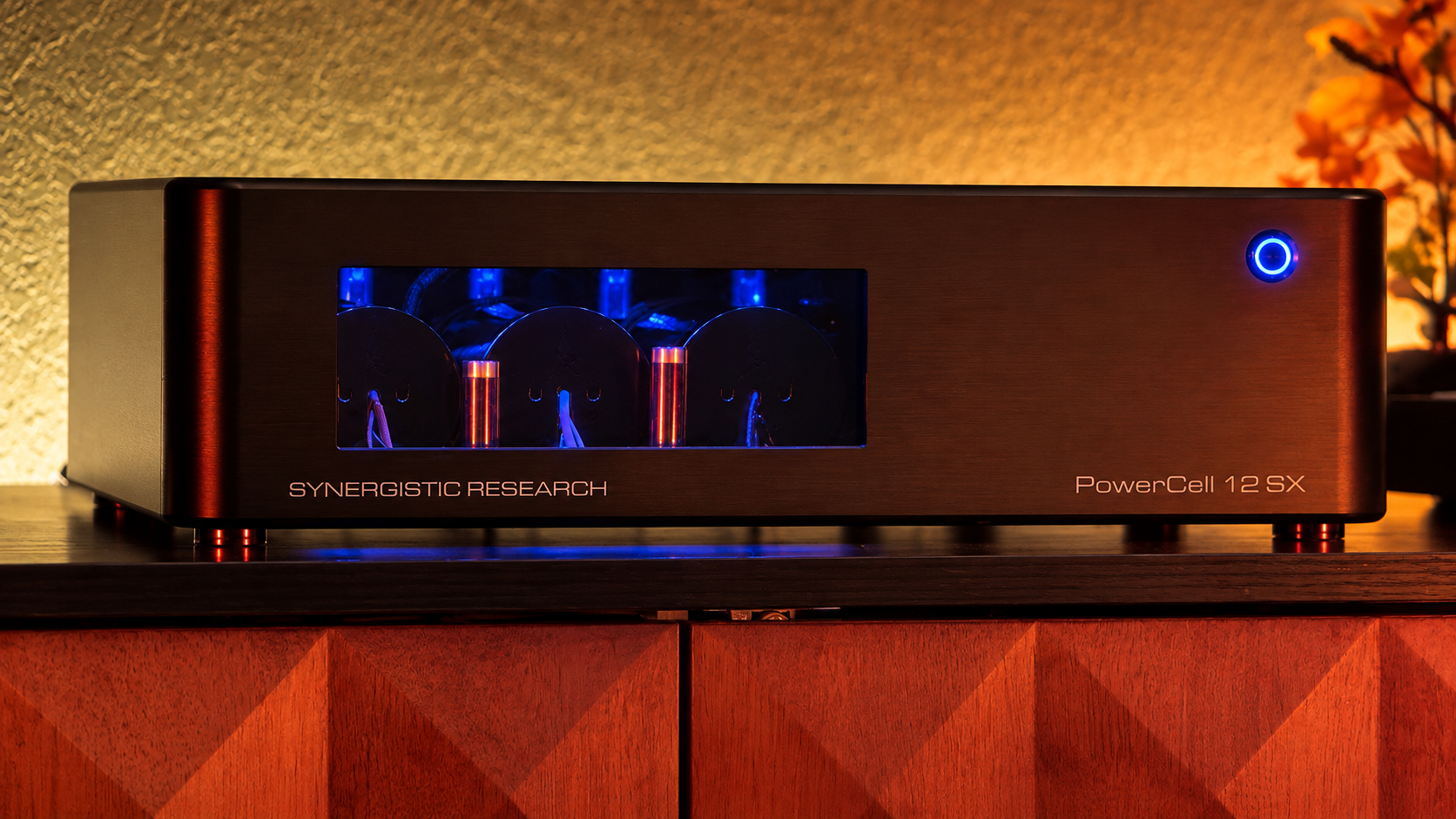
My Synergistic Research Powercell SX12
So why $30k?
I can’t tell anyone that any amplifier should cost $30,000. Value is personal. Heck, some out there cover million dollar amplifiers so this is chump change in comparison to that.
What I can say is that when you open the door into this level of engineering, you are no longer paying simply for “300 watts.”
You’re paying for two completely independent amplifiers. Two massive transformers. Two huge power supplies. The ability to deliver rated power down into very low impedances. Very low distortion. Very wide bandwidth. Heavy construction. Norwegian production. And, hopefully, the sound.
For me the sound is what makes all of this worth talking about.
I love my Helios and with the Fundamental Sub that have gotten much better
The EC 5 Specs and Features. Why $25,500?
If the AW 300 M is about brute force and control, the EC 5 is actually the more fascinating piece technically.
Electrocompaniet says development of the EC 5 stretches back about ten years. I wondered how a preamp could take that long to develop. A big part of the answer appears to be the volume control, and this is the first such system that has seriously impressed me. Manufacturers often hype volume-control designs, but here I can hear and appreciate the difference, particularly in the precision of the adjustment.
Most preamps use some form of potentiometer, stepped attenuator or relay-controlled resistor network to adjust volume. Electrocompaniet wanted something different. They wanted the volume control to become part of their amplifier circuit itself.
The EC 5 uses Electrocompaniet’s proprietary AmpliWire topology. This design philosophy goes back almost as far as the company itself and originated from work aimed at eliminating the transient distortion problems that plagued many amplifiers decades ago.
Rather than relying on huge amounts of global negative feedback, the AmpliWire concept divides the amplifier into different sections and uses a short feedback loop around the output stage. The idea is to keep the stages linear, extremely wide in bandwidth and very fast while still maintaining very low distortion.
For the EC 5, Electrocompaniet wanted to integrate the volume control directly into that topology instead of putting a conventional volume control in front of it. This is where things get very interesting.
The EC 5 uses electronic MOSFET switches to select resistors within the volume-control circuit. There are no conventional mechanical switches or relays changing the level in the audio signal path.
More importantly, the signal path stays a fixed length regardless of the volume setting. There are 1000 individual volume steps. The overall adjustment range goes from around -100 dB all the way to +20 dB, and between -73 dB and +20 dB the EC 5 adjusts volume in extremely fine 0.1 dB steps.
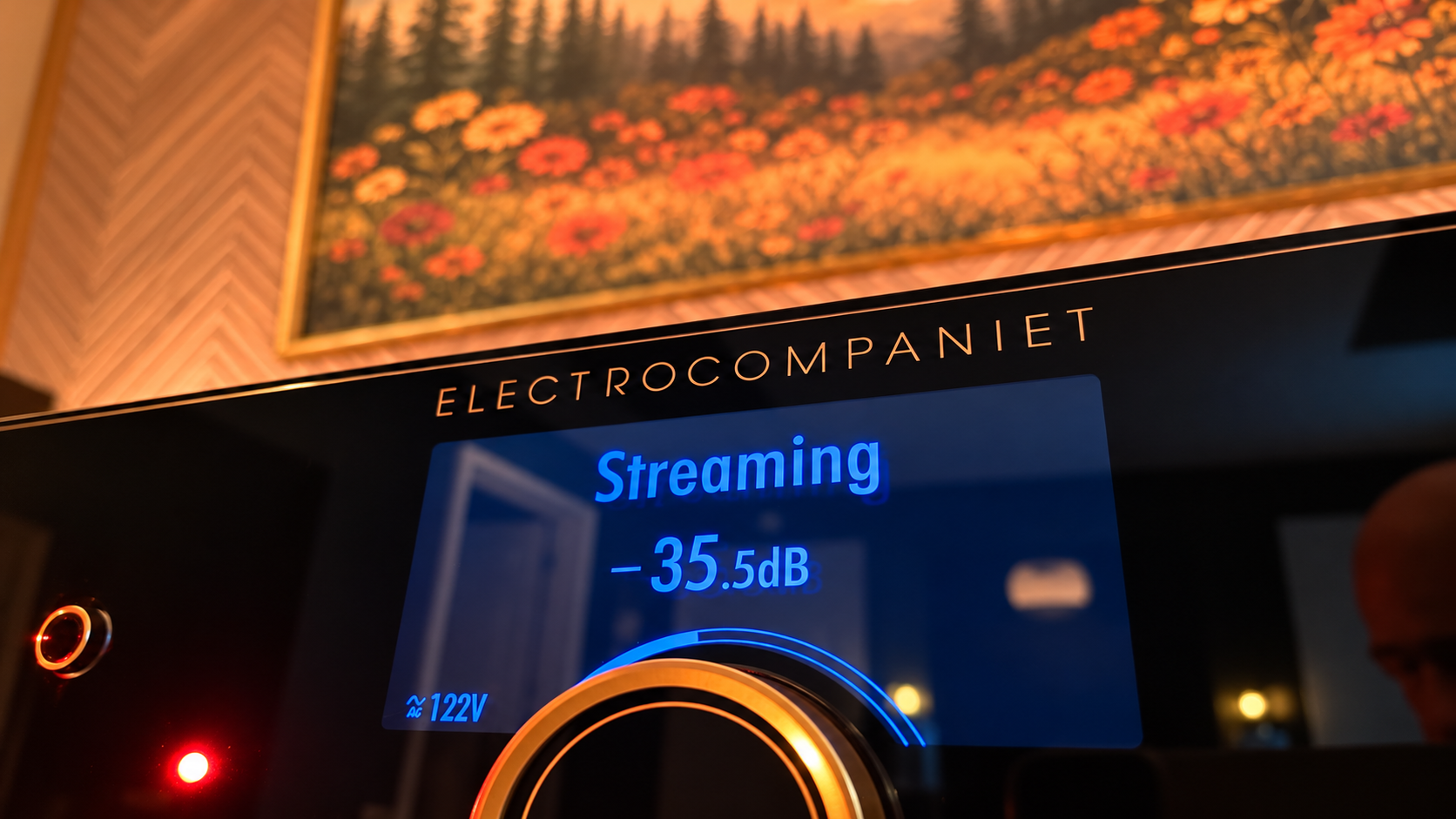
That is insane resolution. This is not just some gimmick added so they could advertise 1000 volume positions.
One issue with a conventional analog volume pot is that channel tracking can become less accurate at very low settings. One channel may be slightly louder than the other, shifting the center image and reducing its solidity.
The EC 5 was engineered to avoid this. With no conventional mechanical volume contacts to wear or become scratchy, it’s also designed for consistent, click-free operation over time.
That may explain something I noticed before reading about how the volume control works: this preamp sounds incredible at low volume. I can turn the system WAY down late at night and the center image stays locked in place. The soundstage, bass and body remain convincing. That has become one of my favorite things about the EC 5. I’ve shared quite a few low-volume listening sessions in my Instagram Stories at @hifihuffofficial.
The rest of the preamp is equally serious.
The EC 5 is a fully discrete, true dual-mono design. The left and right channels have their own circuitry and independent power supplies, each with an 80 VA toroidal transformer. That’s right, my friends: two transformers just for the preamp’s audio circuitry. Each channel also has 15,000 µF of storage capacity, along with three stages of noise filtering and regulation.
Remember, this is a preamp and it isn’t driving speakers.
Yet Electrocompaniet has built a power supply into the EC 5 that looks more like what one might expect to see inside a small power amplifier. The audio circuitry operates in pure Class A from input to output, and the design is direct-coupled with no capacitors in the audio signal path.
The output stage is deliberately overbuilt so it can comfortably drive long interconnects and challenging amplifier input loads. It uses an auto-bias circuit to maintain the correct Class A operating current regardless of temperature, signal or how long the unit has been on. It seems Electrocompaniet considered just about everything in making this a destination preamp.
Output impedance is an extremely low 22 ohms, while balanced input impedance is 47k ohms. Maximum gain is 20 dB. Frequency response is rated from 0.5 Hz to 450 kHz. Signal-to-noise ratio is 113 dB, channel separation exceeds 120 dB, and THD+N is rated at just 0.0002%. Maximum input and output voltage are both 10 Vrms.
As always, numbers alone don’t tell me whether I’m going to enjoy the music. They do show just how seriously Electrocompaniet approached the engineering. I also appreciate the physical separation of the analog audio circuits from the control electronics.
A horizontal steel plate divides the chassis internally. The analog electronics occupy their own shielded section, separated from the control circuitry and transformers. Communication between these areas is handled optically or through a floating barrier, helping prevent electrical noise from the controls from entering the analog section. That’s pretty extreme.
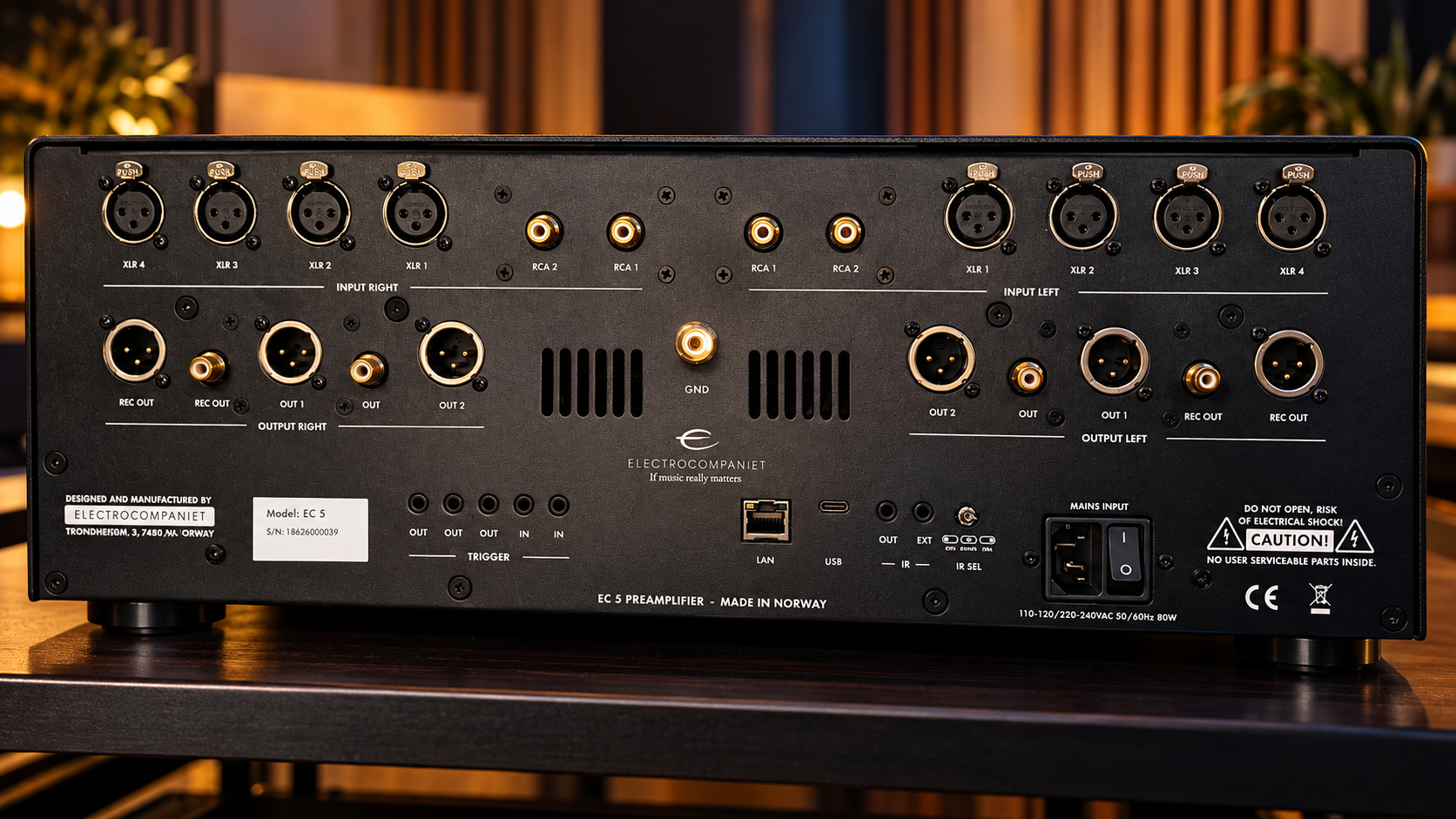
The EC 5 has four balanced XLR stereo inputs along with two RCA inputs. It offers two balanced XLR output pairs, a single-ended RCA output, and fixed record outputs. There is Ethernet on the rear, but remember, this is not a streamer and there is no DAC inside. Ethernet is there for control, firmware updates and communication with the EC Play app.
There is also a USB connection, but that USB port is not a digital audio input. It is there for service and software purposes.
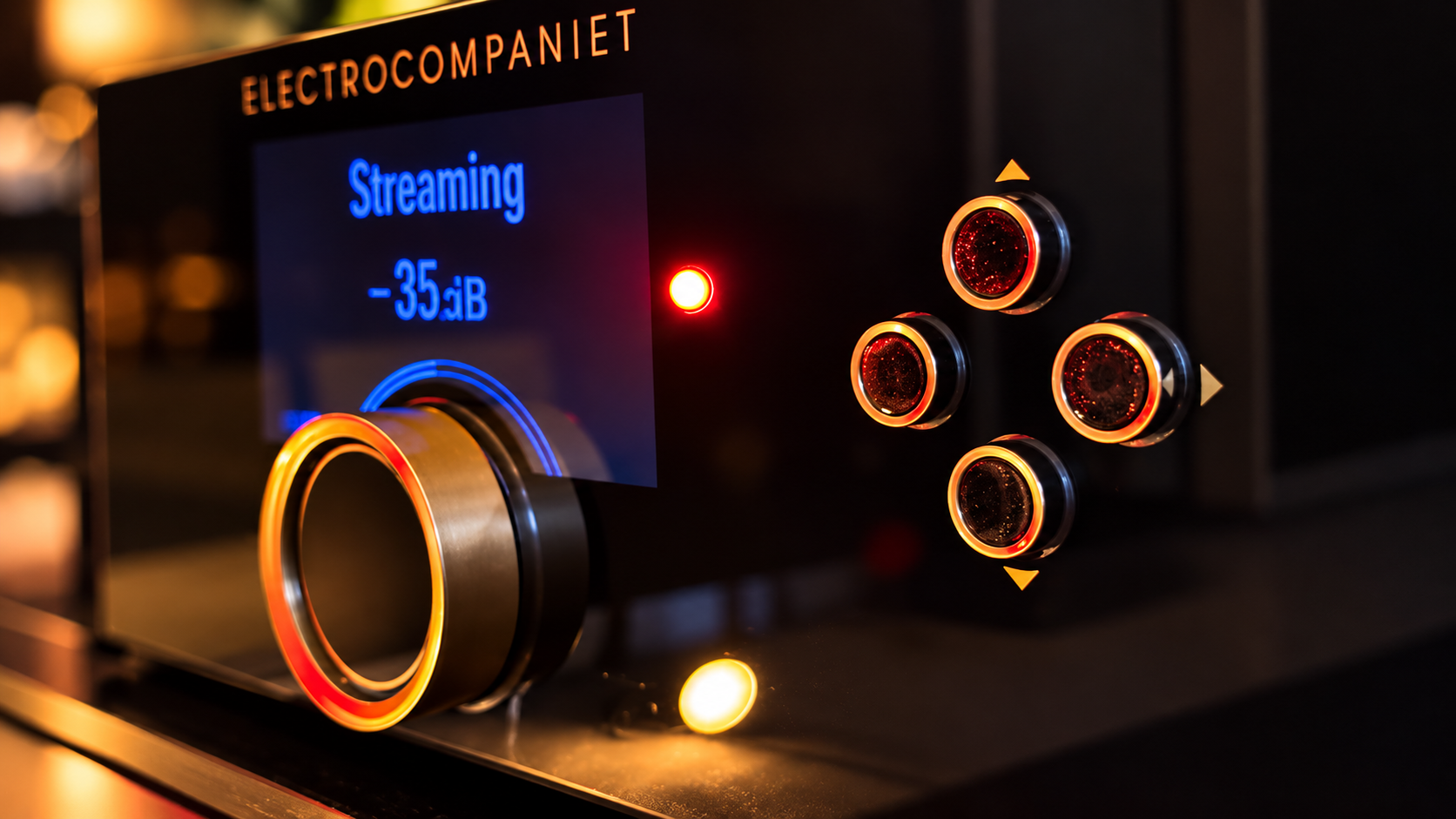
The front display is a large 7-inch IPS color display, and through the EC Play app you can rename inputs, adjust balance, apply source level trims, set a maximum volume level, control the display and check firmware.
While there are digital control electronics inside the EC 5, the audio signal path itself remains purely analog. The EC 5 measures 18.5 inches wide, 7.5 inches high and 16.5 inches deep. Electrocompaniet lists its weight as 26 kg, or approximately 57 lbs. Interestingly, one of the company’s published specifications converts that to almost 80 lbs! Having lifted this beast myself, 57 lbs sounds much more accurate.
The EC 5 also consumes about 80 watts while powered on with no signal, which gives you an idea of how substantial its dual-mono Class A circuitry is. There’s also an unusually long startup sequence.
First, the EC 5 checks the incoming AC mains voltage. The main power supplies then come up and stabilize for roughly a minute. After that, the analog circuits get another minute to warm up before the outputs engage. So yes, you really do wait more than two minutes for a solid-state preamp to turn on.
I actually like it. It feels like starting up a serious piece of machinery.
So why $25,500?
Again, nobody needs a $25k preamp. There are fantastic options for far less, including the brand’s own well-regarded EC 4.8 MKII. Still, the EC 5 is clearly much more than a basic line stage in a fancy box.
\
Electrocompaniet spent roughly a decade developing the EC 5, with particular attention to its volume-control system. It also features a discrete dual-mono Class A analog design, independent transformers and power supplies for each channel, an overbuilt output stage, isolation between analog and control electronics, and construction that borders on obsessive.
Whether that is worth $25,500 is up to the buyer. What matters to me is whether any of that translates to the experience.
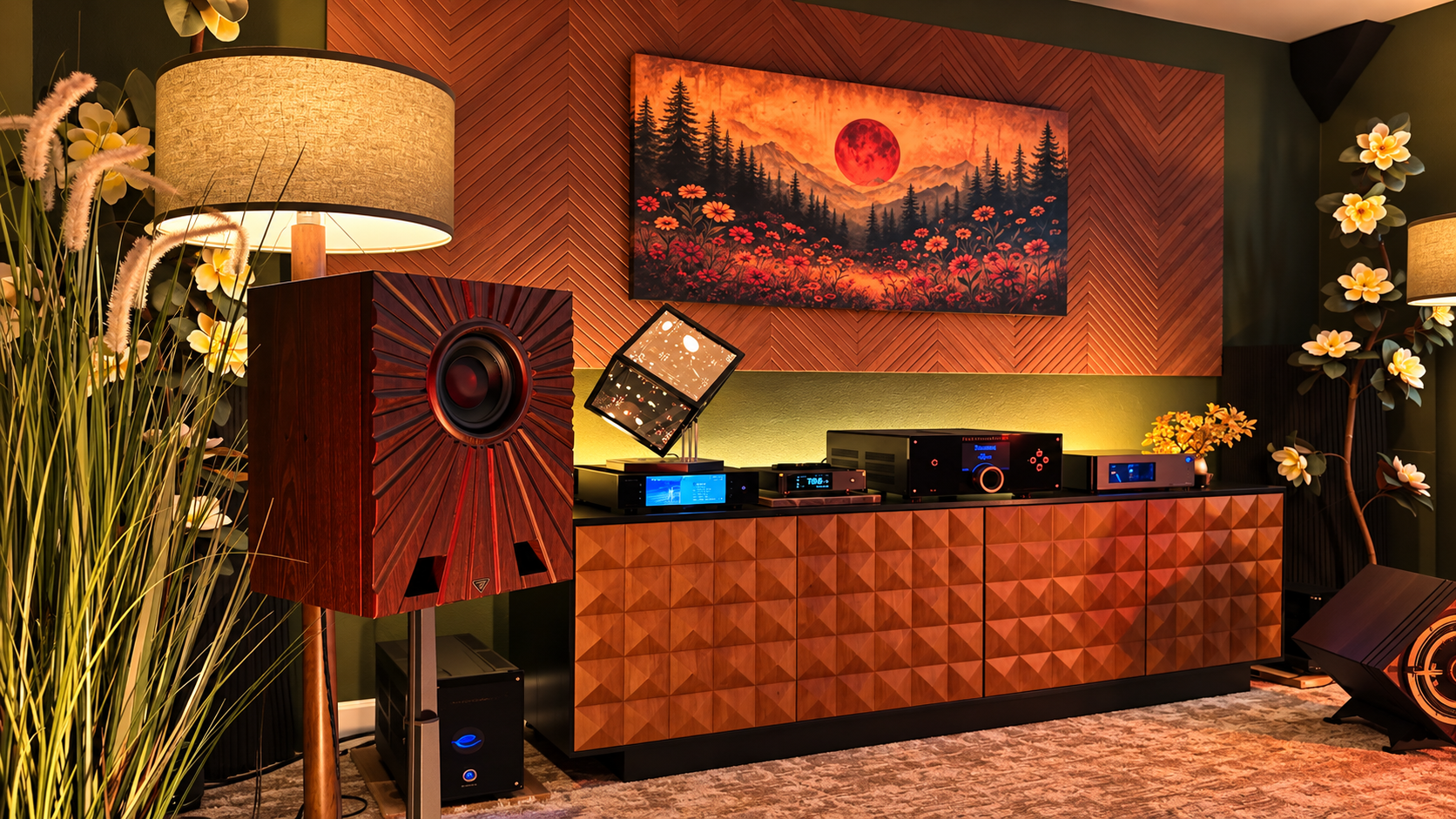
The Experience
The system arrived by freight, given its weight and the risk of having such expensive, heavy equipment knocked around in ordinary shipping.
The review units came in substantial flight cases, so everything was incredibly well protected.
These are not the cases in which the amps normally ship to customers. Review units travel around the country, and the cases help protect them along the way. As I opened the preamp case, I was immediately struck by the EC 5’s size, mass and clean lines.
Knowing this was the flagship preamp, and how much development went into it, I expected something special. Boy oh boy, it delivers on first impressions.
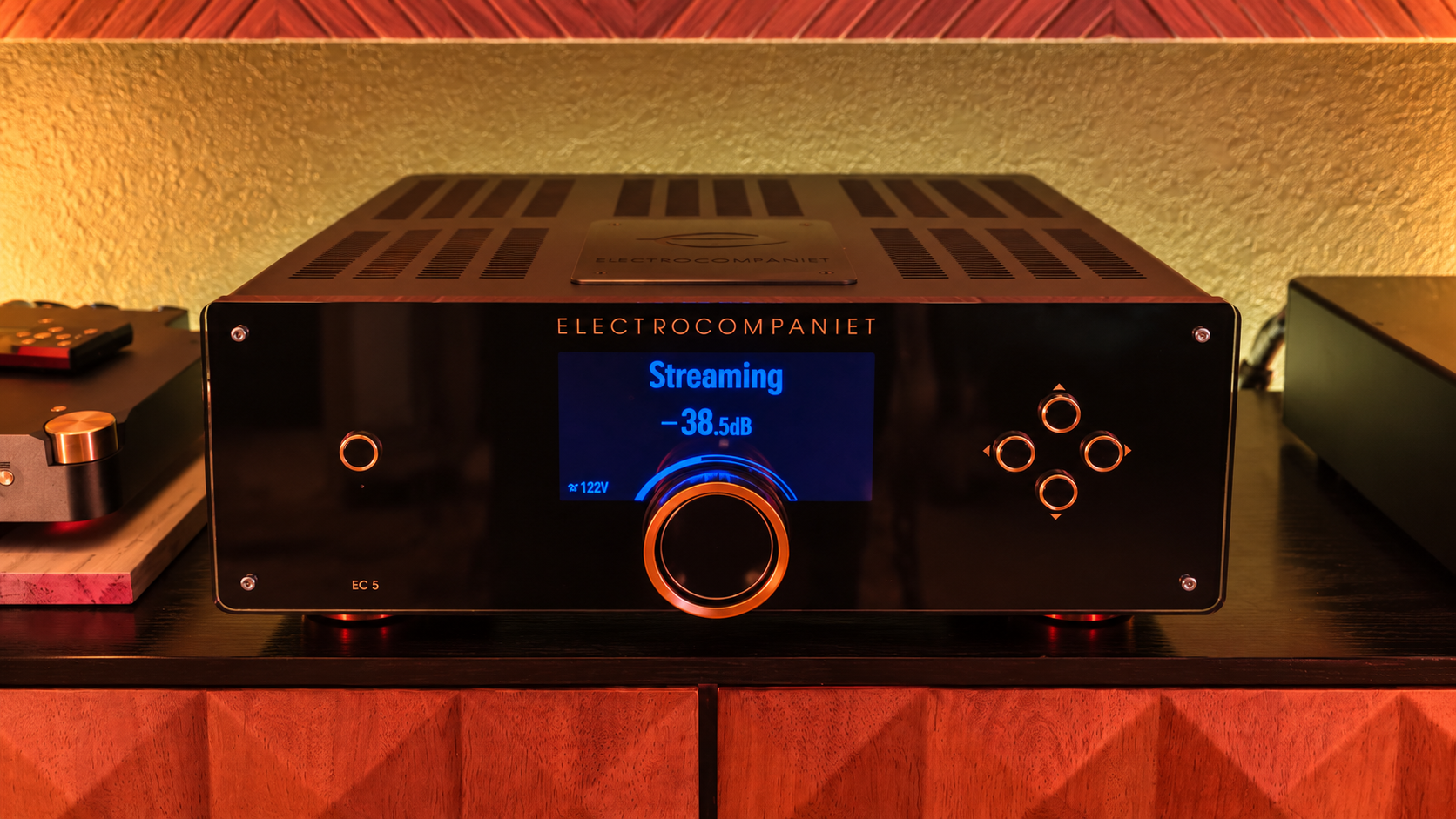
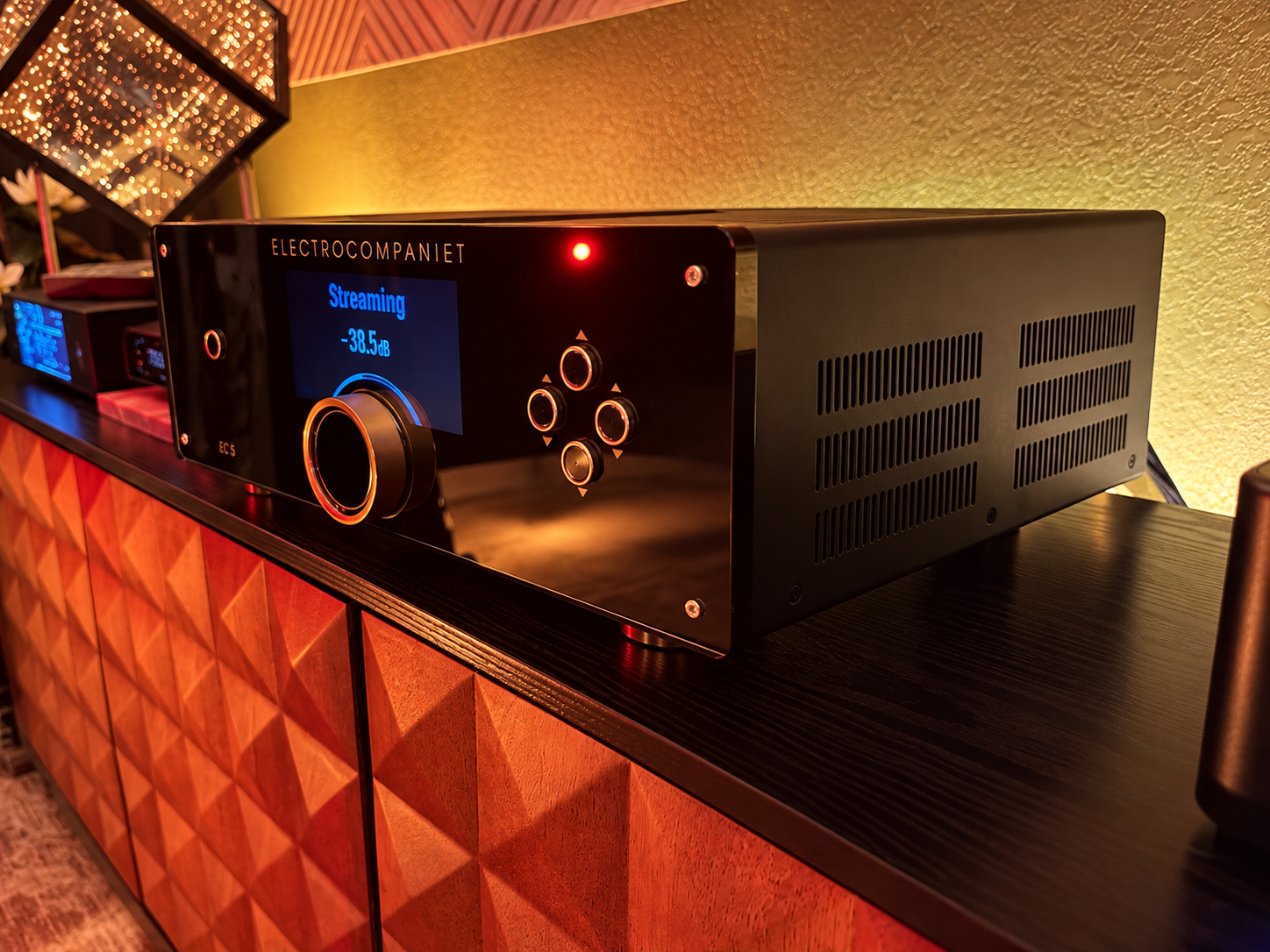
The EC 5 is a fully analog preamplifier in terms of its audio signal path. The front panel uses the classic thick Perspex that Electrocompaniet has been known for over the years.
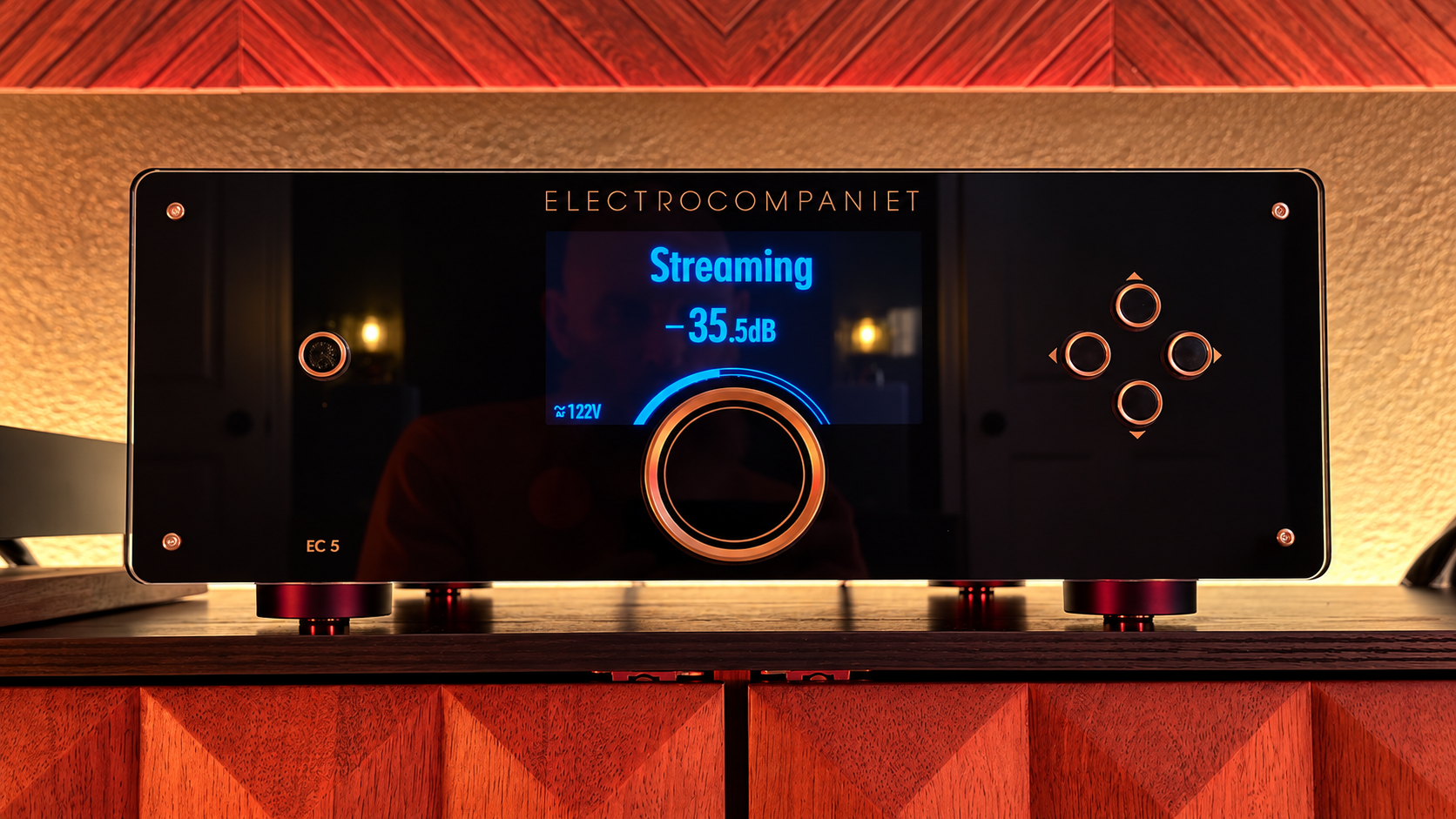
The EC 5 adds four large solid-feeling buttons on the right for input selection. The big volume wheel up front uses a ball-bearing mechanism and is smooth as silk. It feels weighted, substantial and expensive. There is a power button on the front left, and the large display is easy to read and dimmable.
With the EC Play app, you can rename inputs, check firmware updates, set maximum volume limits and adjust other settings over Ethernet. The app found my EC 5 immediately and confirmed that its firmware was up to date. I renamed XLR Input 1 to “Streaming,” which now appears in electric blue across that large display. A very polished experience.
Because it’s a pure Class A preamplifier, the EC 5 runs warm, although I would never call it hot. Running it with both monoblocks can raise my room temperature a degree or two, but none of the units feels alarmingly hot to the touch.
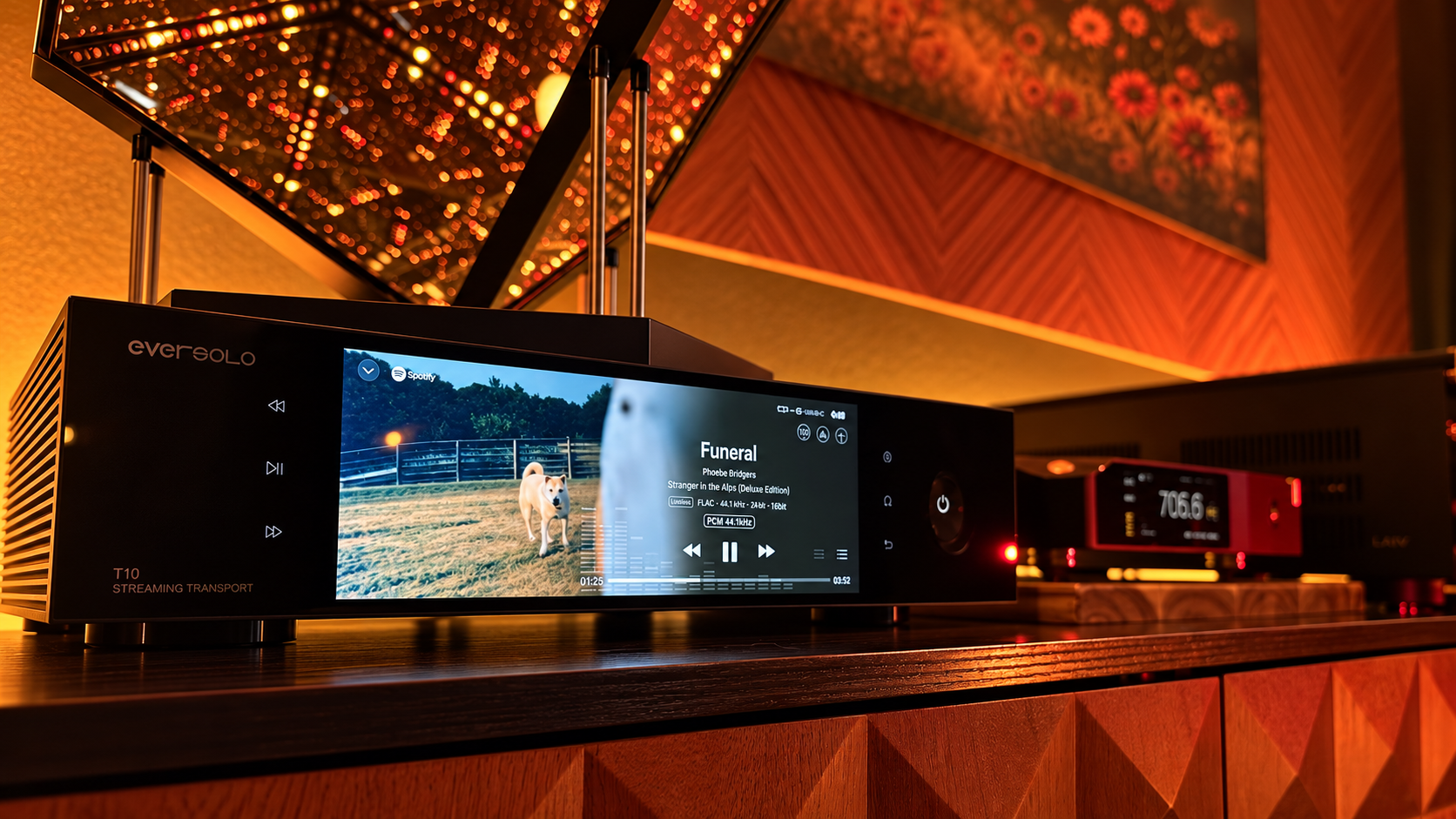
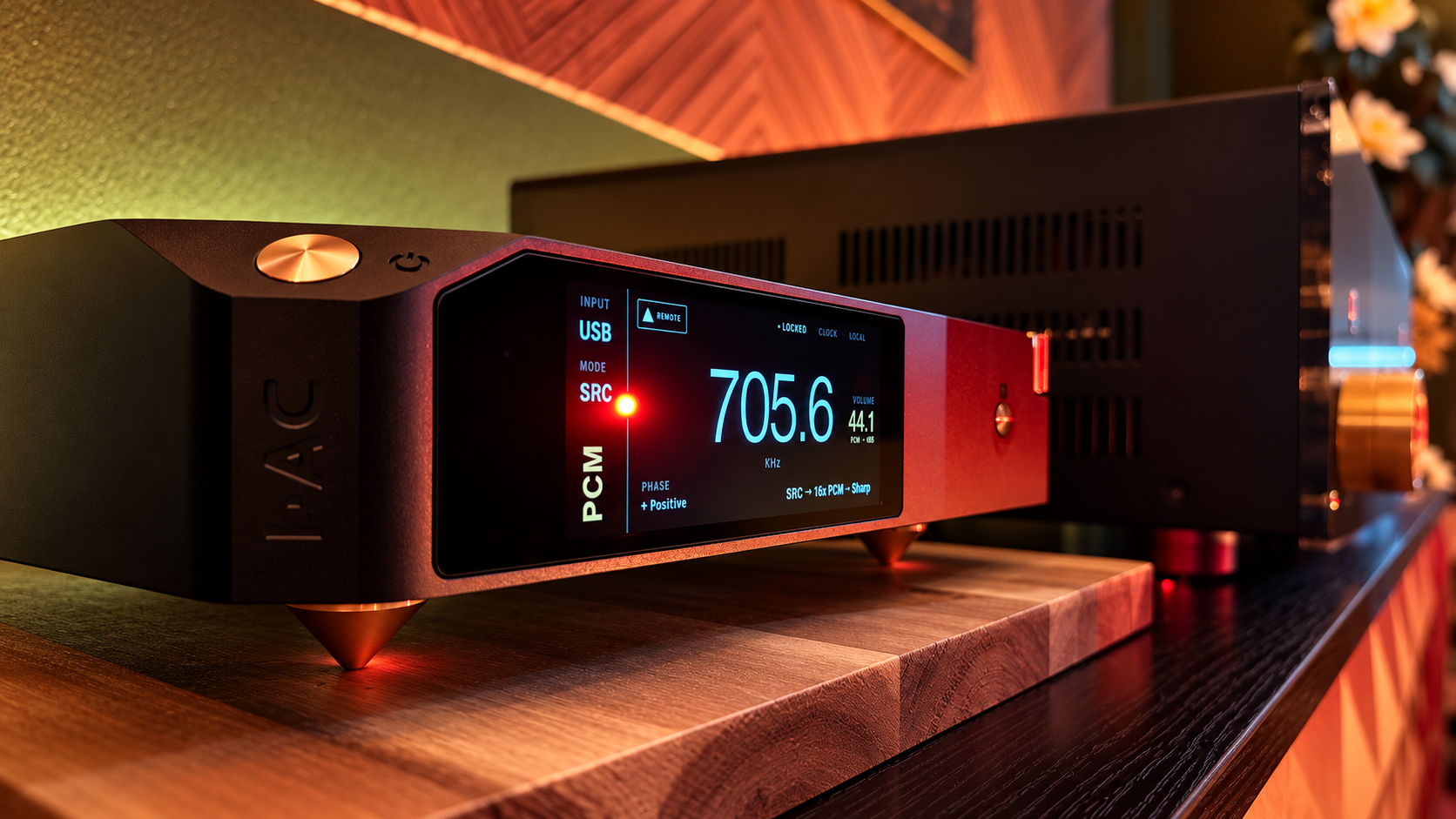
I connected an Eversolo T10 transport and the new DAC I’m loving right now, the LAIV Harmony 2, to one of the EC 5’s XLR inputs. The AW 300 M monoblocks were connected with my Synergistic Research Foundation XL cables, and I started with the Fleetwood Sound Helios speakers and Fundamental subwoofer.
And away I went… into the seemingly endless soundstage of this system.
The Sound
Think deep and guttural when the recording calls for it.
Think old-school richness combined with modern imaging and holographic presentation.
Think impact, balls and drive, but with warmth and life at the same time.
Think incredible imaging within a layered soundstage
Think CONNECTION
It is incredibly hard to describe this sort of “velvet hammer” sound but I will try.
The amps are fast and clean, with extended treble that never strikes me as sharp or hard. Instead, it’s sweet. They (the EC5 and AW300M) aren’t analytical, but they bring extraordinary upper-bass and lower-midrange performance: subtle heft, foundation, deep body and a big analog vibe to instruments and voices. The presentation can be a little laid-back, yet there is plenty of transparency. I first fell for this character in the ECI 6 DX MKII, but here everything is bigger, quieter, more dynamic and more impactful. With the EC 5 driving them, music seems to expand, glow and breathe naturally. Nothing feels artificial.
When turned up loud to ear blistering levels, the sound gets richer, bigger and again, never gets sharp or hard.
If you seek the absolute sharpest attack, the last word in speed and transparency, or a leaner, more analytical presentation, these may not be for you.
For my tastes, this setup delivers world-class soundstage depth, surreal spatial performance and a solidity I rarely hear. There are no holes in the soundstage, and I certainly never found myself asking, “Where’s the beef?”
One of the most striking things about the EC 5 is how well the music holds together at low levels. I mentioned this earlier, but it deserves repeating: the image stays focused and the music retains its richness, body and bass without needing a loudness button or bass boost. For someone who listens late at night, that’s a huge benefit.
Understanding the EC 5’s unusual 1,000-step volume system helped explain why I was hearing this.
I heard some of that signature Electrocompaniet richness in the ECI 6 DX MKII integrated amplifier, but this combination takes it much further. It’s more refined, effortless, deep and layered.
And, well… Magical. Yea, I said it.
The Speakers
I tested the Electrocompaniet setup with three very different speakers: the SV Audio Gro, Fleetwood Sound Helios and Yzabel Audio Classic 1.

SV Audio Gro
With the SV Audio Gro… what can I say? This became my dream system. That’s simply how it is.
The Gro already reach into the 30 Hz region for the bass, but I’d never heard them sound this deep, impactful and huge in scale while retaining such a solid foundation. Their bass performance with the Electrocompaniet setup is the best I’ve experienced from them. Full stop.
Vocals are rich, startlingly real and right there in the room. Layers and depth with body and soul.
The presentation is holographic and slightly airy up top, yet dense and physical through the lower mids and deep bass, with tremendous punch. Kick drums can sound almost life-sized, especially with the Fundamental added. Live recordings make you feel like you’re there with the large scale of sound. Nothing about it is clinical; it’s silky and velvet-like while maintaining superb resolution.
This is, without question, the all out most incredible system I have ever had in any of my rooms.
For a mid-sized room, this is a world-class high-end setup.
Fleetwood Sound Helios
The Helios have always had one weakness for me: deep bass. With the EC setup, they came alive with more bass than I’d ever heard from them. Suddenly they were warmer, fuller and weightier, yet retained that projected soundstage. Compared with the Luxman L-100 Centennial, I lost a little of the all-out openness and clinical precision, but gained body, glow and oomph. Which was better? I can’t say. It depends on the music.
With the Fleetwood Fundamental sub connected through its high-level inputs, I could hardly ask for more: an immersive, weighty presentation with terrific resolution, dynamics and punch. The vocals were velvet-smooth, and the midrange was among the sweetest I’ve heard from solid state. Palpable, lifelike, rich and full of soul. It could also sound somewhat relaxed, depending on the track.
These can’t compete with the SV Gro and EC setup but they offer their own vibe of naturalness, realness and warmth. Both sound at home with the EC 5 and AW 300 M, as though they’ve finally found the right partners. I’ve heard these speakers with so many amplifiers, but never quite like this. They do sound warmer with the AW300 and EC5 than even the Accuphase.
I love the Accuphase E-3000 and Luxman L-100 Centennial, and I think the Benchmark AHB2 and LA4 combination is awesome. None quite matches the EC setup for my tastes. Of course, these aren’t fair price comparisons; the other components cost substantially less and are absolutely top tier at their respective prices. The EC combination costs tens of thousands more. It had better sound incredible! To my ears, it does.
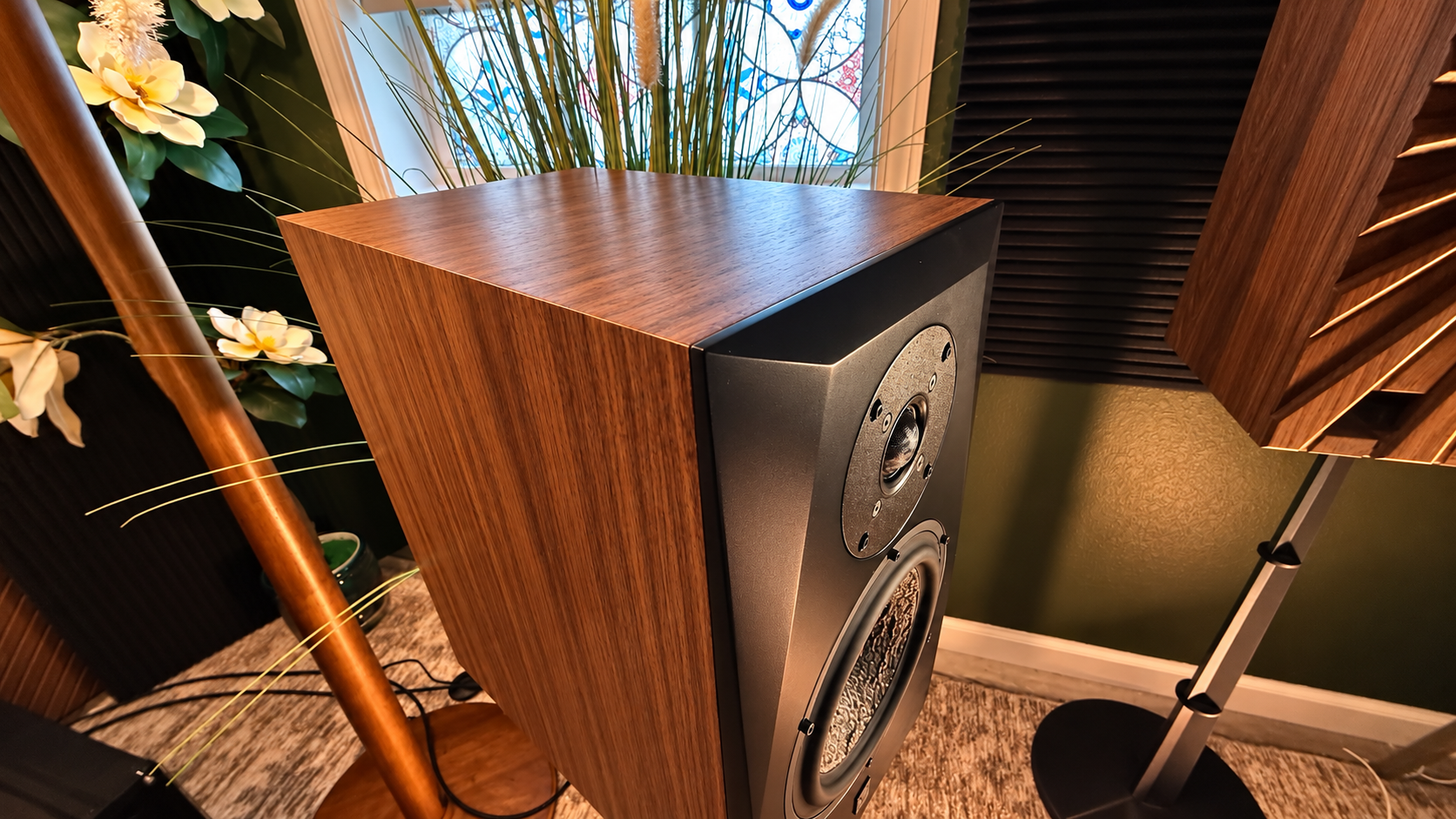
Yzabel Audio Classic 1
These $3,300 USD speakers have an addictive quality and sound far more expensive than they are. Built and shipped from Canada, the Yzabel Classic 1 sounded huge with the EC gear. I heard the same EC traits of body, bass and weight, paired with the speakers’ beautifully even midrange and treble. Voices and instruments had lifelike scale and emotion.
I certainly wouldn’t normally suggest pairing a $55k electronics system with $3,300 speakers. I tried it because I had them here and wanted to hear how much the electronics could elevate them. This was the best I’d heard them. And let me back up: if I owned the EC set with these speakers in my current room, I wouldn’t exactly be rushing out to buy more expensive boxes.
Conclusion
This review is getting long, so I’ll wrap it up. I’ve loved the Electrocompaniet sound since hearing its more affordable integrated sibling, the ECI 6 DX MKII. This setup, though, is better in a big way, as it should be for the cost.
This experience with my SV Audio Gro speakers has convinced me that the EC 5 and AW 300 M are something very special. For those who can afford them and want to build a world-class system that prioritizes emotion over an analytical presentation, they deliver. They bring the weight and feel of real music, and I’ve never heard bass performance quite like this. Read other reviews of the AW 800 M and AW 300 M and you’ll see how often the bass comes up. For me, it can make familiar music feel new again.
This isn’t an ultra-airy, ultra hyper-clean sound. Rather than looking through crystalline glass on a sunny day, imagine sitting outside on a spring morning: dew on the grass, moisture in the air, a touch of humidity, birds singing all around and a cool breeze. That’s closer to the feeling these give me.
The EC 5 is, without question, the finest preamp I’ve heard. To be fair, I haven’t hosted many truly exotic preamps. The Pass Labs XP-22 was more neutral and open, with less bass impact but a sweeter, airier top end. The EC 5 feels made for the AW 300 M and AW 800 M amps, of course, but it also sounds great with other amplification. I tried it with the Benchmark AHB2 and the Accuphase E-3000’s power-amp input, and it brought a welcome sense of refinement and richness to both. The volume control is on another level, and the remote is substantial, too. No cheap plastic here.
The AW 300 M? What can I say? To me, these are masterpieces of monoblock design. Even the powerful Class D monoblocks I’ve used sounded a bit lightweight in comparison. The EC sound has real authority, yet it’s the emotional connection that keeps pulling me in. I’ve never heard the older NEMO amps, although I’ve been told this new generation improves on them. I can’t verify that comparison. What I can say is that I’m listening as I write, and the music keeps interrupting me. I’ve experienced systems costing several times more than this EC setup, yet I prefer this one’s impact, dynamic power, immersion and emotional pull. Damn.
I have been trying my best to go smaller but these make that real hard.
If this sounds like your kind of system, audition these pieces at a local dealer if you can. You can learn more at the Electrocompaniet website.
Both the EC5 and AW300M represent the best I have heard. End game, destination kind of stuff. They both win my Gold Award.

UPDATE after the Review: Yeah, these are now staying here as my new room reference. The EC 5 and AW 300 M will join my longtime favorites like the SV Gro and Helios, both my end game as well. I already have the speakers to make the most of these audio instruments from Electrocompaniet, I can get an industry discount (review units), and they produce exactly the sound I crave. They have the power to handle just about any speaker I might bring in, yet they sound human rather than artificial. Complete. Nothing missing. Norwegian-made gear from an independent, legendary brand. See how I’m talking myself into it? Lol. Grab a listen if you can!