
The Fuji GF670 Medium Format Film Camera Review
By Steve Huff
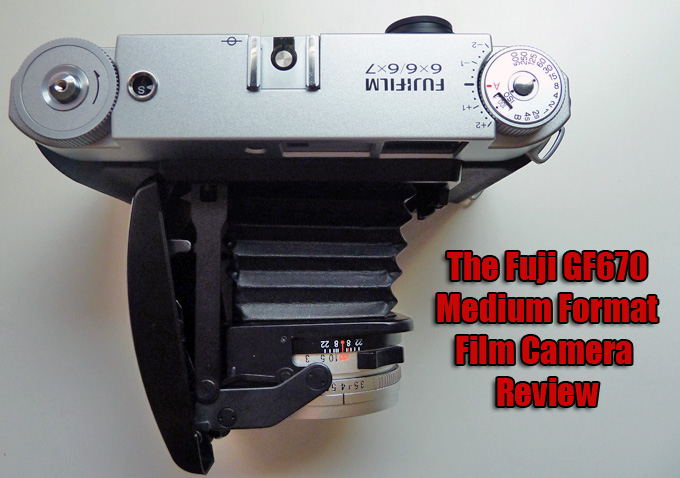
Wow, I am on a roll! Three reviews THIS WEEK alone! Holy cow. I am waiting for that moment where I get writers block and I sit in front of my screen for hours while writing one sentence. It has not happened yet and that is probably because I am so nutty passionate about photography and I LOVE trying out new gear just to see what is out there and available. I may not be able to buy it all, but at least I can find out what is cool and worthwhile. One camera that caught my eye a few months ago was the Voigtlander Bessa III folding medium format rangefinder camera. I saw it online and found out it took 120 film (medium format/larger negatives/better quality) and it allowed you to shoot in either 6X6 square format or 6X7 for even more negative real estate.
Yes, this is film and yes it is medium format. But that doesn’t mean it is a big, clunky and heavy camera. Nope, this one is actually pretty sleek and designed to be easy to carry around with you wherever you go. The Voigtlander model comes in black but for those who like silver you can also buy a Fuji version, which does indeed come in silver! That model is the Fuji GF670.
The big BAD ASS Fuji GF670 – 6X6 or 6X7 with a flick of the switch
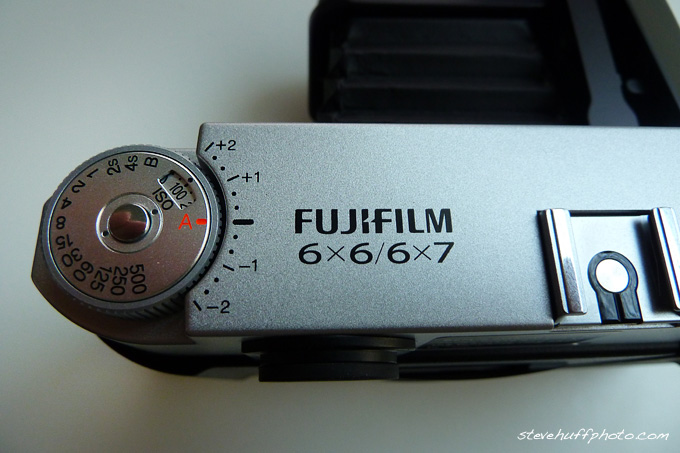
*This review will be on the Fuji version of the camera.
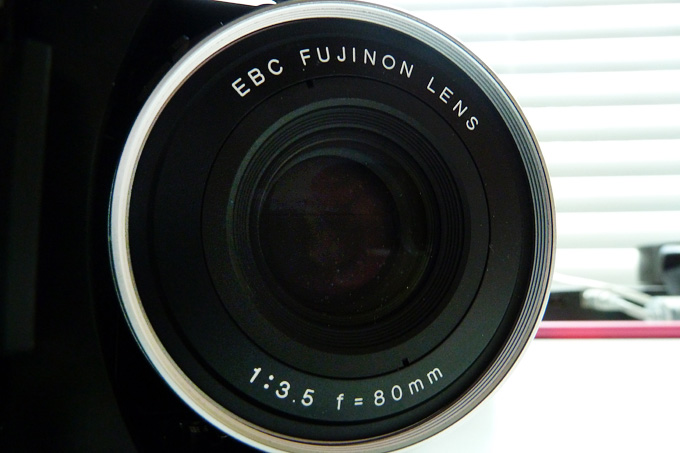
The Fuji GF670 comes with a built in 80mm lens that folds out of the camera, just like the old Voigtlander Bessa II. When I first saw an image of the camera I thought it looked like a normal 35mm rangefinder on steroids!
After reading about it and thinking how cool it would be to shoot one, I ended up forgetting about it for a few months. Then one day I spoke with my contact at B&H Photo and realized they had the Fuji and Voigtlander version of this camera. As already stated, the Fuji version is actually the same camera but is silver and marked with a lens that says “Fujinon” instead of “Heliar”. From what I understand and after doing some digging I found out that these cameras are the same, made in the same factory and of the same quality. They are made by Cosina in Japan. What is interesting is the Voigtlander version is $2299 and the Fuji is $1899. A savings of $400 if you pick up the Fuji. $1899 is quite a bit for a new (non Leica) film camera but again, this is Medium Format and it’s a somewhat portable, take anywhere camera. PLUS, it is MEDIUM FORMAT!
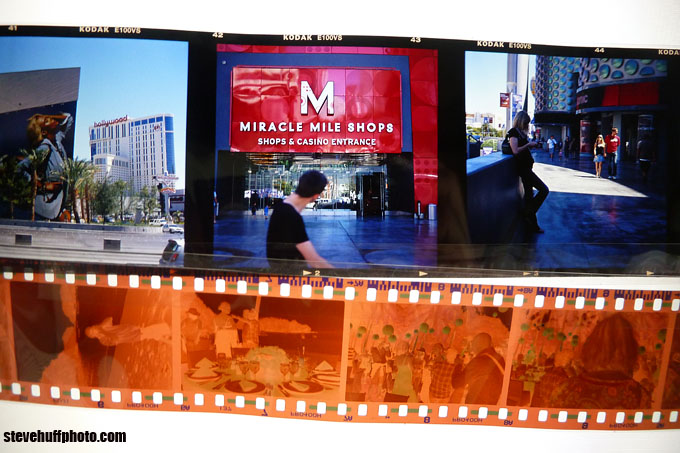
For those that do not know, Medium Format film gives you a much larger negative than 35mm. Because of this, you get less grain, better tonality, and better details. The files are richer, much like they are with medium format digital. But this is film and with digital MF kits running between $20 and $40k, it almost makes this GF670 look like a bargain. So I wanted to try one out once and for all and see what it was all about.
TOP – Medium Format Ektachrome slide film – BOTTOM – Standard 35mm film negatives – You can see the size difference between the two formats with Medium Format providing a much larger negative.
I asked B&H Photo to send me one to check out and when it arrived I was actually quite surprised with the build quality which seemed to be pretty good. No, this was no Leica MP but it was semi-solid and felt like a Leica RF, just taller and wider. The cool thing I noticed right off the bat was that when the lens was folded in to the body the camera was VERY portable. Here is the video I made when it arrived.
The Fuji GF670 Un-boxing
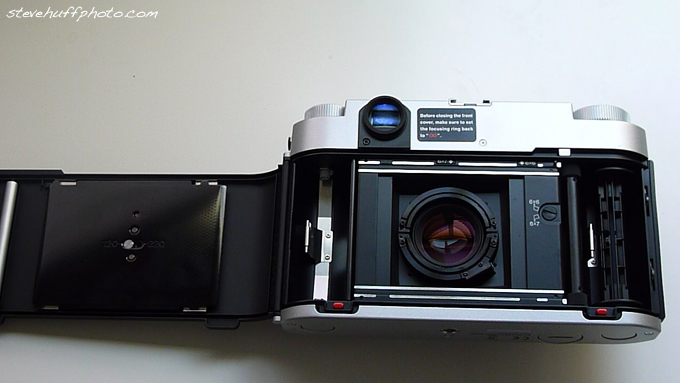
After the video was shot I loaded the camera up with some film and decided to test it out in my backyard with a portrait test and then on the street AT NIGHT! Usually medium format cameras are used in studio or for posed portraits in good light, and I will admit that to get the most out of the negative you should use it in good light. But I am a goof and I wanted to see if this could double as a 35mm rangefinder, so my wife and I went to a first friday event in Phoenix. I was loaded with Ilford Delta 400 and had a spare roll of Delta 3200 in my pocket. But before I get into the results, let me show you another video on how to load this camera with film. It’s easy and takes only a minute or so. One of my fears when it arrived was that I would not know how to load it, but after reading the loading section of the manual, I knew it would be simple.
Loading film in the Fuji GF670 – Video shot with Leica V-Lux 20
The Build and Feel
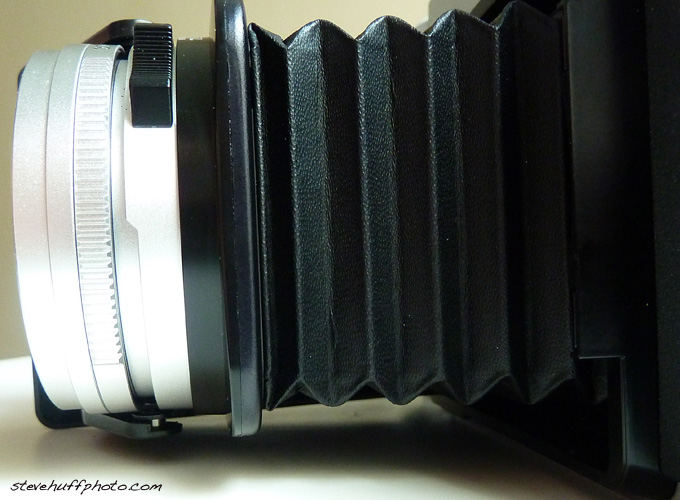
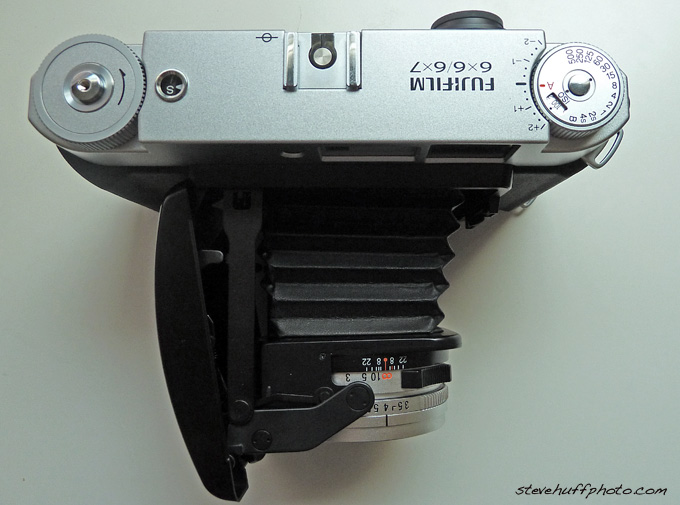
First things first. I have to say that the viewfinder of the GF670 is FABULOUS. Its huge, bright and clear, and the frame lines are really easy to use. It makes framing a breeze and due to the size of the VF, it is a joy to look through. The rewind knob is a roller wheel and not a crank. I was not so sure I liked it but it worked well. It was smooth and easy to advance the film. The film counter on top makes it easy to know what frame you are on. Overall, the camera was well built and felt substantial in the hand. Again, it is not up to Leica standards in this dept but I have no complaints. The only concern I had is that the bellows seems fragile and if it were ever punctured or damaged then you would have an instant light leak. I am not familiar with folding cameras, and this is the first one I have EVER used so I am not sure how easy it is to damage the bellows. It just seems like it would be easy to rip or tear so I was very careful with it.
My First Experience With the GF670 – Quick portrait test
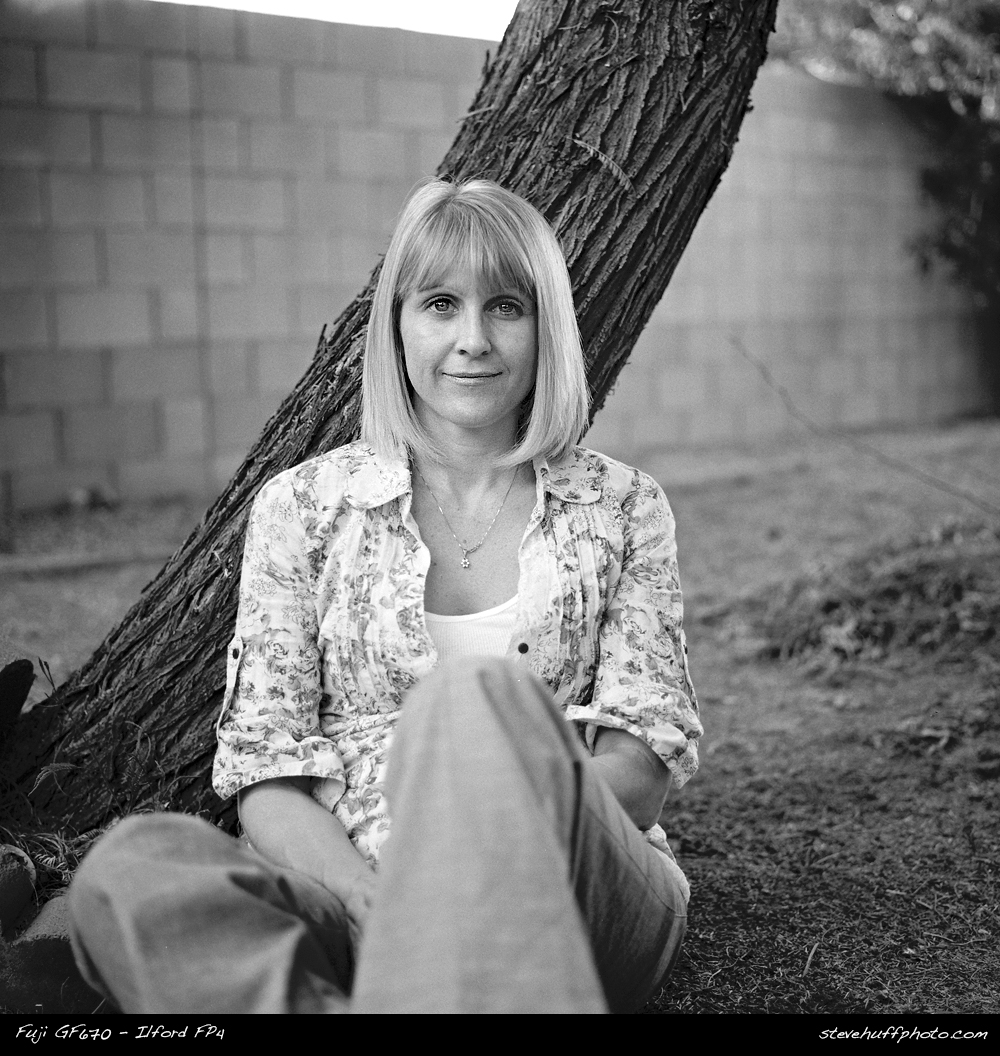
After loading the camera with film I told my wife I had to take some test shots of her outside. I had some Ilford FP4 (ISO 125) loaded and snapped off a few frames just to make sure the focus was good and also to see how the lens would do wide open at F3.5.
Two shots wide open with Ilford FP4 – I found the lens to be wondeful
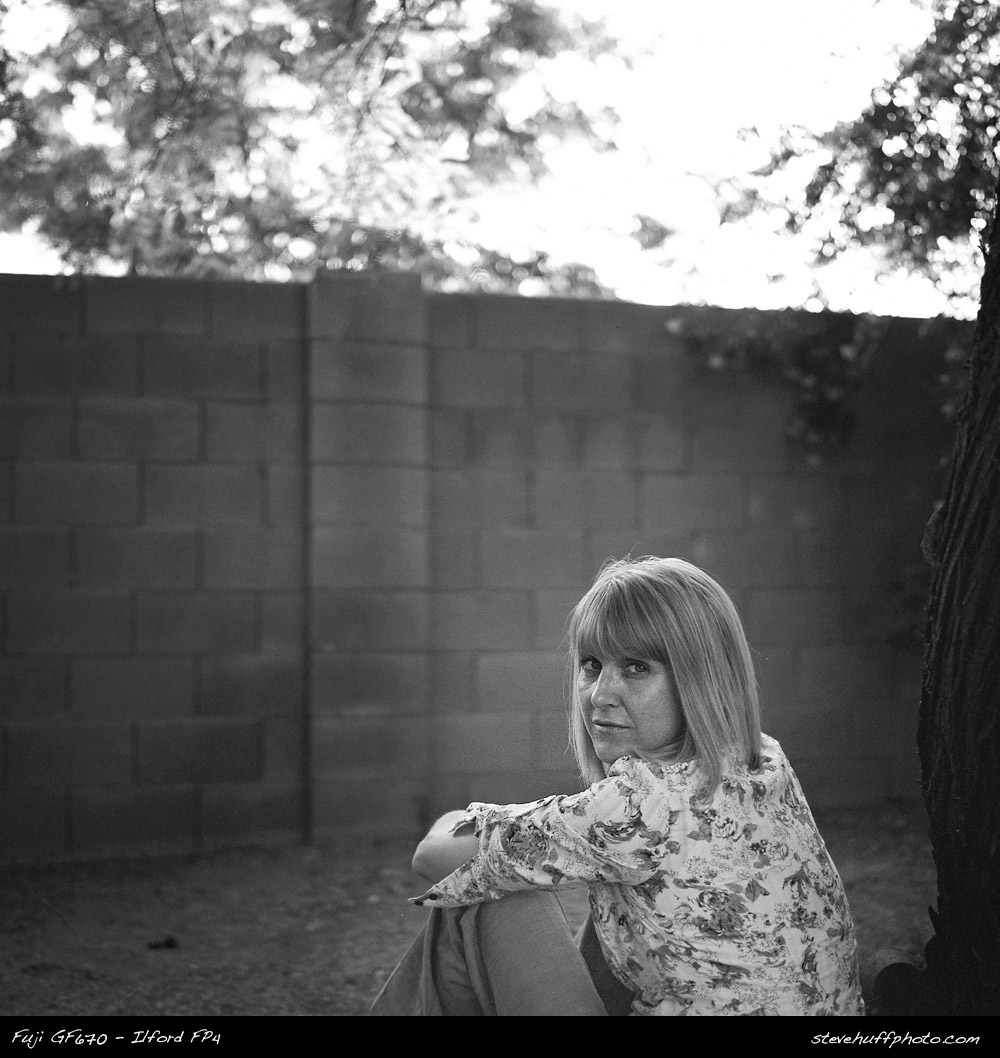
and of course, the obligatory “test my camera cat shot”
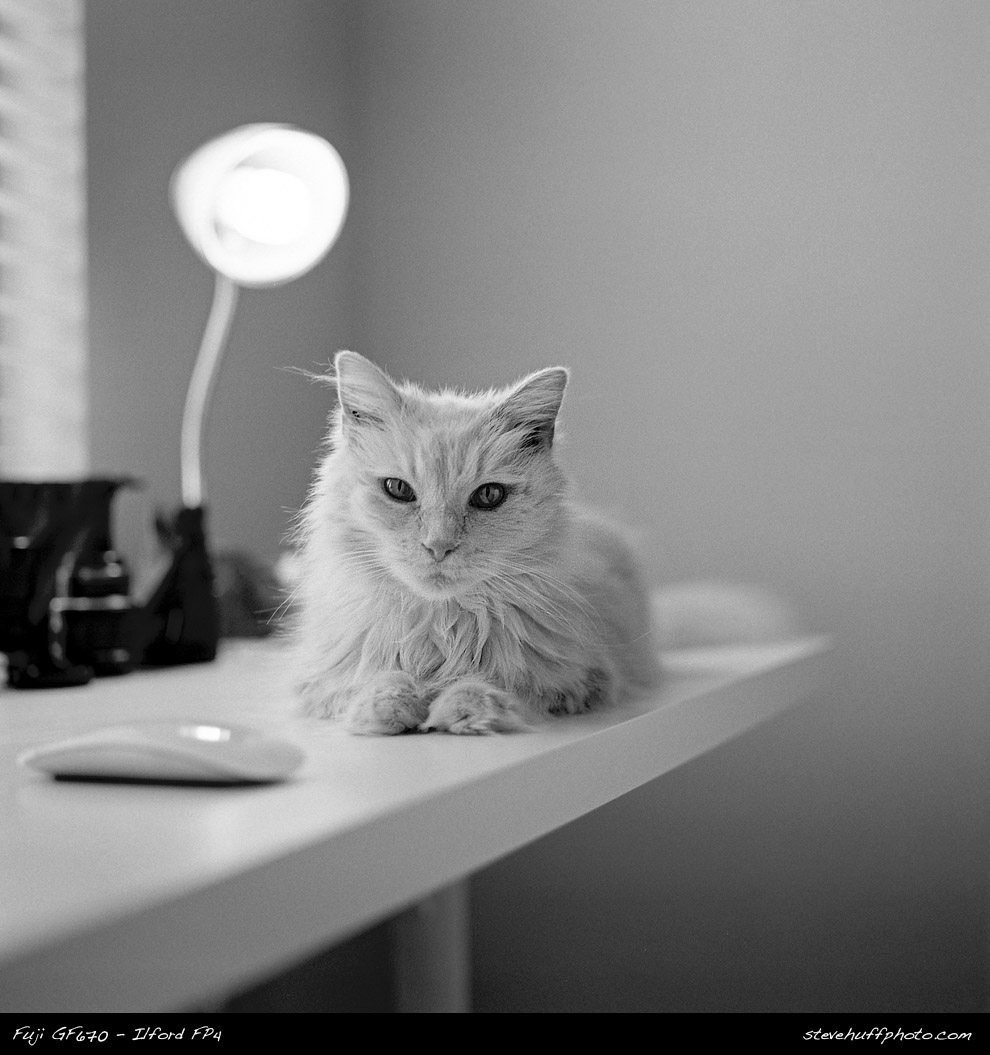
So the 1st test shots came out great. Focus was spot on and wide open, the lens drew in a very pleasing way with smooth Bokeh and plenty of detail. After I shot through the 12 frames of FP4 I loaded up some Ilford Delta 400 and we headed out for some evening street shooting. I was not sure if this would work out at all, I mean, who takes a medium format film camera for night time street shooting?
My Second Experience with the GF670 – Night time street
Here I am shooting the GF670 at night using it just as I would a Leica MP or M7. This image was shot by my wife with the E-Pl1 and 7-14 lens in grainy B&W mode.
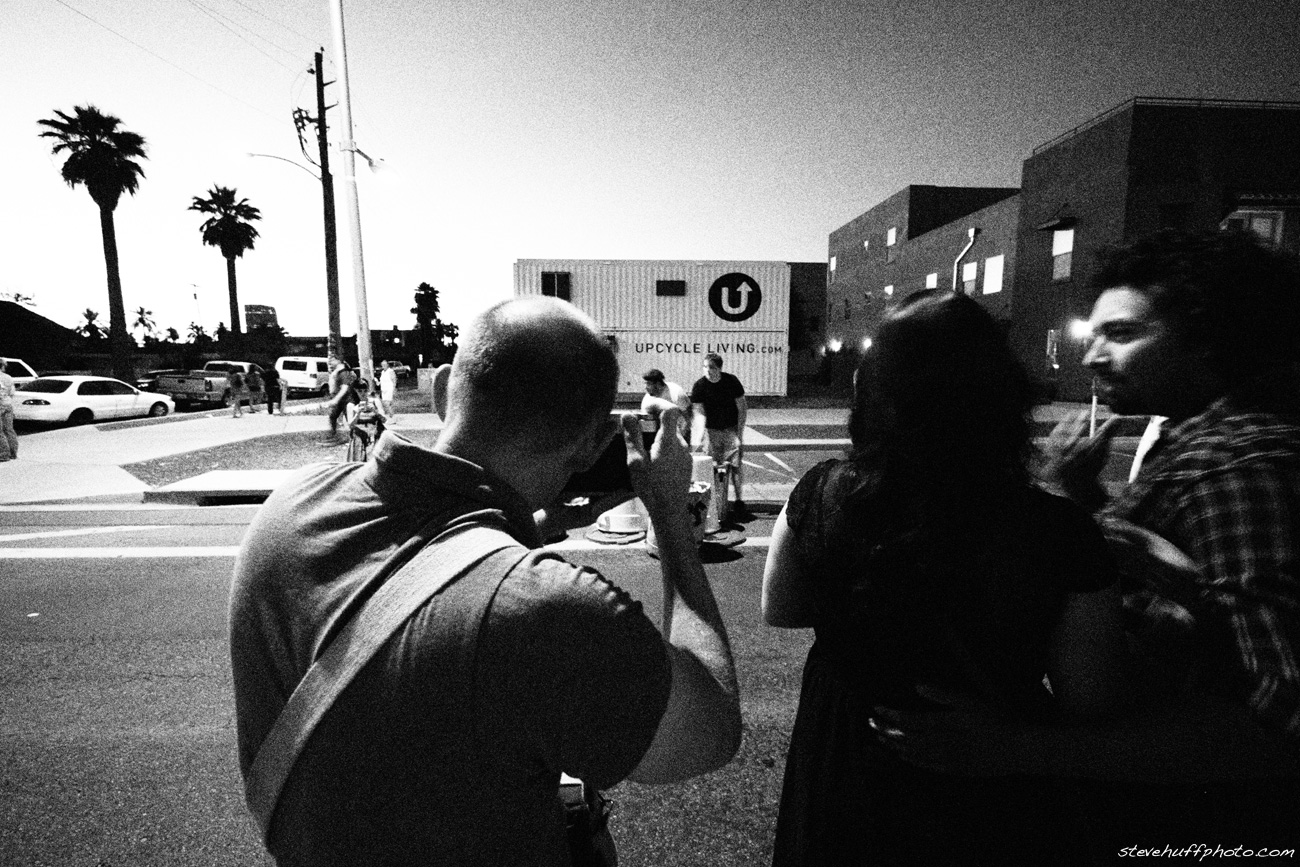
My wife and I drove downtown to a first Friday even where there are lots of street vendors, artists and just plain ol’ crazy people roaming around. It was VERY cool and we plan on making this a regular event to go to and shoot, eat and have fun with friends. We saw a VERY talented girl who wrote her own songs and she was performing them with just her and her keyboard. She sounded amazing and we stood and listened for a while. If she would have been selling CD’s I would have bought one on the spot.
There was still some light left for this shot – Ilford Delta 400
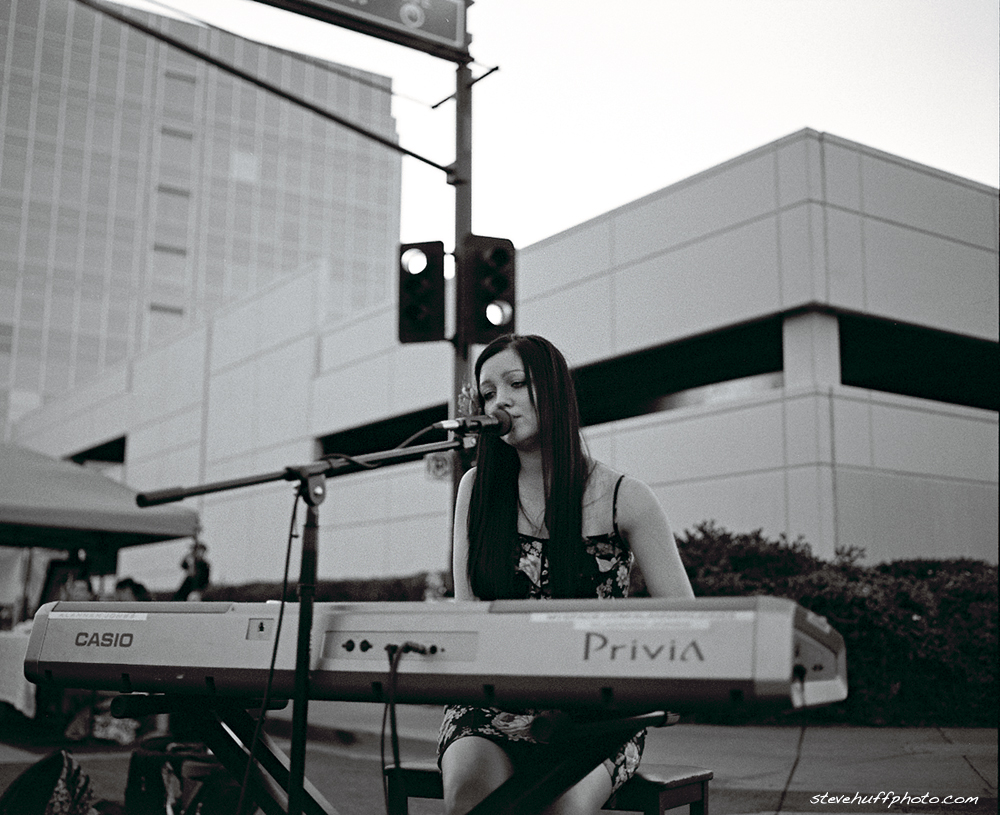
When we arrived there was still some light left and I knew the 400 speed film would be fine until it started getting dark. But I was really digging using this camera. It was not too big, nor too heavy and when I wanted a bite to eat or something, I just folded it up and let it hang at my side using a strap. After 20 minutes I felt like I was shooting a 35mm RF, just one that was a little larger.
So as I walked the street with the camera I realized that this was VERY doable. I left the lens folded OUT while walking and I had a few people walk up and ask me if this was an old antique camera. With its fold out lens it resembles the old cameras as there were many made like this back in the day. Everyone seems to think it was really cool but when they asked how much it cost they freaked out! Here is one conversation I had with a guy who walked up to ask about the camera:
Guy: Hey man, is that an antique?!?
Me: Nope, its a new camera.
Guy: How many megapixels, that looks wicked.
Me: It’s film.
Guy: Film?? (he looked confused)
Me: Yep, it’s a Fuji medium format film camera.
Guy: Oh, it’s those kind that take the big film..ahhh.
Me: Yep!
Guy: How much does it cost?
Me: $1899
Guy: Whoa!!!!!! (then he walked away)
I thought it was cool that there was so much interest in it. A woman also walked up and asked me where she could buy one after she looked it over so there seems to still be some interest in film, especially if it’s to be used with a sweet looking camera like this one. But all of the looks and portability in the world wouldnt mean squat if the camera did not perform well. I was curious about the lens because some say it is a Voigtlander lens and others say It is a Fuji. I believe it is a Fuji designed lens but even if it is not, it performs very well and gives you that “medium format look” that you just do not see with 35mm.
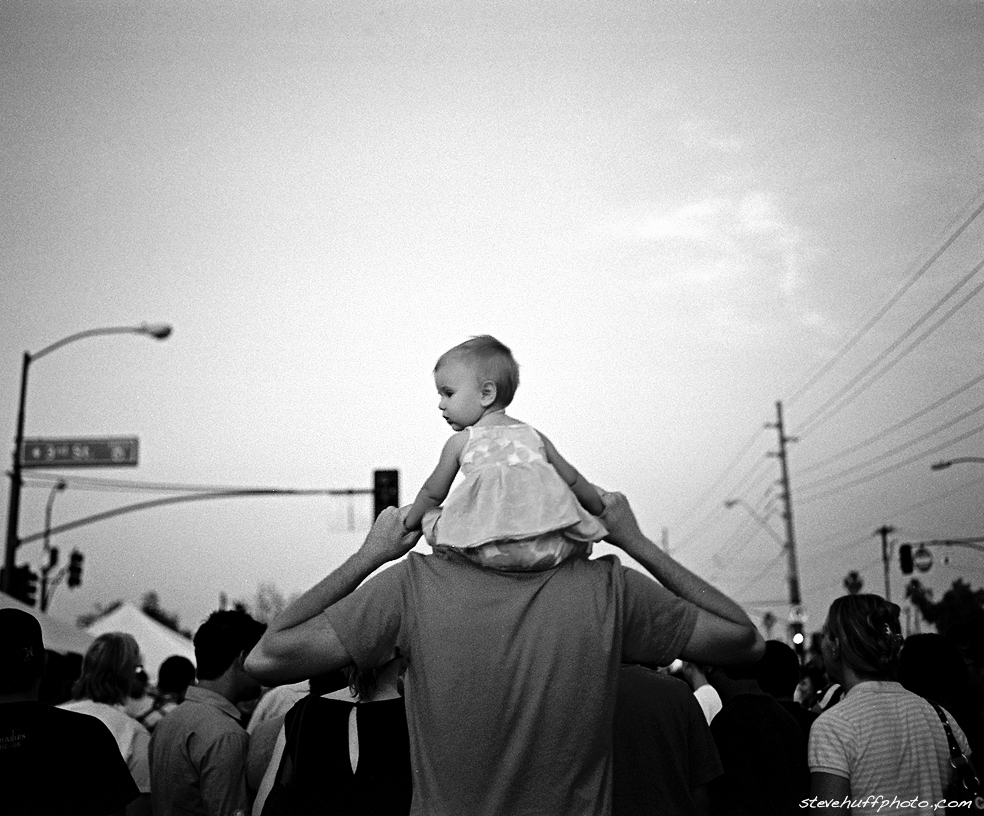
Shot with Delta 400 at 3.5 as I walked behind them
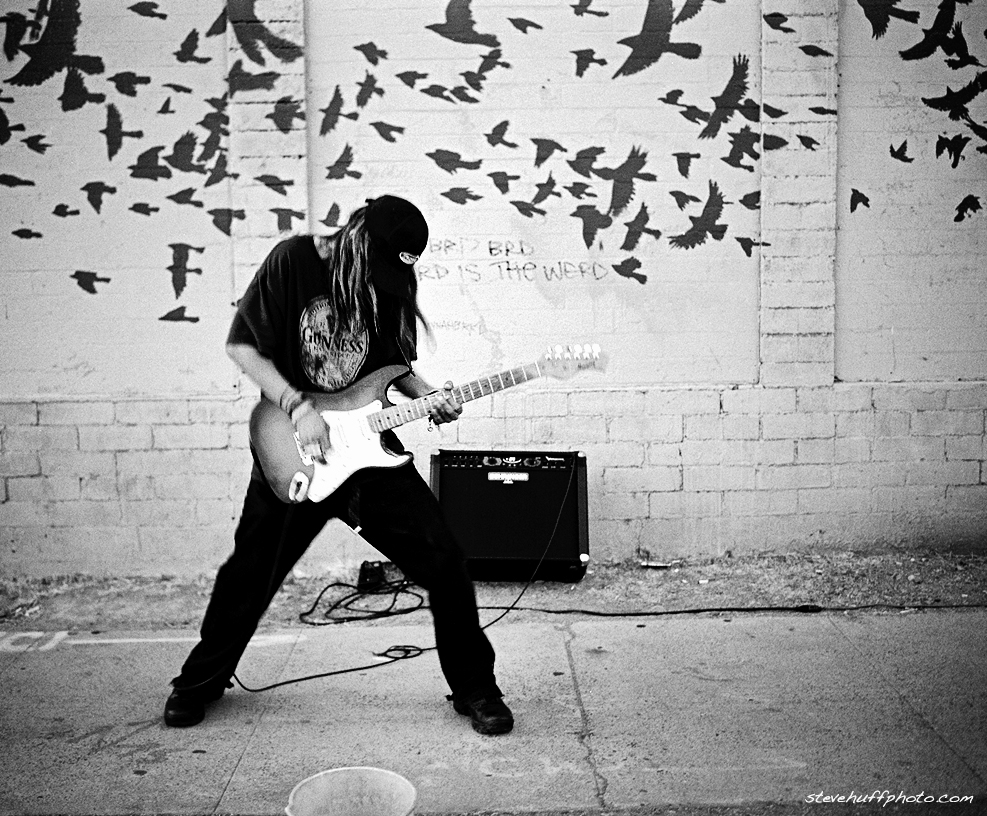
This guy played three chords over and over and over while he swung his head around. I snapped this using Delta 400 and two hours later when we walked back towards the exit he was still playing and swinging.
After eating and walking around for an hour it started getting dark. I finished u p my 400 and loaded up the Delta 3200. It was no problem loading it in the middle of the street. It took me a minute or two but I had no difficulties at all. The cameras meter also had no trouble metering in the low light, so that was a plus. The following images were all shot with 3200 film. You can click on any image in this review for a larger version.
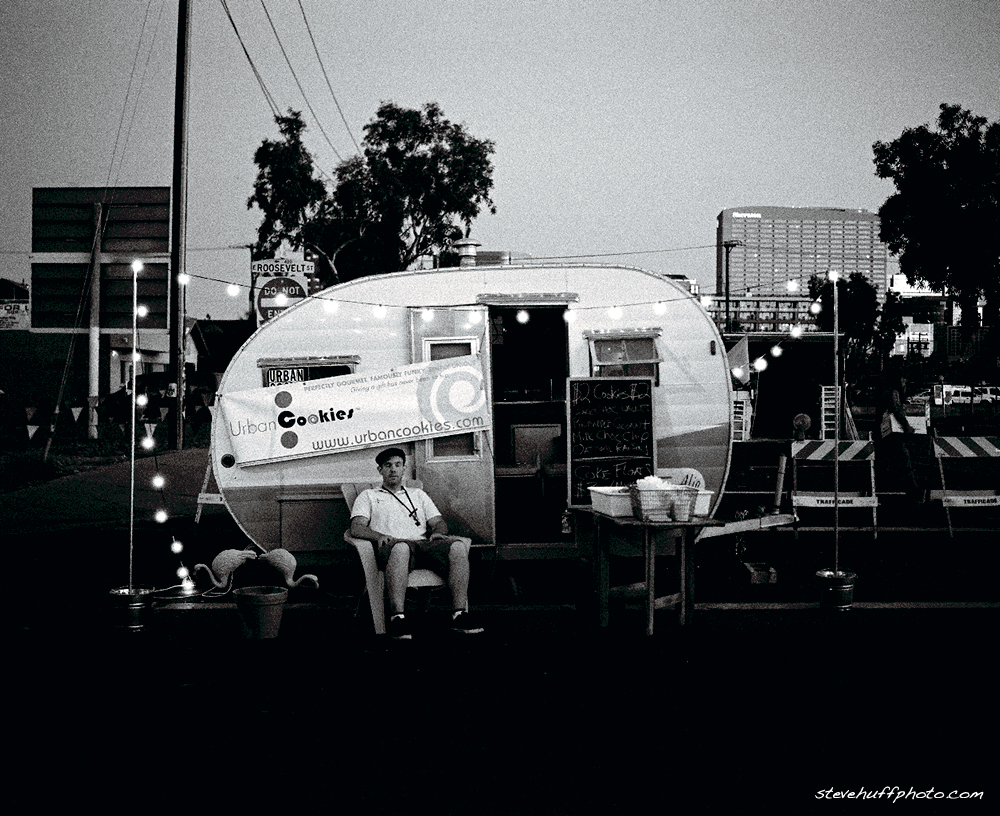
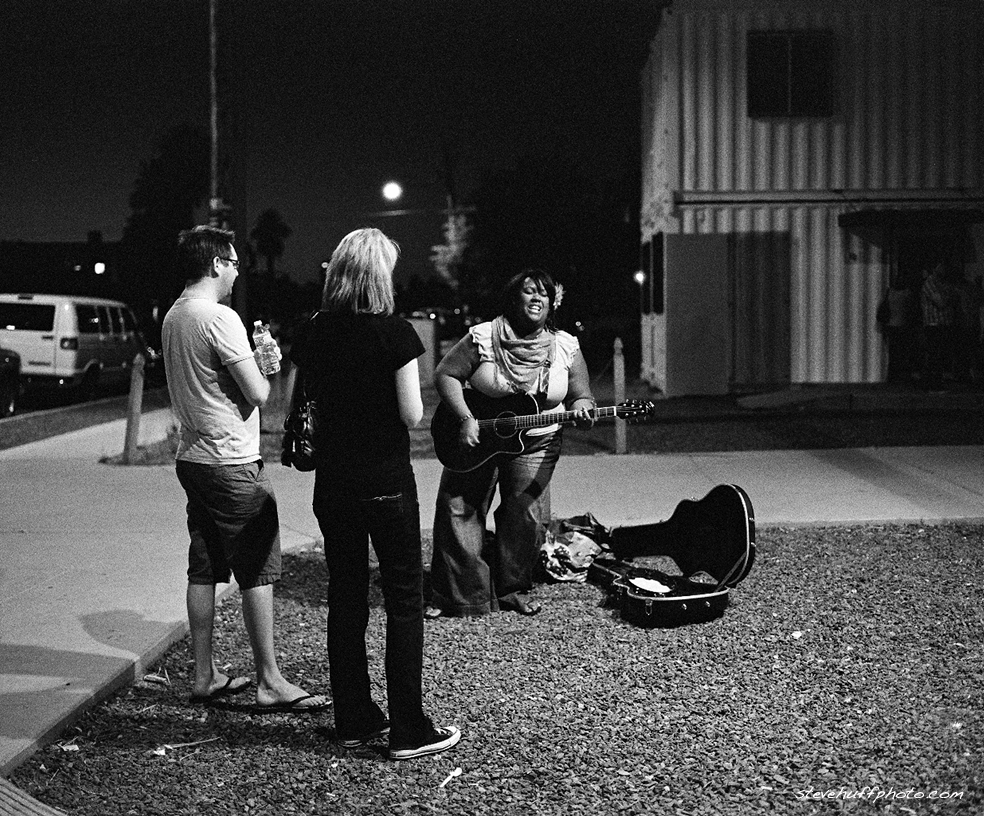
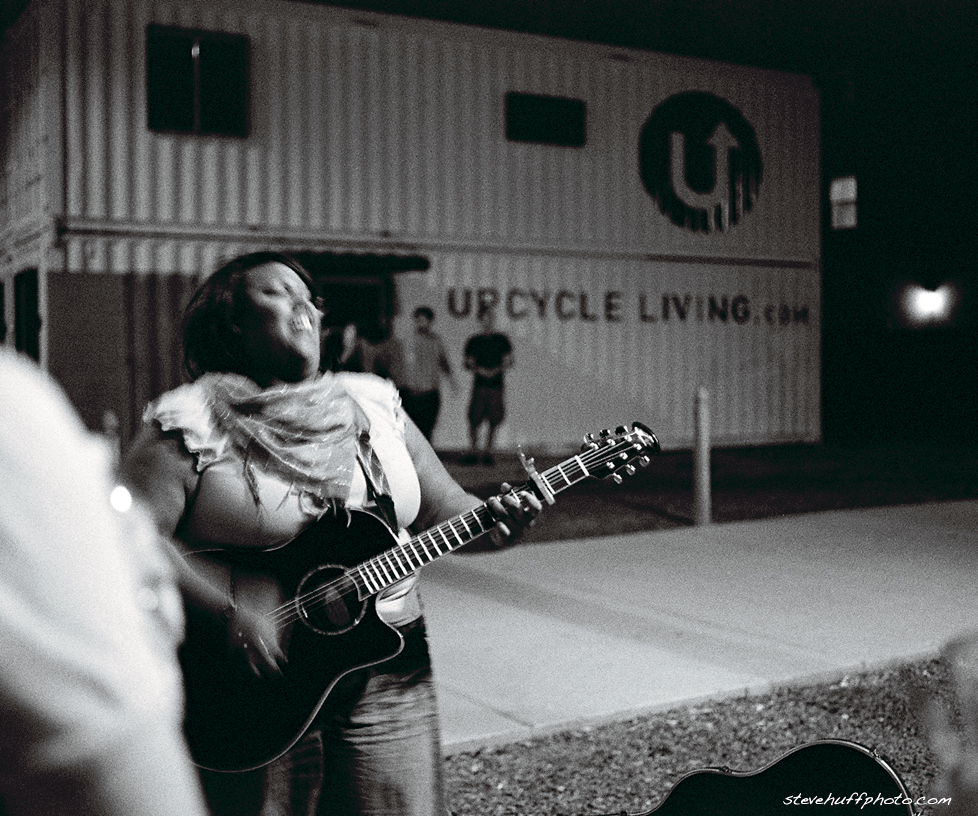
I admit, these kind of shots may be better to shoot with a 35mm camera but the GF670 did an admirable job here. By the time of the last photo above it was REALLY dark and we were headed out to go home. This lady was singing a horrible out of tune song about missing her dog. She had some guts though and was even making a few $$’s in tips. Maybe I should go out there and sing for some cash!?! All in all it was great fun heading out there and shooting with the Fuji. It was a positive experience and at this point I was really liking the camera quite a bit. My wife was giving me that look “Don’t even think about it, it’s going back to B&H!”.
My third experience with the Fuji GF670 – Vegas baby!
I delayed this review by one week mainly because I wanted to shoot more film with it before I wrote about it. I felt like shooting 3 rolls was not enough to really get to know it, plus I wanted to take a short travel with it to see if it still held up well, especially the folding mechanism and the bellows. We took a drive to Las Vegas and while I mainly shot with the Leica M9 and new 35 Summilux ASPH, the Fuji GF670 came out from time to time. This time I brought along some Tri-X 400 and Kodak Ektachrome 100VS.
First up, Kodak Ektachrome 100VS
This Ektachrome really POPS. This is a straight scan from my local lab though I did crop it a little. These reds are a bit over the top but it’s sort of interesting, and I can see how it could be really gorgeous in the right circumstance and light. You can buy this film at B&H here.
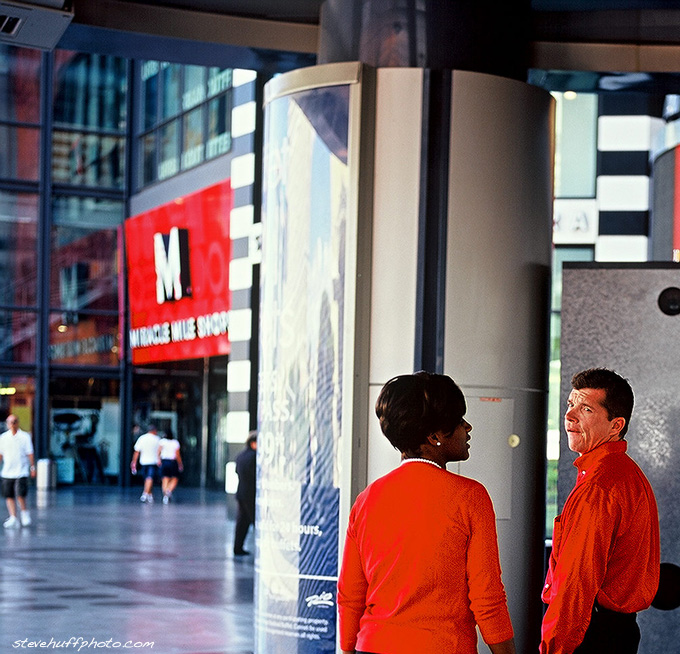
I was coming back over to meet my wife and she did not see me coming. I snuck this shot of her while she was texting me to ask me where I was at 🙂
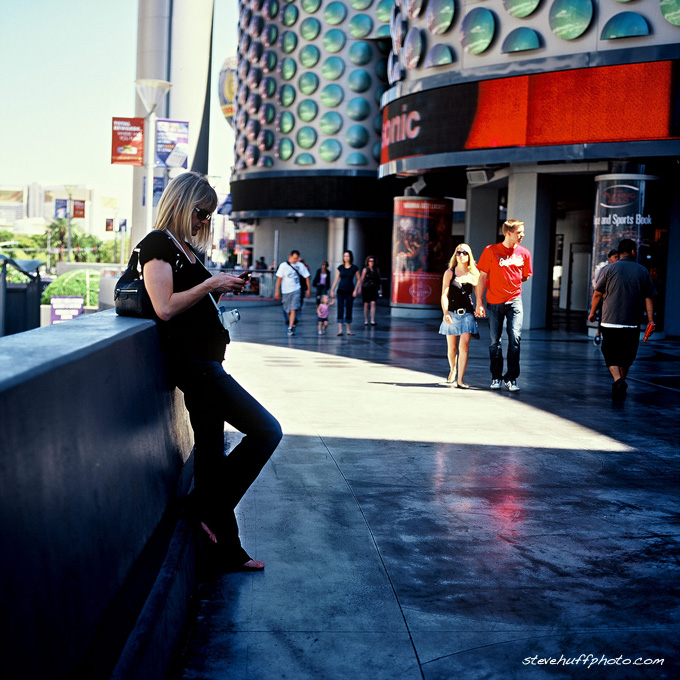
Here is a shot that I snapped with the Fuji AND the M9 35/Lux. You can see the 35 Lux version in my 35 Lux review but I feel this Ektachrome version is more pleasing if not a little over saturated for skin tones. The color is bold but wow, the look of film wins me over every time.
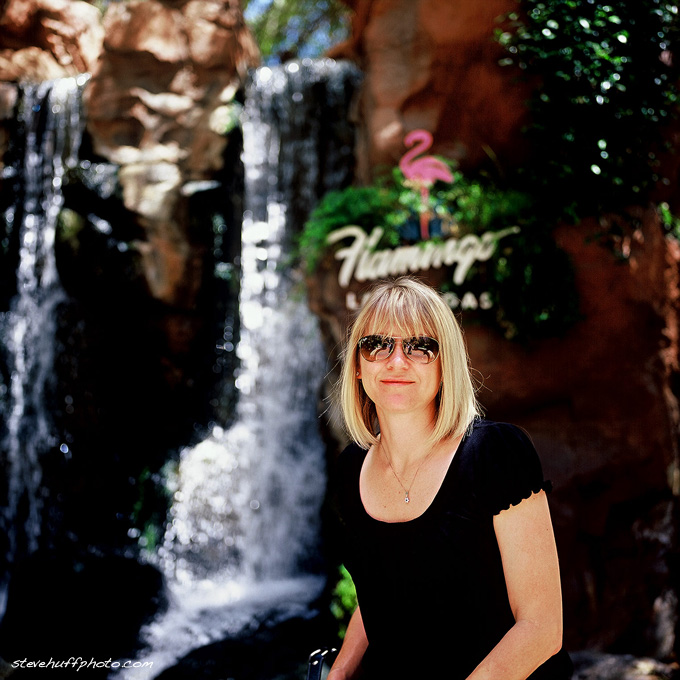
Reds is where the Ektachrome really pumps it up…

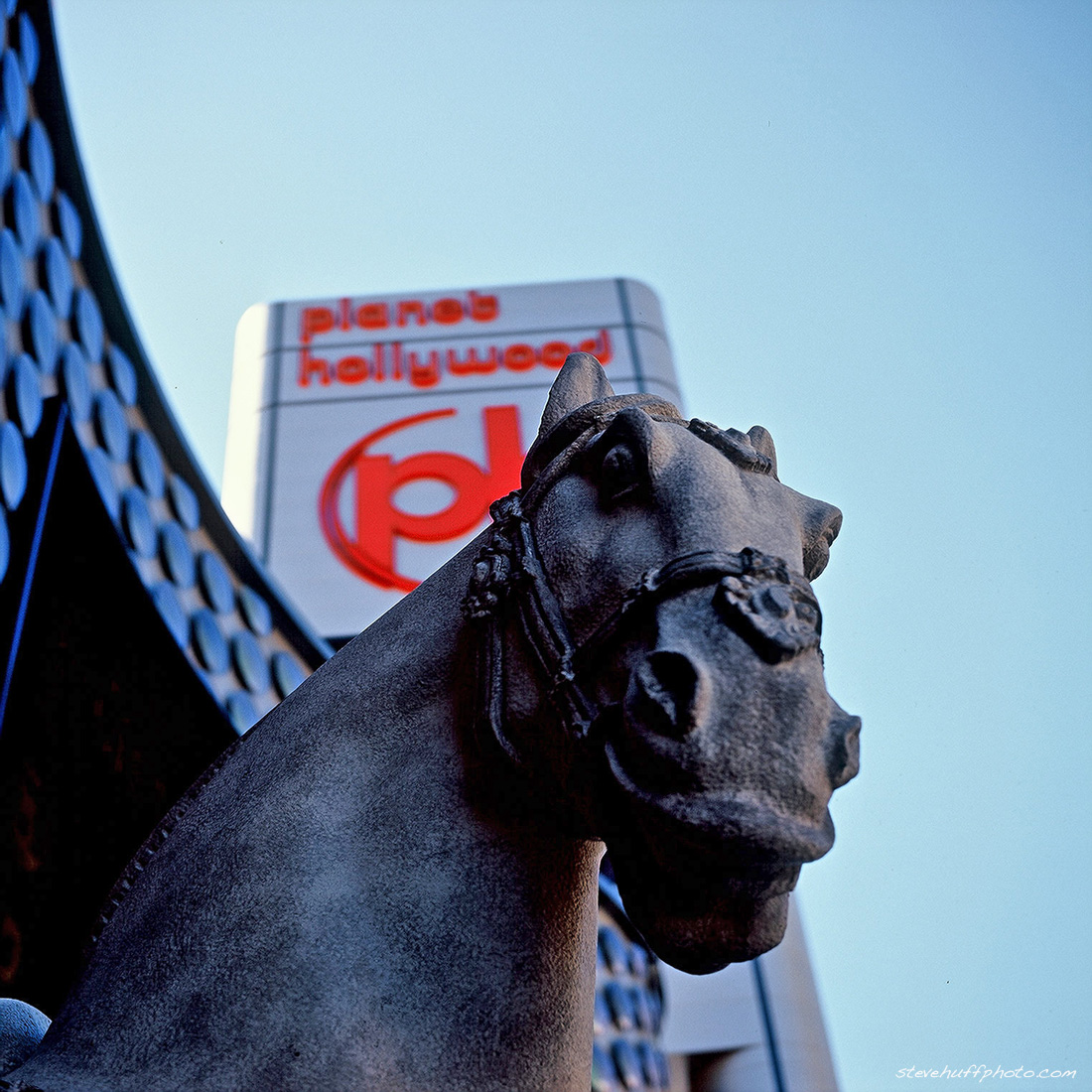
I shot 12 frames with the Ektachrome and these were my faves. This film is pretty nice and VERY low grain. If you like your color to be bold and beautiful, this is a great film. I now want to try it in 35mm.
Good ol’ Tri-X 400
I love Tri-X. I used to shoot with it all the time and it was my #1 film of choice when I would process my own in my laundry room. It’s classic and it has a look like no other B&W film. I had one roll and one roll only so I loaded it up for day 2 in vegas and hoped to catch some cool scenes. B&H sells Tri-X in 120 HERE.
This is the guy who was breathing fire in my 35 Summilux lens review. Here he was looking at some girls in the escort books they hand out on the strip.

“Larry” – I saw him playing with sticks on his legs trying to earn a few bucks. This guy lives on the strip and survives day to day from money he gets from the tourists.

A Michael Jackson impersonator was on every block. This one charged $ for a photo which explains why he turned his back on me when I went to snap.
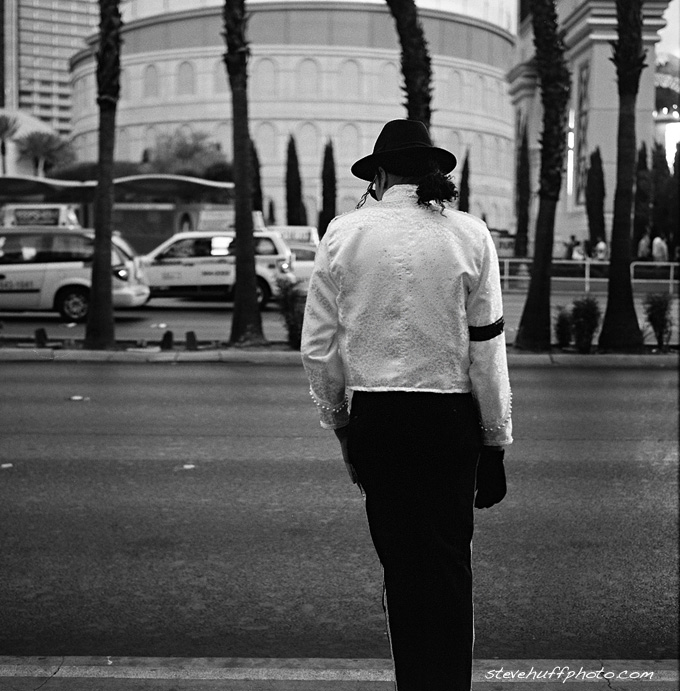
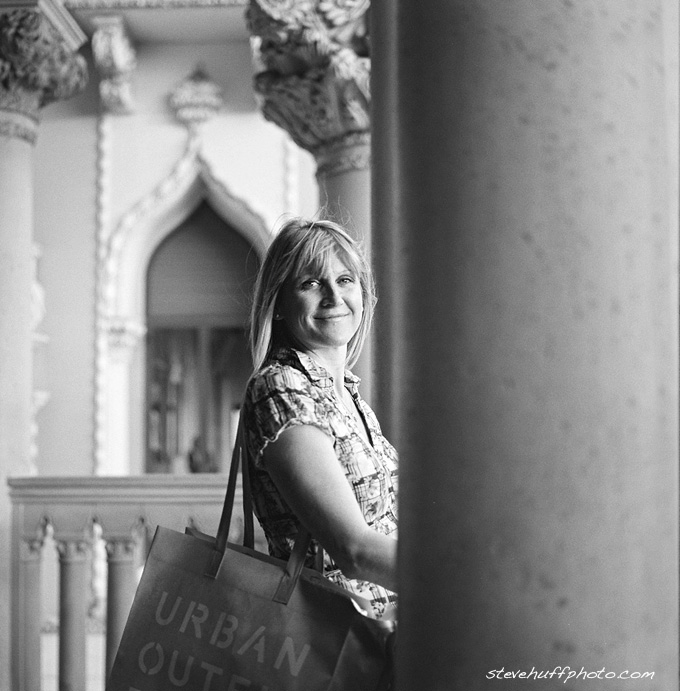
Hanging out at the Venetian
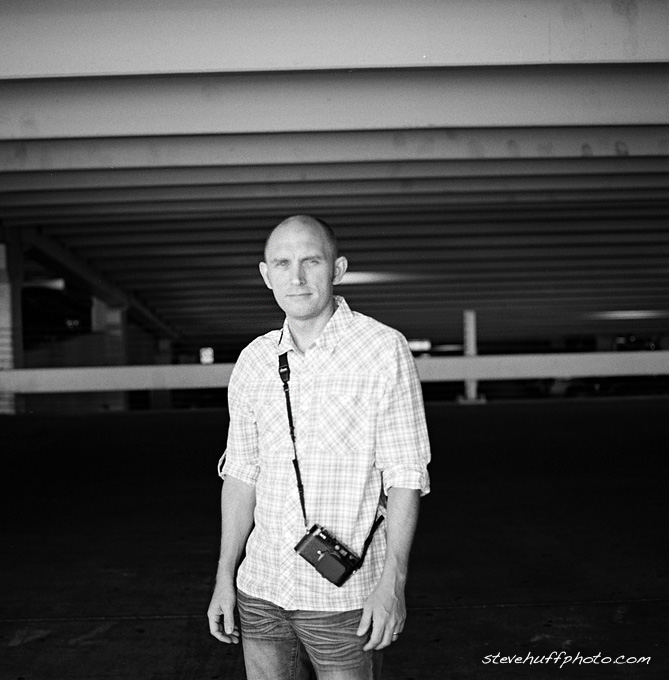
My wife wanted to take a shot with the Fuji so she snapped one of me in the parking garage..
On my roll of Tri-X I actually had 12 keepers 🙂 I really liked this film the most and found it to be the best mix of speed, tone and texture. It’s also just about the cheapest film you can buy in 120.
Getting 120 Film Processed
I already have been asked the question on WHERE To get medium format processed. Local drug stores can not develop this film, well, they can but they will mail it out for you. I happen to have a pro lab not far from my house and they do the processing for $3 and scans for $10 so it cost me $13 a roll to have it developed and scanned to a CD. There are plenty of labs to mail the film to and most turn it around pretty quickly. But, you will not find a one hour processing drug store for 120 film, at least in the USA.
PROS/CONS
PROS:
- Looks like a rangefinder, works like a rangefinder
- Medium format = less grain, smoother tones and better negatives
- Built in meter works great with Aperture priority mode. Just focus and shoot.
- Can be used for beautiful portraits, street work or just about anything due to its portability.
- The viewfinder is big and bright and actually nicer than my Leica MP finder!
- The shutter is SILENT. You may not even hear it click.
- Easy to load and unload.
- Build is decent and seems solid.
- $400 less than the Voigtlander version, and it is the same camera.
- Can shoot in 6X6 or 6X7 using 120 or 220 film. 12 or 24 exposures.
- Cost is on the high side but its build, results and quality make it worth it IMO.
CONS:
- Not sure how the folding mechanism or bellows will hold up over a period of a few years. The bellows seems fragile so be sure and take care with it (as in do not poke it with anything).
- Sometimes the lens does not fold out 100% completely and you have to pull it out to make sure it is out.
- Lens must be set to infinity to fold it back in. I have forgotten to do this several times and wondered why it wouldn’t fold.
- Shooting film can get expensive with film costs, processing, scanning.
- How many more years will film be available? Your guess is as good as mine.
My final thoughts on the Fuji GF670
I like this camera. I like it quite a bit. I really enjoyed the quality and look of the medium format negatives but I disliked the costs involved. At about $18-$20 a roll for buying the film and getting it processed, it is not a cheap way to shoot! Then again, neither is 35mm film. You can also process B&W film yourself to save a few bucks and if I were to buy this camera I would limit its use to those special times when I wanted the MF quality or the look of film.
The GF670 is sort of like shooting a Leica M7, It has an Aperture Priority mode with a really good meter in the camera, it has a rangefinder and focuses the same way as a Leica M (or Voigtlander Bessa) and has the same feel as a rangefinder camera, just a bit taller and wider. It’s really well made and the shutter is SILENT. I mean, REALLY silent. There were times when I did not even know if the shutter fired! It makes a Leica MP sound like a freight train. Yea, it really is that quiet.
The lens is an 80mm lens which is like the equivalent of a 50 in 35mm land. Its bokeh is smooth and I had no complaints with the sharpness or detail at all. The camera is a cinch to load and unload and easy to fold in and out. My early concerns with the bellows almost came true. While in Vegas the belllows was bent in and it would not pop back out. I was afraid that over time it would rip but two days later when I went to do the loading video I noticed it was back to normal and look A-OK.
The camera seems sturdy, well made and I encountered no issues in my two weeks with it. Overall, if you are looking to get into medium format film photography and want something portable and easy to carry, this is a great option. These days you can find loads of medium format gear used at great prices but the key with this one is that it is portable, easy to carry and has a meter built in. You can buy this one NEW and you can buy either the silver Fuji at $1899 or the Voigtlander in all black at $2299. I’d go with the Fuji because it is $400 less and I like Fuji 🙂 PLUS, it is the SAME camera, and this is not digital where you have to worry about firmware differences or packaged software. B&H Photo has it IN STOCK as of this writing.
So there you have it! I know many of you were waiting for this review and I was thrilled to test out this camera. It’s a beauty but up to you to decide if the cost is worth it for YOU. I would buy one today if I could swing it. There are so many great cameras today it is so tough to find that right one. I do know that this Fuji sparked my interest in Medium Format so I am currently testing out another camera thanks to a buddy of mine who sent it over for me to test. It’s a Bronica 645 and also a rangefinder. I’ll have a write up on that one soon, but probably not until after July 4th.
Thanks for reading my review of the Fuji GF670! Hope you found it useful! Until next time,
Steve
HELP SUPPORT THIS SITE TO KEEP IT GOING AND GROWING!
Remember, anytime you follow my links here and buy from B&H or AMAZON,
If you enjoyed this article/review, feel free to leave a comment at the bottom of this page and also be sure to join me on twitter or facebook! Also, you can subscribe to my feed at my subscribe page HERE and read these posts in your browser or news reader! Thanks so much for visiting my site!
[ad#Adsense Blog Sq Embed Image]



THIS IS OLD. My split/divorce in 2010 was documented on these pages in depressing and personal detail. I am not married now but have been with my Fiancé Debby for 6 years now and am happier than I have ever been in life. Married for 15 years before Debby though. So this is an old article, and just because I divorced does not mean I delete my past ; )
Dear Steve,
You display your wife on a couple of pictures and I cannot recognise her?
It seems to me you have a new wife? Is that right? Nice pics, by the way.
hi
thanks for this usefull review..
will you make a review for the bronica rf645?
thanks
Sébastien
Sorry to resurrect a topic this old, but yesterday I took my GF670W apart…and yes the top and bottom plates are plastic. Plated and painted though, like what the Canon AE-1 had. I wouldn’t call it beautiful when the paint wears off.
Looking at the specs, this explains why the Fujis are so light (not necessarily a bad thing) while the Bessa 667 and 667W are substantially heavier and more expensive.
Actually, Fuji makes some of the most fantastic lenses in the world, on par with Zeiss and Leica
Yes Mark an Iphone and an app are cheaper than a 6×7 negative and silver print. Yes lightroom is cheaper than CS6 and yes Steve’s review has incorrect information and bias film bashing.
Jason,
Here are multiple price points for two different digital workflows an supporting links:
1) Shoot with an iPhone, edit with an app, post to Tumblr, FB, etc. iPhone: $200 with contract, Photo app: I like Snapseed for $5.
2) Shoot with an iPhone or Panasonic Lumix GH1, edit on an iPad, post to Tumblr, FB, etc. iPhone: $200 with contract, iPad: $399 for iPad 2 (which I own), $20 for Snapseed on the iPad, $29 for the SD card adapter to load my GH1 images into the iPad, ~ $600 for a new G3 instead of my old clunky GH1. And yes, I can edit GH1 RAW files on my iPad.
The iPhone 4 and iPad2 each use a 1 Ghz dual core ARM-based processor with an address space of 512 Megabytes (http://en.wikipedia.org/wiki/Apple_A4). Far from being the super charged desktops you mention (MacBook Pro, iMac, Intel i7 devices, etc.), these mobile devices have plenty of compute power to modify and adjust multi-megabyte digital images. If you want to scale up the CPU, memory, disk space, and display components into a laptop or desktop, you can certainly spend more . . . but only if you choose. Even then, commodity pricing continues to squeeze margins out of most non-Apple branded products and very powerful laptops can be purchased for the price of an iPad 3.
Workflow times for the above: minutes . . . far shorter than the time I spend developing B&W film, drying it, cutting it, scanning it, adjusting for tonal curve issues, covering up dust spots, etc. But if you have the time and inclination, these time costs are not relevant. However, to many if not most people, time is a perishable and valuable commodity and if they can achieve their desired objective for less time, most will choose the faster path.
The recurring cost per 35mm frame to purchase and develop B&W film at home is around 15 – 18 cents each. The recurring cost to save a 20 MByte digital image two years ago (!) was 1/6th of one cent (http://ns1758.ca/winch/winchest.html). The price has probably dropped by another 20% in the past two years. Thus, two years ago, it was 90 TIMES CHEAPER to capture a digital image than buy and process a single frame of B&W film.
But it gets worse. With a digital image, I can erase a file that I don’t want to save. With film, that 15-18 cent cost is a sunk cost. Once I buy and develop the film, I can’t reuse it. It is a permanent capture and storage medium whose price is slowly rising, not rapidly falling.
Don’t want to use an iPad for photo editing? Ok, spend $724 for a quad-core Intel i7 machine with 8 GIGABYTES of ram and a 1 terabyte hard drive (http://www.geek.com/articles/chips/geek-deal-264-off-quad-core-dell-inspiron-15r-w-3rd-gen-core-i7-20120731/).
And PS CS6? You’ve got to be kidding me. Get Lightroom 4 for $131 (http://www.amazon.com/Adobe-65164937-Photoshop-Lightroom-4/dp/B007BG9VLK/ref=sr_1_1?s=software&ie=UTF8&qid=1343846560&sr=1-1&keywords=lightroom+4).
Bottom line: the break even point for digital vs film is 158 rolls of B&W film (5700 frames at 15 cents each) developed at home. At that rate, you can afford to purchase the latest Dell laptop mentioned above and a brand new copy of Lightroom 4. But that is true only if you use that computer JUST FOR PHOTOGRAPHY.
If you use that computer for anything else, the break even point drops fast in favor of digital. And if time is a valuable commodity, then the argument for digital is even more compelling because if you put ANY value on your time, then the break even point approaches just a few rolls of film.
Mark
Your reply has a lot of good information, but you talk in generalities without siting proof or prices. Photoshop CS6 is not dropping in price because of smartphones apps. MacBook Pros are not cheaper because of Ipads. Yes digital is faster to process but again as you stated it depends on how much you shoot. You also assume everyone has a top-end computer. Post-processing requires such a computer. Try post processing and saving 1000s of M9 images on a $400 computer. As for your $10 quote at Ritz that is on the high end and my point is that developing film is very easy and requires little to no space. Steve also quoted a price for buying film and process of $18-20. Even with your highend $10 Ritz processing that means it is really $14-15 per roll. BTW, AandI Photo is $8 and many other second cities have places where you can mail in that go even cheaper ($6-7), with 35mm being cheaper at some drugs stores. That makes his statement wildly untrue. Steve is either uninformed about film in which case he is not qualified to come to such conclusions about film and therefore should not be stated or he is lying.
The loss of film products you claim has also come at a time when new films are being created from Rollei and even Kodak. The new Portra films are a huge step forward unless you loved VS. The loss of E-6 has been a long time coming and is understandable just as disposable cameras and even most p&s’s. None of that really relates to what I am stating.
Steve based many statements and conclusions which are his opinions on certain stated facts. I found his facts to be untrue. Yes we are all bias and as I said I have no problem with him pushing Leica M9’s etc, wish I could afford one and a few lenses. I have also stated I enjoy the blog as well. But I do have a problem with conclusions being backed up by untrue facts. Steve is not stupid and I am sure he has encountered many blogs, articles and personal opinions about film. Including conclusions in this review with such stated views on the cost of film is calculated with a certain intent. I was only pointing out that digital is not cheap. It requires are great deal of time, money, hardware, software, updating items and physical space just as film. I also am pointing out to those who read his conclusions or Cons on film that film can be and is cheap and can be cheaper than digital with a little effort and with certain choices.
In the end the consumer has the choice, I shoot both as well. I love my fujifilm x100. I shoot 4×5 and 120 most of the time and I am trying to encourage photography as a medium both film and digital as accessible and affordable. While those two things may require effort and work, it isn’t an extreme. I also do not know or dislike Steve or his site. I enjoy 95% of the review. I think the points I am making are important and truthful.
I will now add my two cents. I shoot both film and digital. I have compared both extensively. My conclusion is that when it really counts I choose film every time. Exceptions are for certain wildlife, sports, or low light levels requiring short exposure (extremely high ISO). Film and Bayer digital cannot be easily compared as they are really totally different image structures. But, film is superior in many ways, both technically and more importantly, subjectively. Our vision is analog and it is only natural that analog imaging look more realistic. Film is similar structure to human vision. Digital (Bayer) is really a computer colorized B&W image with added computer manipulation to overcome the various shortcomings of the digital sensors and manipulation. A 35mm film image contains about 150 megapixels worth of information if it were a Bayer digital camera. Medium format will be 2.8-4x that. A CCD scan of film LOSES 2/3 of the image information and adds some digital problems. So, when we talk about image quality a medium format transparency film image on a light table or projected or direct printed with quality equipment and technique such as Ilfochromes, will be superior to anything digital, even medium format digital. The latest high end digital cameras, such as the Nikon D800 or Sigma SD1, have a resolution around 100 lp/mm. Velvia films have a resolution of 160 lp/mm. The Nikon has a larger sensor then the Sigma, but the Sigma has a full color sensor (the only non-Bayer color sensor on the market), so the Nikon has slightly better resolution. Basically, a Bayer interpolated sensor’s “real” pixel rating should be around half of the rated amount. The Nikon D800 therefore has about 18 mp and the Sigma has about 15mp (full rated as it’s non-Bayer). Imagine the problems a digital camera would have working with medium format film sized digital files!
As far as cost is concerned, it depends on your usage. Unless you must shoot an enormous amount of images for some reason, the long term costs of a film system will be lower than digital, for reasons already expressed. Also, film printing (analog) is both cheaper and faster than high quality digital inkjet prints. Most people, especially digital users, shoot WAY more than is necessary. Shooting pictures is addicting. If you stress quality instead of quantity, your images will improve and, with film, it will be cheaper. By the way, done right, film capture does not require as many captures as digital because film does not have all the idiosyncrasies of digital and has a greater “keeper” ratio.
Unfortunately, the same companies that make film products are profiting greatly from their digital products. As such, they will not say anything whatsoever to promote film. Why sell a $5 roll of color film when you can sell a $500 digital camera instead. The intermittent photographer is much better served by film as they can put their camera and photos in a drawer and pick it up in 5 years and buy the latest and greatest new film and take exquisite photos. With digital, this is dicey. Equipment, software, and protocols becomes obsolete. You have to keep cables and computers and chargers and cards and instruction manuals. Then the digital files can be corrupted without your knowing.
Shooting film is a liberating experience where the camera disappears allowing the photographer to previsualize the image, rather than having to fidget with an electronic toy to find the settings and menus desired.
One day, they will make viable full color digital cameras utilizing minimal computer interference and having discreet controls. Then we can talk about photography instead of “digital photography”.
Jason,
I read Steve’s post on the GF670 nearly two years ago and as a direct result purchased the camera. Far from reading his review as “film bashing,” I read it as one that praised the camera’s innovation and that he was a bit wistful that the era of film is passing (my interpretation of his sentiments, not his words).
I have been so pleased with my decision to buy the GF670 that I have blogged numerous articles about it. One of those posts (http://markgoode.com/2010/09/08/a-tale-of-two-rangefinders-the-fujifilm-gf-670-and-the-leica-mp/) has been read over 12,000 times.
I didn’t detect any unstated bias in Steve’s review. In fact, one of the reasons I enjoy his blog site (and link to it on my blog’s home page) is that his reviews are laced with personal opinions that are declared . . . he’s not trying to be some faux journalist who tries to be objective (whatever that really means) . . . he brings his own personal experience to a topic, declares his preferences, and then reports his findings. It’s refreshingly honest and often just fun.
I shoot nearly 300 rolls of film per year, most of it black and white, and all of the B&W film is developed by me at home. The recurring cost of shooting film is meaningful to many people especially if they choose not to develop their own film. I was unpleasantly surprised recently when I brought in a roll of C41 (35mm) to be developed at the local Ritz and learned that the price was now $9.99 per roll, without any prints! As the third party labs disappear from the marketplace, the decision to shoot film — especially color film — becomes more problematic for those who choose not to develop their own film.
The other practical reality that most people have to come to terms with is time: digital is simply faster to “process.” The time from digital capture to presentation is extremely short and if time matters to someone, then a shorter “development time” will be important. Bear in mind, I develop multiple rolls EVERY WEEK but I am a committed film shooter . . . I also have the time to do this. My kids are all adults now (fatherly duties have diminished) and I have the time to dedicate to the sometimes tedious process of developing film.
Computers have become a commodity and most first world citizens own at least one. And the ownership of a computer is rationalized not just on the basis of post-processing images but on many other tasks. Thus, the marginal cost of using an asset you already own to post process a digital image is actually very low.
Very few people print their images anymore. Nearly 80 BILLION images are uploaded to Facebook EVERY MONTH. Few of these are ever printed. The market proof point of this is compelling: there are only three vendors that sell photo quality inkjet printers in volume: HP, Epson, and Canon. Kodak has tried to make a success in the market and has so far failed. Why? Inkjet printing is a commodity, the barriers to entry for even a brand name like Kodak are very high, and the demand for photo quality printing is not scaling as fast as the capture rate. People now “shoot and post” not “shoot and print.”
The cost of post-processing software is being driven down by the explosion of mobile devices (whose software is often a fraction of the cost of a desktop version) and the successful efforts of Apple and soon Microsoft to “disintermediate” the software distribution business; they are cutting out the “middle man”. So, digital workflow costs are dropping and will continue to fall.
And disturbing to all of the camera manufacturers is the rise of the smartphone camera and the propensity of people to use their phones to capture life’s moments and not a dedicated camera! Margins in the point and shoot business are collapsing, brands are consolidating, and the major vendors (Canon, Nikon, Pentax, Panasonic, Olympus, etc.) are trying to hold on with mirrorless cameras or higher margin DSLRs — whose popularity is beginning to wane. Watch how quickly the prices of new P&S digital cameras erode and look at the two year turn-over cycle in cell phone plans and the new smartphone product introduction rate: they are related.
But this economic dynamic is not happening in film; in fact, the opposite is occurring. Manufacturers are dropping products (ref. Fuji’s decision last week to end production of several color film products), the largest film manufacturer, Kodak, is in bankruptcy, and the days of low cost C41 processing are coming to an end in North America and Europe. I expect film and processing chemical costs to rise. I also expect there to be a further contraction of film products and vendors.
I continue to shoot film for the simple reason that the dynamic range of black and white film exceeds that of today’s digital sensors. It’s that simple. The tonal range I can get out of a good B&W negative exceeds that of a digital image by at least four stops and sometimes more. But it is only a matter of time before the digital sensor technology can match that of film and when that time comes, I too will throw in the “film towel” and use a digital camera.
But all of these arguments aside — and I don’t expect anyone or every one to agree with my point of view — what I found most disturbing about your original post is that you accused Steve of lying. I don’t know Steve and we’ve never met. But my experience in reading his blog is that he’s an honest soul who is enthusiastic about the industry and passionate about the craft. He may misstate something now and again but he’s not a liar . . . it’s not in his character.
I’m glad you shoot with film and share your passion for the medium. But I also value the insights of people like Steve about the industry and new products. And if you detect a bias in his writing, well, that makes him human. We all have our biases . . . including you.
My only point in even commenting is simple. I do not like photographers who have obvious bias toward digital to bash the cost of film. Its gone on for years. The reality is that it can be less expensive to use, develop and print film with a little research, reading and effort. Not to do it is a choice. I quoted a price for 120 film off of BH Photo, it ships for free, no tax. If you choose to shop local and I do living in L.A. even with our huge taxes, yes it can cost $5+ a roll. I understand that time for some is important but as you stated spending time on a computer with 100s of files can be just as time consuming. A new Mac is as much as a new Di-cro Enlarger and finding a used enlarger is far easier than finding a used Mac than can handle new software. Scanners can usually be paid off after 50-80 rolls of film. Anyone shooting in mass, knows all of this and will be investing in something like this if money is a concern. It is more than just a scanner, lots of software is also needed which can cost $1000s. Epson ink and paper is far more expensive than darkroom paper. Lastly, film has remained unchanged for decades and requires little to no updating. That is not true with digital and over a matter of 5-10 years you will have to purchase numerous expensive items over and over. My enlarger from the 1970s works as good as it did then that is not true with any computer, software, printer or scanner.
With that being said, I do realize that printing color requires more of a setup and does costs more than b/w darkroom processes. Your printing options are larger,quicker and greater in number with digital and for those with limited space darkrooms may not be right for them.That does not mean the prints are better though. Also a larger format Epson is as big as an enlarger and very expensive to maintain. For years digital dogs, media and companies have bashed the cost of film. It is well documented on every site. I am merely stating that what Steve is saying is not true about film. I am not in the extreme as tons of people still use and shoot film. I would only appreciate if bias opinions are left out of his reviews as many people read them. Reading this review, one could gather than Steve would prefer us to buy a Leica X2, M9 or Canon 5d. IMO if you can afford such hardware plus all the extras that I have listed you can certainly afford film even if you process, scan at the highest prices. Therefore it is a choice and I would prefer if that choice was left up to the consumer and that Steve could not try to sway people away from a new film camera based upon the untrue bashing of film costs. A new film camera is big news as used good ones are becoming rare and expensive. A used Rolleiflex from the 60s is almost $1200 in Ex condition, mint ones can be more than this camera. I welcome a new film camera and anyone reading this review is interested in possibly film photography. Scaring them away over a bias opinion is not right.
I do like this blog/site, I think Steve does a good job and I hope has fun doing it. I just have to express my desire that all sides be told equally. Digital is cheaper and easier for Steve, but that may not be true for everyone. Steve has made choices that make it that way for him but being a public figure I have to express the other side which is just to point out that photography is expensive, both digital and film. I just don’t like to reading film bashing on a review for a new film camera. Thats all. I mean no disrespect.
I’m a film shooter myself, about 90% of the time. I mostly shoot medium format. I love it. Though you and I have a lot in common, and could find lots to agree on, I disagree with large portions of your argument regarding costs, and your opinion of Steve’s motives.
IMO, Steve is not lying, he’s just saying what he experienced, and that is what many film shooters experience if they choose to work the way he does (lab dev/scan). Maybe he didn’t research deeply enough to get the min/max costs of shooting B&W, color, or slide, but he’s hardly lying. I think maybe you and Steve are both extrapolating your experience to everyone else’s. It just so happens that Steve and you operate at opposite extremes.
When I shoot color negative I take it to my local family-owned photo shop for processing. They get it to me the next day most of the time, and I like to give local businesses at least some business. That costs $11, with good-res scans. It costs $13 with high-res scans. 5 rolls of Ektar costs $25 on Amazon right now. We’ll call it $5/roll. If I buy it from my local store, it’s a bit more. So my cost is $16-18 to shoot and process a roll of color film. I shoot a Hasselblad most of the time these days, so that’s a minimum of $1.33 per shot. It would be a bit more for slide film, of which, if you noticed, Steve shot at least one roll.
Tri-X is $4/roll on Amazon. I agree with you that it’s dirt cheap to develop your own B&W film, and that’s what I do. I also shoot B&W 75% of the time, so that helps. If you love B&W, and I do, you can definitely do plenty of shooting for reasonable money.
Your other points are really all about process or output choices. There are a low-cost (less convenient) ways to shoot, process, and print film, and higher-cost (more convenient) ways. You are correct that you can economize to the extreme and get your film processing prices below Steve’s quoted ones, but many people will not go to that effort. It’s not necessarily being lazy. Some people have families, and little time, or don’t have enough room for a darkroom, or what have you. Some people never need a physical print, so they have no expenses there. Or, they print seldom, and go to the drugstore with their memory card and get 4×6″ prints for .25 or whatever it costs.
The funny thing is you talk about how much it costs to maintain a computer system, then talk about scanners being cheap. Yes, scanners are pretty cheap, but you do have to hook them up to a computer. So, your whole computer argument, if you’re going to scan, is moot. Hybrid photography, which is what I do, is just as time-consuming as digital, IMO, and also has all of the back-end costs. I find I spend just as much time at the computer after developing my film as I do after dumping the contents of a memory card. Scanning is a slow and methodical process, and then I spend time adjusting the results of the scans.
I must be crazy 🙂
ummm, $100s for a darkroom. New Canon/Epson Printer $700-$$3000. New computer Mac/PC $1000s. New Scanner $700 and up. Photoshop $700 every few years. Calibration of screens and printer $300 and up. Ink $13 x9 min.= $117 every 150 4×6 prints, for a basic printer paper. Paper:$12 and up for 25 sheets of 8×10. Its way more expensive, time consuming and depressing sitting a computer. You tried a darkroom for one year. What a joke. Try starting a computer for the first time ever and make prints. It takes a year just to set up a system on a computer and you waste tons of ink and paper because your screen will never match the print. Ink doesn’t last long either. You chose one path, fine, stop bashing mine which is cheaper because I tried to learn something and took some reading and effort. Stop the lies and discouraging people to get into film.
I do love you blogs and reviews and this is well written. I do disagree with some of your wording and opinions. You are easily a digital blue dog. That is fine, I respect your choice in camera, your love of Leica, your love of fine equipment and experience of reviewing cameraa given to you to review for a few weeks. It is not acceptable that you straight out LIE about the cost involved with film. $18-20 per roll is a lie. Current Kodak cost is $4.50 a roll for either color or B/W. Developing B/W is super cheap (less than $1) and very very easy. Color does cost you if you choose to develop with a top end lab but not that much. Scanners are cheap and a one time cost. Therefore, you are not being truthful about the costs in film. Secondly, 120 film offers better image quality that 35mm digital cameras including the M9. Med. Format Digital cameras are another story. But even if you choose digital. New computers, Mac or PC, Photoshop every few years, Epson/Canon Printers, Color Correction software, Paper and Ink are extremely expensive. If you outsource these things you can easily exceed the cost of film. Making darkroom prints from home especially B/W prints are cheaper than making prints on a computer. It does require a little more learning and effort and is not for Uncle Buck. Lastly, used Med. Format Film cameras are being snapped up just like used leica glass, therefore there is a need for good new Med. Format Cameras. Film will not die and is coming back. Your battery and computer will die before film. Please refrain from barfing your digital dog preferences while reviewing cameras. Thank you
Good review, Steve! Years ago–decades actually–I had the Fuji GS645 rangefinder, this camera’s junior version for 6×4.5 roll film. It didn’t have A priority, just manual everything and of course was smaller. Similar excellent, high-contrast Fujinon 75mm/3.5 lens. The only negative for this–and maybe in the future for the GF670 is its Achilles heel bellows. Mine was a thick paperlike material which looks much like the 670’s. After repeated openings and closings it developed cracks on several folds which caused light leaks. The bellows can be replaced, even with leather, but sooner or later cracks/holes will probably appear. Other than that the 645 produced superb, high-contrast, hue-rich slides, slides you fell like you can just step into they are so real. (I never shot print film.) Fujinon lenses are superlative too, often used for pro TV gear. I suspect the 670 is just as good as if with a similar bellows material then just as prone–eventually–to cracking and light leaks. So be it.
Great review. Flim well be around for a long time. It is a medium that many well enbrace or reenbrace. I am an old photographer. My first camera ( I would only have use of it ) was a Ziess Ikona. It was a folding camera much like the Fuji GF670. I feel if most people do not under stand that Fuji is a world class lens maker. That lens is more that likely very sharp. I have no real idea who makes the camera, but my money would be on Fuji making the camera and lens.
One draw back to the camera when I looked at one on line, was using a protective filter and lens shade. One would have to remove in order to fold the camera away. It looks like the kind of camera you love to own and use. Also, Steve look at all the great shots you made. I feel film cameras make you stop and think before pushing that button.
Steve – great review on the 670.
One point though, when tlking about getting 120 film developed, you said that you cannot find a “1 Hour” place anywhere in the USA to do it. Well, actually, Ritz/Wolf will at least develop C-41 rolls in an hour if they are not swamped. They send out E-6 to their lab in Atlanta. Their Fuji film developers will take 35 or 120; most stores have the 120 cartridges to put the film in. I used to manage a store in the Chicago area…they don’t really advertise the fact that they do it; truth be told, it took me 6 months to figure out we did and I worked there.
Now, getting it scanned there is another thing. They don’t always have the 120 masks needed for the Fui Frontier SP scanners. God knows where they went! My advice to some one who would like to get their 120 C-41 developed at Ritz/Wolf is to talk to the manager, not the associate. He or she should be aware that they can run 120 as easily as 35. If they do not have the 120 cartridges to put the film in, bring your own…(check eBay, about $15-20 each) you can pre-load your 120 in a bout 45 seconds and just hand it to them. It takes about 7-8 minutes to go through the developer…then take your film home a and scan it on a V600 or something.
A shame to see a fantastic camera and samples that make you think…why bother? 120 is about rez, and you see more of that from a nex-5 than you see in this review. I don’t think it’s the camera. The writing is fine, but the workflow needs some work.
here’s a 645 shot scanned by v700
http://www.flickr.com/photos/flat-eric/3165051696/
Now, that sort of thing made me get a 120. Yes its 100, but there are plenty of 400 and 800 shots on flickr from lowly 645s which make you drool. Grain AND clarity.
If it’s worth a write up its worth giving us an idea of the potenial.
PS – Yes I DO enjoy arguing – but one can’t do so in a vacuum. If your points were beyond debate, there would be no debate from me. It is a pity that you cannot see any validity to my arguments and believe I am being “argumentative for it’s own sake”, but that is a resistance I expect to encounter in someone unwilling to acknowledge fault or entertain a differing viewpoint.
I would also argue (without validity and just for the sake of it) that open reel tapes of published music (which were once available and prized as the peak of high fidelity) not being available any longer is NOT “irrelevant” – it is entirely germane to my argument that things change and that film (like other formats) is likely to suffer from a further erosion of availability, choice and increase in price at the very best.
You and I fundamentally agree – but I wish to underline the fact that film (whilst not “dead”) will continue along an inevitable trail of dwindling supply and increased pricing – as have all the other commodities you mentioned … something which your previous post, in its endeavour to assert film as an ongoing viable format, failed to acknowledge. Scarcity + desirability of purchase has ALWAYS equalled higher prices (just look at Leica lens prices at the moment since their supply has become limited).
Your argument that film is more popular than vinyl music – which you have since clarified as being that film is NOW more popular than vinyl rather than that it was always thus (and actually you did also mention analogue tape in there if you choose to recall) when that was not the case prior to digital music becoming widely available, actually hurts your argument. Digital music became available to the masses in the mid 80’s, leading to a dramatic decrease in the music available in analogue format. Digital photography is a relatively new invention (something like the Nikon D70 was only released in 2004 which was approximately 20 years after CD’s were introduced). If the trend of analogue music is repeated with analogue photography (given the 20 year head start digital music has had over digital photography) analogue photography is in for a world of pain in the next 20 years – once again, something you fail to acknowledge.
So what if records don’t cost more now than they did 40 years ago in comparative terms (something I doubt, but will accept for argument’s sake) when you cannot buy vinyl records of over 90% of the music available today on CD or digital download. That may work if your musical tastes were frozen in the 70’s, but for anybody who wishes to purchase new music nowadays, your choices are severely limited when it comes to analogue reproduction – my argument is that it is likely the same will happen with film.
Maybe, some of our differences in our respective beliefs about tube amplifiers comes from the different perspective we adopt. You are happy with the cheap tubes used in mass-market amplifiers intended for (frequency limited and distortion loving) guitar usage. I am thinking of the well produced tubes (which had their hey-day in the 1950’s) utilised in Hi-Fi amplification – most of which are no longer available, and huge premiums are paid to buy “New Old Stock” (no longer produced) tubes which are rapidly dwindling in supply.
No, that is not at all what I said. I said that film, as unpopular as it has become relative to its status 20 years ago, is, at the present moment, still a far bigger market than vinyl records (not “music”) are today. My point was that if vinyl records are doing relatively well, in spite of having “died” 22 years ago, it’s extremely unlikely that you won’t be able to buy film into the foreseeable future. And records have managed to hang in there despite having more technical flaws than film has.
You’re beating a strawman. You should have taken the time read what I had written more carefully before going off half-cocked like this.
Records are, relatively-speaking, a tiny market, but there are still enough of them being produced to make it profitable for the businesses that make them. A small market is still a market.
I’m sure Fuji are making loads more money off their latest digital point-and-shoot than from this medium-format rangefinder, but that didn’t stop them from putting out the rangefinder. It doesn’t have to be one or the other; the success of digital does not portend the end of film.
Pragmatists will use digital to cut costs and save time while those of us who appreciate the value of film and don’t want to be tethered to a goddamned computer will continue to use film. Is a little diversity in the marketplace such a terrible thing?
Enough so that half the amps on display at your local guitar shop use them.
So what? Large amp manufacturers aren’t using NOS tubes in their products.
And yet half the amps on display at your local guitar store are tube designs and many guitarists are perfectly willing to pay 2-3 times what they would for an IC-based design for one.
Completely irrelevant. I mentioned open-reel tape in the context of music production, not as a mass distribution format.
So you share my view. What are you arguing with me for, then? Do you have a valid point to make or are you just being argumentative for its own sake?
No one is denying that film photography has seen a major decline. That is irrefutable. What I’m addressing are these chicken-little claims that the death of film is imminent.
I say there are enough people who use film and see the intrinsic value in it to ensure its long-term survival. No one should hesitate to buy a film camera for fear that film will become unavailable.
That was precisely my point. To repeat what I thought I had already plainly stated: if the biggies won’t do film, smaller companies will step in to fill the void. Film will remain available as long as there continues to be a demand. I don’t see any evidence that people have stopped using film.
“Severely” limited? You don’t know that. But limited, yes, that’s a possibility, as I stated in my initial post. Still, “limited” is not the same as “non-existent”.
What evidence have you to support that? Taking inflation into account, a Fender tube amp or a vinyl LP doesn’t cost more today than it did 40 years ago. Neither does B&W, medium format, or even Polaroid or 8mm movie film (the last two having always been expensive, from what I remember). Businesses don’t stay in business by pricing their products outside of what the market will bear.
For all the scaremongering about film going the way of the dodo, I remain amazed at how much there is to choose from. I just counted 28 types of 35mm B&W print film made by seven different companies available from the B&H website; how is that consistent with the notion that film is disappearing? Nor is any of the film particularly expensive (less than what you’d pay for a pint of beer at a bar), despite B&W being something of a specialty item and the price of silver having quadrupled over the last few years.
So you are saying film is more popular than music – I disagree, or would at least like to know from whence you are drawing this “fact”. I would have thought that in the days of analogue music, records and tapes would have been more popular than photographic film by far. How many records and tapes did most families have as compared to rolls of film they shot ? I’d wager more. How many records are being produced now – not many compared to CD’s and the range of music is severely limited. How many tubes are available ? The NOS of popular tubes has rapidly dwindled and there are far less new tubes being produced than they were (most of them are cheap Russian or Chinese tubes of questionable quality compared to the old productions anyway). How many new recordings are available on open reel tapes ?
I agree that film will not become “unavailable”, but if any of these other examples you raised is any indication, manufacturing will be taken over by smaller “boutique” companies and the choices will become severely limited (prices will also likely increase dramatically).
Why should film become unavailable?
Transistors were supposed to have replaced vacuum tubes over 40 years ago, yet walk into any musical instrument store and half the guitar amps on display will be tube models.
Vinyl records were declared “dead” 22 years ago, yet record sales have tripled since the 90s.
Open-reel tape recording was dealt crushing blows from DAT in the 80s, ADAT in the 90s, and then hard disk recording, yet there are currently three companies manufacturing professional-grade open-reel audio tape (that’s one company more than existed a couple of years ago). Open-reel has outlived both DAT and ADAT and may still be around when hard drives have become obsolete, just as vinyl seems poised to outlast the format that “killed” it 22 years ago.
How often do you see people shooting 8mm movie cameras in the street? Once in a blue moon, if that? But it’s still relatively easy to buy 8mm movie cartridges. Didn’t video “kill” 8mm in the 80s? What’s going on here?
I’m sure companies can continue to manufacture film quite profitably even as it becomes a niche market. B&W and medium-format film have arguably been niche products for decades, yet are still widely available. If Kodak and Fuji were ever to quit the film business (which would be extremely unlikely), smaller companies would move in and fill the void.
Suggesting that film could become unavailable short of some major catastrophic event is alarmist and fatalistic. If vacuum tubes, vinyl records, analog tape, and even typewriters have managed to survive the digital age, so will film, especially when you consider that it is way more popular than any of those. Options may become more limited, but film isn’t going anywhere.
It’s surprising that so many otherwise intelligent people lack the acuity to distinguish between a technology going the way of the dodo and a technology merely being displaced as the dominant one. The truth is that at any given time, there will be several different technologies in concurrent use that effectively do the same thing. Zealots don’t want to hear that, preferring to see things in absolute black-and-white terms rather than shades of grey.
So Uncle Larry no longer uses a film camera to take snapshots at the family reunion, and the staff photographer at the Jerkwater Times no longer uses film to capture the action at those thrilling peewee hockey tournaments. So what? Film is and will continue to be popular with discriminating artists, just as tube amps remain popular with discriminating guitarists.
Clarification: I meant to say “Advance Knob” – Thx 🙂
You have mentioned a REWIND KNOB. Neither 120 nor 220 film are re-wound; as a matter of fact, in your “loading” video you make it clear that the exposed film ends up on the take-up spool on the right. Could you please clarify?
love folders had a plaubel 67 folder great camera, just be careful and belows ok and can be replaced easily. i am thinking about this as it is new not 20 years old and i prefer 6×6. wil see this or x-pan II
Platinum & palladium printing with large format is my favorite. Plus you get to print in the sun. No enlarger. Bump to Ford on contact printing.
Steve what sort of head did you use on your enlarger? As like classic lenses there are a lot of options for some cool feels to prints – as well as with colour vs bw prints….
I find that the hybrid process is great. EXCEPT the choices of paper and print styles is rather limited. Use Kodak Endura or other metallic papers is not an option. Along with lith printing – not to mention the ultimate – contact prints.
I used to print in the darkroom all the time. Had one in my home for a year and used it several times per week. Not only was it insanely expensive, the prints themselves didn’t do too much for me. Once I compared them to the best digital prints I went back to all digital. I am afraid the days of the wet darkroom are slowly fading as there are really only a tiny amount of people still doing it. Im not knocking it, but today, it is a very expensive and time consuming option. Also, for a review like this there was no way I was going to invest hundreds of dollars to start up a new darkroom so I can write about the prints (couldn’t show them as then I would have to scan them). For me, scanning film is fine and dandy but sadly, film has just gotten to expensive for me, even my local pro lab closed down two weeks ago. Like it or not, we are in and heading further into a digital world. Doesn’t mean I wouldn’t shoot the Fuji 6X7, just wouldn’t shoot it on a regular basis due to cost.
You should try my 8×10 Wista and make prints not just scan the film. What’s the point of using film if you are only going to scan it. Take that Tri X and make some prints on silver gelatin. Than you’ll say WOW! Yes I make digital images too and bought an X100 thanks to you! 😉 One last thing digital has really created a mess of ignorant and lazy photographers. Question Who was Alfred Stigletz or Julia Margaret Cameron? If you can’t answer at least one than I must remove that Leica from your hand and put in it’s place a plastic Holga so that you might learn something about photography.
Excellent review Steve, love the look of the new Fuji GF670 , I’m recently bought a Fuji GW690III and the negs it produces at 6×9 are incredible, my digital slr’s are obviously more suited to shooting weddings when lighting conditions can continually change, especially here in England ! but in good light and when you have time the Fuji GW690III image quality is on another level !
I’m very very tempted to buy a GF670 especially after seeing your review. If it produces images like the GW690III it will definitely be worth the money, I’m trying to find someone in the UK who has shot with one so I can see the prints from it because for me it’s all about the final product, print quality.
loved the camera since i saw/read your review. finally i decided to get one. why? well, 99,5% of what i do is on film, and with a leica with a 50mm mounted. fast documentary type or street shooting. to put it this way, my first digital camera after 4 years was the lumix lx5 mainly because i use it with the EVF mostly, so, get it? basic tech shooting that doesn’t get in my way. about three years ago i started to get into medium format. the the framing, bigger negs, all the advantages known. i my problem was basically what camera to choose from. i started with a friends Hassy 500. beautifull camera, the system? amazing. but, but… it wasn’t my cup of tea. rarely used it in two years. then, i jumped into a rolleiflex TLR. for my shooting, it was better, i started using it a little bit more. but it worked better for slow shooting, the handling, although magic didn’t suit me completely. but i can live with this one and learned when to bring it and when the leica would be more suited. and then. this huge autobot arrived. i call it and autobot, ’cause of the size and how it transforms, 120 or 220, 6×6 or 6×7. and the belows! it gives me the same feeling of the corvette lights popping up. to me, it’s just magical, and it’s a range finder! only had it for two days. can’t wait to try and merge a the shooting style of leica with medium format. who knows if it could work? or maybe not, but i have found a camera that i really really feel comfortable carriyng around in the streets and among the crowds. thanks steve for the great site and picking on the reviews of products that share a style of shooting
Ps. Ever considered reviewing old/classic equipment? i would like to know your opinion on these cameras? thanks again
What a great camera and what a great pictures! Everything is good with this one except the price tag. Not like the digital toy X100 with no contrast no sharpness and horrible colors.
Thank you for the review Steve. When this camera was announced I was very eager about it. But once the specifications came out I took a long time and finally decided to get the Mamiya 6 instead. Not because the lens is “only” f/3.5 , but mainly because of the overall size (in particular depth) of the camera. Mamiya 6 with 75/3.5 folded is very comparable. Even though I like the M6 (it does have its quirks too), I still get the itch when I see what the Bessa III delivers.
I am wondering whether it would have been possible to make the camera a bit more compact or, if not – why not make it 6×9 – I believe that would have had little influence on the total size.
Still – kudos to Fuji/Voigtlander for bringing this camera. There is already the wide version which unfortunately is not thinner as the lens is fixed.
Fantastic review. I want on of these to go along with my GWIII 6×8 Fuji Rangefinder.
I noticed you dropped a letter in wonderful when describing the camera with the portrait of your wife. “Two shots wide open with Ilford FP4 – I found the lens to be wondeful” Thought you should know.
I am looking forward to seeing/buying this camera.
Cameron
Steve
How’s that bellows holding up a year later?
Tongue in cheek question, so no worries. I’m using a bellows camera, mounted on my Canon, that dates to 1914, the Kodak Vest Pocket, with a bellows that is not as thick as yours on your Fuji. So, it will stand the test of time.
Great review, and terrific sense of place, and portraits when you wrote up the camera. Appreciate your enthusiam!
J
Nice review. I had the Fuji GS 6×4.5 folding bellows camera. It’s like a cousin to this one. Fujinon lenses are excellent. The only problem I had and you may someday have with this camera is that the bellows material (hard paper on the 6×4.5, ??? on the 670?) got pinholes in the corners and bends after a couple of years of opening and closing. Of course, these made the images unusable due to leaked light. Other than that, which can be replaced with leather bellows, it was a super imaging machine.
Love the wordpress style you are making use of. I reckon I will probably give suffusion a shot personally in a different real estate blog. Thanks a lot for the ideas!
Scott.
Main advantage of 645 is portability and reasonable image quality vs old 35mm film as the neg is 3 times the area. 6/7 is very good but the hardware is bloody enormous and weighs a ton. Have you ever gone on location lugging a full 6/7 kit? I’d take 645 any time or go the fully monty and take 5/4 which kicks 6/7’s butt. Depends entirely of course on the end resulted needed.
Not a fan of the RF 645. Good quality but ragged at the edges and unreliable (So I’m told).
Steve,
I have wonder why a someone serious enough to consider medium format would pay $13 for developing and scanning of a roll of B&W. If you buy Kodak, now you’re up to $16. For one measly roll? There are better ways to do it. My favorite film is Fuji Acros, at around $3/roll. Developed in D-76 or Rodinal and you’re up to something like $3.25. And pushing Acros shouldn’t present any problems. And I know I can make a better scan on my Epson than the drugstore.
Actually, it’s difficult to imagine anyone seriously considering this camera, especially for the money. I had something similar years ago, the Fuji 645 folder. It was neat, it folded, it gave fairly good results, but it really wasn’t a serious camera, especially with a fixed lens. I’d call it the “mirror lens of MF.” The Mamiya 6/7 is a much more versatile camera, as is the Bronica RF 645.
Heh. Re vinyl, head on over the Rangefinder Forum and check out a recent lively discussion:
http://www.rangefinderforum.com/forums/showthread.php?t=98360
Neither film or digital are ‘better’ they are completely different ways of making an image. At present 2010, large film is higher quality than digital..yes but for how long? 5 years ago mf digital didn’t exist. Then stuff came out around 30km now its down to 15-16k. Give it a few years, giuven the amount of R&D put in then it will probably be affordable…and the quality? Hell people buy new 33 1/3 RPM records..god knows why thee quality really sucks…!
Hhmm your last sentence has me wondering…There is always something there trust me, its a matter of knowing the basics. And like the other comment manual rarely fails.
Review was OK. Does the camera have a shutter cable release? I did not like the comment regarding film and how long it will be around. Film will be around and some companies come out with new films because digital will never surpass the quality of film, MF/LF, period. I mean, you probably need to spend 60K to get 8×10 neg. quality. There is a lot of people shooting film and I think maybe an article on the qualities of film will be better and overall positive for the sake of film. I bet a lot of people in our current “advanced” world don’t understand.
I’m off for 6 weeks to a seriously remote island group in the Pacific..no phones…no mains so no chargers..errr. looks like its the 645zi and 2 boxes 220. Gotta travel light.
part 2…well it did it again…every number lighting up in the view finder while pressing shutter button half-way. I don’t think I am doing anything wrong, it just “happens”. Going to have to get it replaced I fear.
I received my Fuji gf670 a couple of days ago and today while shooting frame #7 of my first roll, the led exposure info was not behaving properly, I think. 1st, every number lit up from A thru 4s and I could not get the proper exposure info. That cleared up after awhile, then it started blinking the proper exposure at me even tho I had it set on the proper exposure. It would do this whether it was set on A or manual. That cleared up and it has been behaving normally ever since. I’ve taken some more photos, fiddled with it a bit and can’t make it do that thing it was doing. Am I doing something wrong or should I take this as a warning that I should send this back to B&H and get another? Has anyone else experienced this idiosyncrasy? Thanks!
@Jim
I thought about the zi. In the end I went for the 645i. I may try and get a wi later if there are any about. The thing I didn’t like with the zi was the view finder which was small and had all the zooming stuff in it. The standard i and wi have a nice big clear view finder like all range finders.
Sold the DSLR and gone back to film.. I just don’t like the plastic pictures.
Got a Fuji 645zi which is pretty dammed good and portable. Also just bought a Crown Graphic 5×4 which is damned good but not no portable. results from the last are jaw dropping..
Long live film. (I like taking the picture and not being reliant on a pocket image making computer, programed by some guy in Yokohama that does everything for you except change your sloggies…)
I just posted my own review of the Fujifilm GF 670 but in comparison to my beloved Leica MP. You might find it interesting . . . you can find it here: http://wp.me/ph0f6-1K
Thanks!
I just ran across this article, and though dated, I had to make these comments
I have an old Fuji GS645 bellows camera with a 75mm optic, and the two things about the design that are unfortunate are the fact that the bellows eventually develops pinholes, and that you need to close the camera with the shutter cocked.
I got mine used back in the ’90s and shot at night at first and didn’t know the bellows leaked more than the BP oil rig until I shot in mid-day!
Leaving the shutter cocked means the tension spring will lose it’s strength the shutter slows down over time.
Otherwise I totally dig the GS645. I recently discovered a fellow online (certo6.com) who repairs folding cameras, and as soon as I have some extra money I want to get the ‘ol Fuji back in the game.
Steve, thanks for your excellent review of the Fuji GF670. After reading it, I decided to take the plunge. I ordered one from B&H (and yes, I clicked through from your site :-)), got it today, ran a roll of Tri-X through it, and am very pleased.
I am a passionate Leica film camera user: an MP is nearly always in my hand and my M7 not far away. And, I’ve collected a bit of Leica glass in the last few years, everything from my wonderful 24mm Elmarit to the 90mm ASPH. I develop my own B&W, scan the negs, and print or post. Chrome or C41 is still processed by the lab. I also own a Mamiya 645 AFD which I use for portraits.
Given that Leica glass is my baseline reference, you won’t be surprised if I say that the Fuji’s lens is not in the same league. But . . . it is a very capable lens and with a small bit of post processing in Photoshop, I can get a lovely image with great tones. Though I’ve only run one roll of Tri-X through it (and I love Tri-X’s grain), it is remarkable to see a tonally luscious image without any apparent grain.
Your remarks about the fit, finish, and handling are spot on. It’s not as sturdy as my MP but it is very well built. It balances well in my hands and the controls are where I expect them. The shutter is not just quiet . . . it’s as if Fuji incorporated stealth technology! It makes my MP seem positively noisy!
And the weight? Well, it is not an issue. My Mamiya 645 AFD feels like a tank in comparison. I know the Mamiya is best for the studio but I kept dragging it around wanting some MF love . . . however, it’s just too heavy. The Fuji on the other hand is a feather weight in comparison. I’ll be taking it along with my MP.
About the only complaint I have doesn’t involve the camera at all; it’s my scanner! I use an Epson 700 to scan my medium format images and the film holder that Epson ships is just too flimsy to hold the negatives correctly. The slight bending that occurs causes some of my negs to scan a bit out of focus (though they are not). So, I ordered a new film holder from http://www.betterscanning.com. They’ve come out with what appears to be a more effective film holder that holds the negs very flat.
Thanks again for your review . . . and especially for reviews relating to film and film products. It’s not dead yet!
Mark
Don’t forget that Steve also only uses a flat bed. And a stock one at that. Even with newton glass and shimmed holders you are always going to have focus and flatness issues. I doubt the camera back is causing film flatness. Also 6×7 isn’t that large that it is an issue. Roll tension will nullify it as well. It is 6×12 and up that film flatness becomes an issue.
Mind you though with MF roll film, if you shoot a few frames and then leave the film in the camera – the next frame that was bent around the spool at right angles can sometimes form a bulge that affects flatness. If you shoot quickly or use the first frame on a new roll this doesn’t happen so much.
Also from another post it appears that Steve was putting the film in the wrong way around in the epson with the back facing the lens and the emulsion sitting up. That too will seriously alter acuity and cause flare.
Agreed, but keep in mind that my photo is from a 1930’s folder with an uncoated lens, scanned on a flatbed.
Also, there is this thread on RFF with photos from Bessa II folder with APO-Lanthar lens that to me look to outperform Bessa III. here is a lik to that thread:
http://www.rangefinderforum.com/forums/showthread.php?t=84989
Having shot several rolls of film with the GF670 I can offer the following: The results I got were inconsistent regarding sharpness. I tested the lens and was pleased to find that it appears to be quite good. So why aren’t all results super sharp?
I believe it is a combination of mostly three things.
1) While the shutter is very quiet and low in vibration, the shutter release button is not smooth and may impart subtle camera movement when depressed. The problem here is that the shutter release button is very soft at the top of its travel but gets hard at the point of tripping the shutter. This is made worse by the fact that the camera is relatively light weight and there is no place to grip the lens for balance. Developing a good camera specific technique would help.
2) I suspect that film flatness may be an issue. The film winder is a delight to use, but perhaps it is so easy to spin because the pressure plate and film spool do not put enough tension on the film to keep it flat. Try advancing the film slowly and at a constant rate and stop the lens down a bit. Or perhaps you could modify the film supply spool to give it some more resistance.
3) The focus may also be an issue, at least for me. My camera was calibrated well as revealed in testing, but it is difficult to see when the split image is EXACTLY aligned. With an 80mm lens, even a little bit off will be noticed. Stopping the lens down some will help with focusing error. My focusing tests were accurate so this may not be as big an issue as the other two items.
Having said all of this, I have taken some very sharp images with the camera, but not consistently.
I think with better technique on my part, and perhaps minor camera modification, the results would be more consistent.
The color shots here look just as sharp as yours, if not a bit more contrasty if you click on them for the larger versions. Keep in mind the B&W were shot with ISO 3200 film and ISO 400 film. They will not be as sharp as ISO 100 color. Thx
Nice review, but most photos dont look very sharp or have that “medium format” feel. Not sure why. I have an old folder with uncoated lens that delivers results that are as good or better it seems. Honestly, I’d expect better for a $2K camera.
[img]http://i647.photobucket.com/albums/uu192/krosya/Weltur/knoght.jpg[/img]
If I could take only one camera with me when travelling it would be a mechanical film camera that can be used without batteries.
Ahem … the camera … NOT my “special friend” !!!
Just bought a Fuji GW690 – Fixed lens, 90mm 6X9 camera … very sexy BUT it is a BEAST – they don’t call it the “Texas Leica” for no reason … it is a HUGE camera, but at least it should compensate for the size of my “special friend: … is it available in Red ??
thanks Steve for the GF670 review and for the forum.Fuji are brave for introducing it in this digi. age,I hope they sell plenty and lots of film. I feel that 6×7 and 6×6 are too close and that 6×9 and 6×7 or with 6×4.5 would be more useful as not many square pics. are used,also a 100 mm lens f2.8 and all speeds available to 1/500 would be superb,if,the circle of illumination would support 6×9.I am asking for the moon and the stars here but I hope that the gentlemen at Fuji read your forum and what potential users say. I too prefer film but with digi. printing as the red light is not so good as the eyes get older!
I hope that m/s Linhof and Pentax 6×7 are also encouraged to develop their excellant products further.
thanks again for the reviews and for the chance to speak, tom boustead.
p.s. I like digital cameras too.!
Great! Let me know how it goes 🙂
Steve, I’m so glad I watched your videos. It made it quite easy to load the Fuji GA645 camera. The controls on the GA645 are similar to your camera’s controls. Now I have to use up two rolls of film and have them developed. Very exciting.
I’m glad I read this because for years I heard about the shitty close focus on the Mamiya, though I loved the Mamiya 6 & 7 models. I just picked up a Fuji GA645 with 60mm lens. It has only 700 shutter fires on it. I can’t wait to try it out. I missed using medium format! I agree. It’s the best kept secret. It’s a great street camera too.
Mark, I just bought a used one in mint condition. As soon as I get batteries and film, I’m going to go test a roll of 120 film. I can’t wait. (I have the 60mm version of the GA645).
Steve
Great review.
Picture this, your child is in the school play. The penultimate moment has arrived. You focus. The Digital SLR “beeps” and locks in focus. All the parents next to you give you that distracted look of doom. You fire the shutter. The sound of camera echos throughout the theatre. Then another parent decides to do the same except they blind the performers using a flash. Next year the school says not photography of any kind is permitted during the performance.
Silent cameras are a god send for anyone trying to photograph their children on stage. It’s good to hear that the fuji is one of them. That combination of good low light capability and silence is nowhere to be seen. Even Leica’s M9 is not silent enough. I use an M7 and I think it’s quieter than both an M9 and MP.
But then the fastest tungsten balanced film is Fujifim’s 64T. Thankfully you can push it 2 stops without quality loss. The Rolleiflex is the quiestest medium format camera I have used. A Roleiflex has an f2.8 80mm lens. Your fuji is f3.5. Not as quick but still not bad.
The alternative is Provia 400X with an 80A filter and pushed 2 stops (to make up for the filter). At least that is an ISO 400 equivalent
Can I suggest trying to shoot a shool play with 64T and Provia 400X to see how Fuji performs. I find that in those difficult lighting conditions, this separates the good lens from the great one. The Leica 90mm f2 apo summicron is a great one. I don’t know how good the Cosina lens is in this type of light. Are you better off with th e fuji shooting film or Leica’s silent D-Lux4? Better yet, an article on what camera and lens to use to shoot school plays without being a nuisance.
As for the cost of processing. For my kids school play, I would pay for the processing costs happily.
Thanks Again Noel
Thanks, Mat. I did check the link and there are some nice scans. I actually now have a GF670 to play with, so I can give you my impression in a couple of days, for whatever it’s worth.
Great review Steve, and a truly great camera. Personally I chose the Plaubel Makina 67 over the Bessa III for two reasons, f2.8 lens (this one extra stop can be very helpfull hanheld and the more portable package when folded, it fits everywhere. The problem with the Makinas is that they “enjoy’ a cult status among photograpoghers and collectors so their price is very high, and they are fragile, especially the light meter which will eventually fail nomatter what you do due to a design fault (folding and unfolding the camera stresses the wire). Plaubel still repairs them (they fixed mine and it’s like brand new) but repair cost is very expensive. Other than that its a marvellous cameras and shooting wide open provides excellent images !
You should try a Mamiya 7 with the 80mm lens, I am currently scanning some slides from a friend of mine who owns the camera and the sharpness is simply stunning, superb image quality !!!!
Hey Luis, just poking around Flickr for some images uploaded at hi-rez from the GF670 and there are some pretty impressive scans there. Couldn’t find anything at sufficient resolution to print at 16×20, but a number of people have uploaded ones good enough for an 11×14 and the sharpness is good.
Try in here: http://www.flickr.com/groups/fujifilm_gf670/pool/with/3658824519/
Richard, are you referring to the Mamiya 6 or 7 having shitty close focus distance? (I’ve heard that too.) But I’ve also heard the Fuji’s breakdown easier than the Mamiya. Both are nice cameras. Medium format rangefinders. Lovely.
gorgeous shot!
Steve, after reading your reviews for a couple of months I wanted to drop a short feedback.
Thanks for the review about this very interesting camera!
I use in most cases film based rangefinder cameras (Zeiss Ikon and Bessa R2a) and also the older relative of fthe GF670, the original Voigtländer Bessa II (6×9) with a Color Skopar lens. I love the medium format folder because it is so compact and during city tours when traveling, I don’t like to carry my other bulky medium format gear around.
My Bessa II has been recently under service because I discovered some sharpness problems due to some mechanical problems with the front standart. Therefore, I was very curious to read about the ruggedness of the new camera. Although I love my Bessa II and it gives me after its adjustment also outstanding results I’m thinking about buying the Bessa III, mainly because of its nice viewfinder and the built-in meter. As a side note, here in Germany the Bessa III is available at about the same price as the GF670.
One thing which might be interesting to all is the optical design of the Fujinon 3.5/80 lens. Since the same lens is used in the Bessa III where it is called Heliar 3.5/80, I wanted to learn more about its detailed design. Actually it is NOT a classical Heliar design which is very famous and similar to the Tessar type. Instead it is a Gauss design using six elements in four groups, very similar to the famous Schneider Xenon, Zeiss Biotar and Rodenstock Heligon type of lenses. These lenses have been very famous in the 1930s and are still under the best lenses for portaiture and landscape photography for medium format.
[img]http://www.vogelcsapo.de/Bilder/BessaIII/EBC_Fujinon_3580.jpg[/img]
I found the schematics on the japanese website of Fuji:
http://fujifilm.jp/personal/filmcamera/mediumformat/gf670/feature.html
Steve, keep going on in testing film gear!
Regards
Matthias
Image..
[img]http://farm5.static.flickr.com/4019/4713286184_62796ef966.jpg[/img]
Thanks to Richard for the tip, it is probably one of the smartest (if not THE smartest) camera purchases I have ever made. To shoot medium format so effortlessly, with a light, easy camera and GREAT output (lens and metering are superb) is a dream. I love my Contax 645 and lenses, but that’s not a “casual” camera to grab and go, for sure. The Fuji fills my gap between 35mm and high end medium format just beautifully.
This is the shot Richard was talking about. Metered on the cheek between the light/darker part, focused, recomposed and snapped. Portra 160NC is one fabulous film and it shines in medium format. Colors, highlights, just beautiful and the Fuji has one sharp, killer lens.
[img]http://www.flickr.com/photos/leicaman/4713286184/sizes/m/[/img]
The Fuji 645 zi is the zoom lens version of the GA645. I have several of them. The good ones are very sharp over the entire but limited zoom range (55mm-90mm). The lens is slower at 90mm, but still very sharp. The camera is great, with built in flash (amazingly does not cause red eye!), auto focus (sometimes not always accurate), full auto w/manual override, auto timer, bulb setting that does not use battery, accurate light meter (except in backlight situations). The camera is light weight (titaniium body) and the lens retracts into the body when turned off. Batteries last forever. It’s really a wonderful camera, easy to carry durable, and capable of taking great pictures. If you have one, it is important to keep tension on the roll film when loading to make sure it winds tightly on the spool. Also, in general, 220 film lays flatter than 120 by a factor of two and therefore may give best results.
Here is one that I have scanned thus far. Have a tonne more – just no MF scanner at home.
[img]http://farm4.static.flickr.com/3338/4593934167_78c627893c_m.jpg[/img]
“leaf shutter”. :-S
Yup. I LOVE my GA645i. Max just got one too on my recommendation and has taken one stunning portra 160 NC shot with it already.
The thing that makes it awesome is that the active/passive AF works in total darkness still!
The lens and camera is the QUIETEST I have ever heard… that little tiny lead shutter is inaudible – especially when you shoot at f9.5 which is the Fuji recommended f stop for quietest and quickest actuation since the shutter is also the aperture blades during exposure.
About 2 months ago there were a lot online. Now they all seem to be gone. I over heard a Chinese chick at the massive local camera market here ask about one last week. She flew in from Shanghai to find one. I pulled mine out and showed her and helped her get one and a deal and explained the secret key sequence to get the camera to show the current shutter count.
Fuji say between services – which they will still do – the shutter/camera is good for 10K exposures without any chance of fault.
The mamiya’s have a SHITTY close focus distance. It is 2 metres or similar. These GA645’s will close focus to 0.7 metres and 0.6 if stopped down.
And they are soooooooo light. Best kept secret – best kept from the “Internet Photographer”.
But I got my two anyhow! 😉
I also own a Fuji Medium format camera.Its very light compact and easy to use.The model is GA645
When new they cost around the price of this camera.Used today 350-450.A much better alternative than this new camera plus the GA645 has no bellows to tear.The camera is so easy to use and it takes fantastic pictures.It takes 120 and 220 film.It advances the film and sets the ASA speed automatically
It also has a point and shoot auto mode and a manual mode and a semi automatic mode.
I found mine on craigs list in near new condition for 350.It also is similiar to the Mamaya 7 and 8 which some people view as one of the best cameras around.But this Fuiji is less than half the price of a good used Mamiya 7 or 8.Its one of those great undiscovered cameras.Thankfully I already have mine.
The Fuiji GA645 also was sold with a wide angle lens.It seems to be more difficult to find and goes for a bit more.There was a later model with a zoom lens.From what I have read that lens was not such a great lens and that camera should be avoided.[img]04978323-29.jpg[/img]
Makes me want to pull out my old Kodak Tourist (I think it’s 120?). I know that camera was old when I used it in the 70s, and the bellows was fine. Would be interesting to see if it’s still fine. Now if I can just find the thing…
Question: Did you shoot 120 or 220 film in your test? I have seen yours and a few other posted pictures from this camera, and the pictures all seem to lack critical sharpness. I have used a Contax 645AF and a Fuji 645 and the pics are razor sharp. Do you feel the lens on this camera is less than great or is the film not held flat (hence the 120 vs 220 question as 220 film supposedly is better in this regard) or is the focus not accurate or were you shooting at slow shutter speeds? I am seriously considering this camera but I would need it to produce critically sharp pics. Is it up to the task?
Steve, the pics I posted seem to be too large so that they appears being cropped and a little bit too “in ya face”.
Sorry for the inconvenience. How to downsize them ? Should I repost smaller ones ?
Hi Steve, very nice review of a very nice Camera. I like 6×6 very much and still uses may Grandpa’s Solida III Folding from 1956. It has a very nice 80mm Schneider f2.5 Lens (so, one stop more than the Fujinon). This kind of Camera can be bougt around 50$, so I guess it is an excellent introduction to medium format.
Does the flash shoe work? Is it X sync? Or like other folders do we need to attach a cable direct to the lens/shutter and the hot shoe is cold and just holds the flash?
Antoine, thanks for the comments and pics. They are lovely. There still are benefits for buying a new Fuji for a few reasons. Built in meter, warranty, 6X6 or *6X7* and the peace of mind knowing that it is new. But $80 is a crazy deal and if I found one for that I would buy it in a heartbeat 🙂 I have read that the seagulls are not the most reliable cameras and many tend to jam up from time to time. I guess for $80….
The Fuji is very well made, solid, and the meter is pretty damn good. If someone wants a shiny new folding MF RF, this is the only game in town. I’d rather spend $1899 on the Fuji then spend $5000 on a Nikon D3s.
Thanks!
Steve
@Antoine, well I guess $1899 is relative to who is buying it, whether it’s worth it or not. Some people spend more than that on a suit which they certainly won’t wear every day, or 10 times that amount on a new car which loses more than $1899 in value the moment you drive it off the lot.
I guess for some people $1899 is a great deal for what is about as good as photographic quality comes in a portable package. For others, $1899 is an obscene amount of money for something that does the same job as a $60 Seagull.
Nice review and nice pics, Steve. However, I can’t understand spending $1899 for a camera that you won’t use everyday, considering the hassle and cost of 120 film processing.
I’m lucky to own two chinese medium format camera, a legacy from my father.
One is a TLR, the Seagull 4A, and the second one is pretty close to the Fuji reviewed here. : the Seagull 203. I’ve been told that they still can be purchased in China for around $30 to $60 new. Anyone talked about bargain ;o) ?
I enjoy shooting with them from time to time, and for the price, I get lovely pics.
The Seagull 203 : http://www.camerapedia.org/wiki/Seagull_203
And some pics I made with my Seagull TLR, Provia 400X, scanned on Epson V700 :
[img]http://farm5.static.flickr.com/4031/4500290431_c04c2d8845_o.jpg[/img]
[img]http://farm5.static.flickr.com/4070/4500869400_cc8dfc029b_o.jpg[/img]
Ahhhh, I see! Ok, you got me 🙂 I meant the winder knob though, sorry!
Steve – Christer’s joke was that there is no REwinding required in MF and hence it is actually a wind knob.
Oh, and Thanks!
Robert, probably a combo of bad light and scanning…
Things I really like about your reviews: they are usually on one page, and the photos are front and center. A few (and only a few) of the black and white shots look kind of flat on my LCD, and I’m wondering why. Are we seeing occasional veiling flare, flat light conditions, less-than-optimal scanning…?
and a mamiya 7ii
steve we need you to review an hasselblad 500 501 or 503cw … 😀
It is metal eh? That’s good to know. Thanks Steve!
@Shawn Hoke – Thanks! Let me know how it works out for you. I bet you will be pleasantly surprised.
@Jim- Thx for the info.
@Max – Thanks! Now I want to go try a few other films but this camera is being sent back today, which I feel a little sad about!
@Elaine – Thanks!
@Richard – I have no idea what the lab used for the Tri-X. The Delta 3200 surprised me as I thought it would be REALLY grainy. That Pan F should be REALLY nice. I may try that film next.
@Garry – Thanks! I’ll give it a shot as soon as I unpack the scanner. I still have two boxes to unpack from my move, and both are for my office.
@Christer – Are there no other MF cameras with the rewind knob? I do not know as I have limited experience with MF but the way it works on the Fuji is perfect IMO. Very easy to advance and wind the film.
@Emily – Thanks Emily!
@Kevin – Nice shots! The Fuji top plate is metal, same as the Voigtlander. They are made in the same factory, side by side from what I was told, so not sure why the Fuji is cheaper. I prefer the all black look myself but the silver saves $400. I wish I had both side by side to check for differences, and to compare the lenses.
Nice review Steve. I used the Bessa III for a couple of hours once when it was lent to me and had great fun with it. I was surprised how easy it was to use, how well the meter worked, and how quiet the shutter was.
The landscape shots I took with it show absolutely wonderful detail when printed at 16×22.
I’m wondering why the Fuji is so much cheaper than the Voigtlander… Perhaps the Fuji has more plastic body parts than the Bessa III?
Is the silver portion of the camera plastic Steve?
Here are three images taken from my quick session with the camera : http://www.flickr.com/photos/kjlloyd/tags/gf670/
Cheers!
Oops ! Seems the pic size was too big in my previous post. Sorry for that.
If anyone interested in the non-cropped originals :
http://farm5.static.flickr.com/4031/4500290431_c0… http://farm5.static.flickr.com/4070/4500869400_cc…
Great review, Steve. I started reading it just for “fun” and by the end, I wanted this camera. The “Huff effect” works once again. 😉
QUOTE The rewind knob is a roller wheel and not a crank. I was not so sure I liked it but it worked well. UNQUOTE
Tell us more about the REwind knob. This must be a real break through for MF film cameras.
@Steve, forgot to say, you’ve got some great photos there, especially some of the street ones at night. I love the Vegas ones too, you can really feel the sunshine.
Great review Steve, certainly one to consider.
I think this camera is pretty much a bargain at $1899, and of course that’s with the lens. Any full frame DSLR will be a lot more, and stick on quite a lot more again for a good prime lens. If you’re out shooting all day, you’ll want a couple of spare batteries I expect too. The ongoing costs of film add up of course, but it’s spread out over a long period.
@Steve, I’d love to see what sort of scans you can get of the Ektachrome with your V700, the detail should be astounding.
What did your local lab use to soup up te TRI-X? I find TRI-X in 120 looks too normal for my tastes. You have however confirmed to me again just how nice delta 3200 looks in 120. I shoot it in a real old folder and my GA645i and it always looks so nice. I think MF was made to go with Delta 3200.
The same look can be had with TMAX400-2 in 135 if shot at 1600 and souped in DDX.
I am going to shoot some PAN F 50 this week in 120 at a studio shoot put on my Nikon here. I have never shot PAN F in 120 – I have high expectations.
Porta 400VC also works nice in 120 and can handle 1-2 stop of underexposure too…
Steve,
Another great review. There’s something magical about medium format film, isn’t there?
Awesome review Steve and great shots there. LOVE that Ektachrome!! Nothing in digi-world gives those colors, sharpness and, and more so, depth. Very nice. Tri-X is Tri-X…always the go-to film.
Pixelmixture is right…if one wants medium format, cost of entry for digital is very prohibitive and there are some killer film camera out there dirt cheap that give some killer output.
@ Armando…got to have some more faith in yourself 🙂 That’s why shooting film gives you a bit more confidence. No second guessing and you learn from mistakes the hard way which always sticks better.
i would have already bought a MF film camera that could later use a digital back if it werent for developing costs. Here in Ottawa developing a roll of 120 is 7 – 12 bucks, plus scanning, gets pricey. I still want one though.
oh yeah, compared to a digital medium format system of course this is a bargain. I just meant for me and what I would do with this its a little out of my range. I’m no pro and I certainly don’t need a big technically amazing negative of my mostly lousy shots 🙂
But if medium format is your deal I’d say go with this camera. Its got a great feel and in use I’m sure its amazing and great fun. Just look at Steves shots, they speak for themselves. What a great and unique look they have.
relax about the bellows i ve seen camera’s 50 years old with their original bellows.if they puncture just use some gaffer tape,but they should hold up well since the leather looks thick
developing the negs yourself will save a lot of $$$.it’s not that hard and you don’t really need that much gear[you can buy pro used stuff for pennies on the dollar] .
Fantastic review, Steve and amazing pics! I just picked up my own medium format camera last week (a Mamiya 645 1000s from 1976) and I’m loving it. Have ran two rolls of Ilford 400 B&W film through it, but have not developed the film yet. Hope my shots turn out as well as yours.
Shawn
Here’s a general question for everyone. If you are traveling to somewhere nice, and you are bringing just ONE camera, would you bring a digital camera or film camera?
Film sounds nice and it has an unique look to it (even when I fail miserably as the user). But for me, I am afraid of relying solely on a film camera. Maybe it’s the fear of not knowing if the shot really came out alright or not. Maybe it’s a noobie thing.
@Randy – Yea, it is pricey to shoot film these days but as pixelmixture says below, if comparing to digital MF, its a deal 🙂 I agree on travel, that is how I get my best shots.
@Nick – I believe the delta was developed at box speed of 3200, but I just dropped it off at my lab without any special instructions. Thanks for the comments, I appreciate them.
@pixelmixture – Thanks! I agree on the costs of digital vs film. A digital MF setup will set you back a load of cash. Looking at it that way makes this camera seem like a deal 🙂 Thanks again for the comments.
@David S – Thanks!!!
Great review, and some of your best photographs ever. I don’t know why, but you seem to compose best using a square frame. Well done.
by the way … these shots feel so 70′ …. colors are beautiful …
i hate you steve … i hate you 😀
i had a bronica RF645 ( i regret i sold it) …. a pleasure to use but 645 is not really MF… once you tried 6×7 you’re hooked
you say film is expensive : it’s right for 24×36 but not for MF.
the first price for digital medium format is about 10 000 $ … this camera is 1900$ …. that gives you 8100$ for film buy,processing,scanning … almost 650 rolls … 10000 photos
and you get the caracteristic of the medium format that you can’t get with a 35mm camera: smooth tones and smooth transitions of the bokeh ….
that’s why i was really waiting for this review.
Very cool, and an interesting alternative to enter the medium format arena. I think the ektachrome is beautiful, and it handled the skin tones really nicely. The Delta 3200 is very nice too. I ve only shot TMax 3200 and made optical prints, and it looks like old school surveillance film at 8X10 which can be nice for motion, music, and bar room shots.
Did you have the Delta developed at box speed?
Thanks for all the hard work with the reviews. Its so refreshing to see well written reviews that don’t treat film as some rediscovered novelty; you shoot multiple types of film and give everyone a chance to see the different characteristics. Keep it up!
I was very very close to getting one last week but after a cooling off period I think the high cost of the camera, film and developing was a little much for me (around $1 per image plus the $1899 camera). That money is better spent on travel to take pictures with the gear I already have.
But if I were a rich man, you bet I’d get one of these.
Thanks for the thorough review. It was pretty much as I expected.
@Chris, made me chuckle about the Bronica shutter. I loaded it this morning and shot off two frames, so I heard it 🙂 Good luck on the C-41 developing!
I think you’re stalking me since I have a Bessa III and the Bronica RF645! In theory, the Bronica lenses should be better than the Cosina built lens on the Bessa III/Fuji GF670, but the bigger negs more than counter any such effect, and the new/old folder wins hands down. If you like the near silent shutter on the Fuji, wait till you hear the shutter on the Bronica, which I once read was like the sound of a mouse dying. Unfortunately it is the sound of a mouse being trodden on, not dying peacefully of old age. Now to talk about costs – if you develop and scan yourself, 120 film is no more expensive than 35mm as far as Tri-X, Plus-X and Delta 3200 go. It’s also foolproof if you use Diafine which gives the nicest quality negs for scanning, though maybe not the best for a wet darkroom. Since I’m a sucker for punishment, I have ordered a kit of C-41 chemicals and I’m going to try developing some Ektar 100.
Using it made me want to buy one, ha ha! But I can’t have it all 🙂 Thanks for reading it!
Very interesting! Makes want to buy one, but I think I’ll focus on 35mm for now. Thanks for the review.